


die Tasche
bag
A container made of flexible material with handles or straps for carrying objects, e.g. a handbag, shopping bag, or travel bag.
EXAMPLE
Sie kramte in ihrer Tasche nach dem Schlüssel.
She rummaged in her bag for the key.
bag / pocket
Loading your saved state.
bag
A container made of flexible material with handles or straps for carrying objects, e.g. a handbag, shopping bag, or travel bag.
Sie kramte in ihrer Tasche nach dem Schlüssel.
She rummaged in her bag for the key.

A small compartment sewn into a piece of clothing where you can keep small objects.
Er steckte die Hände lässig in die Hosentaschen.
He casually put his hands in his pants pockets.
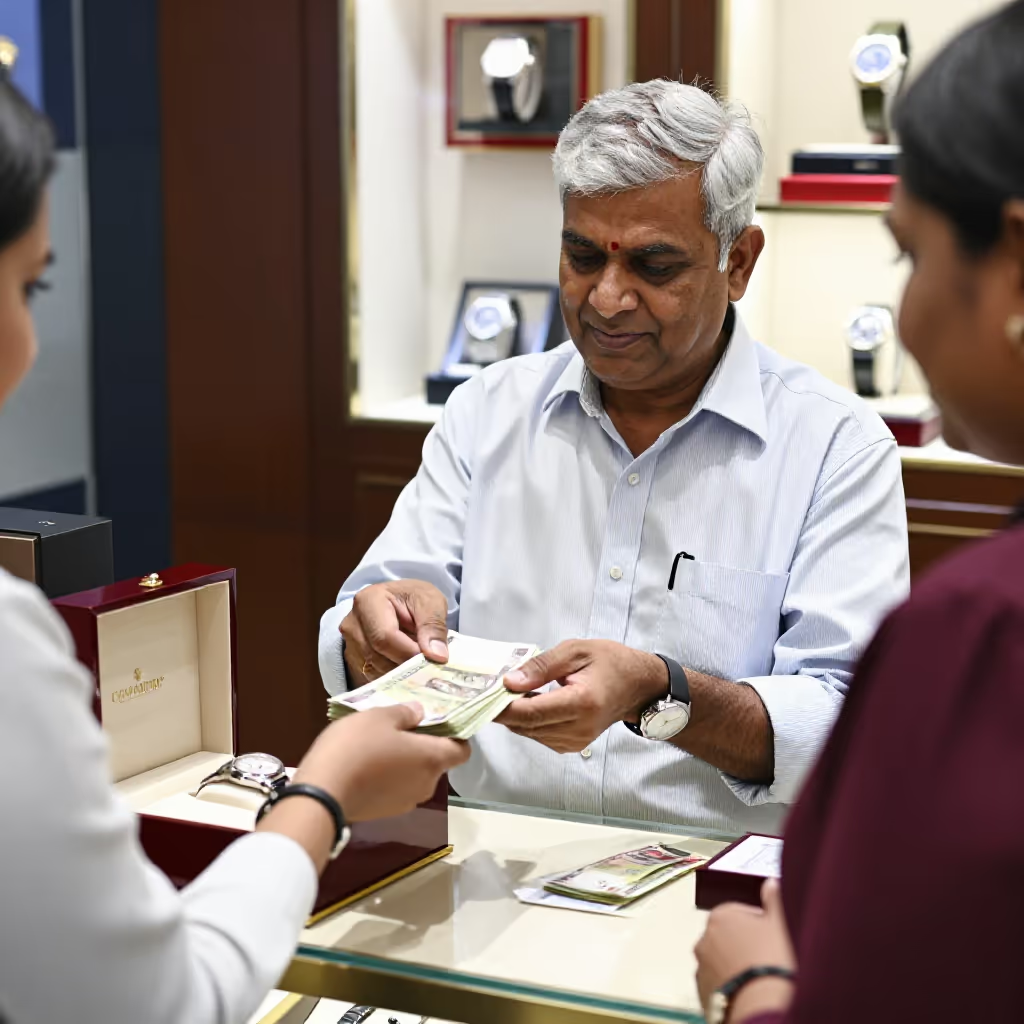
to dig deep
To spend or have to pay a lot of money for something.
Für die Reparatur des Autos mussten wir tief in die Tasche greifen.
We had to dig deep for the car repair.

to live off someone
To be a financial burden on someone; to be financially dependent on someone.
Solange er keine Arbeit findet, liegt er seinen Eltern auf der Tasche.
As long as he doesn't find work, he is living off his parents.

to line one's pockets
To enrich oneself personally in a dishonest or illegal way, usually at the expense of others or an organization.
Dem Geschäftsführer wurde vorgeworfen, in die eigene Tasche gewirtschaftet zu haben.
The managing director was accused of having lined his own pockets.
'Tasche' (bag/pocket) is a very productive base word for many compounds. Depending on the first part of the word, the type of bag or pocket is specified more precisely, for example: 'Handtasche' (handbag), 'Hosentasche' (pants pocket), 'Jackentasche' (jacket pocket), or 'Einkaufstasche' (shopping bag).
Er hat sein Portemonnaie in der Jackentasche vergessen.
He forgot his wallet in his jacket pocket.
The word 'Tasche' (bag/pocket) is often used figuratively in idioms related to money. When verbs like 'greifen' (to reach), 'liegen' (to lie), or 'wirtschaften' (to manage/economize) appear in a financial context, a figurative meaning is usually intended.
Für das Luxusauto musste er tief in die Tasche greifen.
He had to dig deep for the luxury car.
Pay attention to the case with the preposition 'in'. 'In die Tasche' (into the bag/pocket, accusative) describes movement, while 'in der Tasche' (in the bag/pocket, dative) describes a location.
Ich stecke mein Handy in die Tasche.
I put my phone into the bag.
The idiom 'tief in die Tasche greifen' (to dig deep) is fixed. The verb is 'greifen' (to reach), and the person who pays a lot is the subject of the sentence. The expression is often combined with 'müssen' (must/have to).
Wer ein Haus bauen will, muss tief in die Tasche greifen.
Anyone who wants to build a house has to dig deep.
In the expression 'jemandem auf der Tasche liegen' (to live off someone), the person who is financially burdened is in the dative. The subject is the person who costs the money.
Er ist schon 30 und liegt immer noch seinen Eltern auf der Tasche.
He is already 30 and is still living off his parents.
The idiom 'in die eigene Tasche wirtschaften' (to line one's own pockets) is a fixed unit. The adjective 'eigene' (own) is adjusted to match the subject.
Man warf ihm vor, jahrelang in die eigene Tasche gewirtschaftet zu haben.
He was accused of having lined his own pockets for years.
wasted / high
Tasche and Tüte can both refer, depending on the region, to a container for shopping. Tasche is especially suitable for a sturdier, reusable container with handles, while Tüte is more commonly used for a thin plastic container. The exact word choice may vary by region.

Für den Einkauf nimmt sie eine stabile Tasche mit, die sie jede Woche benutzt.
She brings a sturdy bag for her shopping, which she uses every week.
An der Kasse legt sie den Einkauf in eine dünne Tüte aus Kunststoff.
At the checkout, she puts the groceries into a thin plastic bag.