

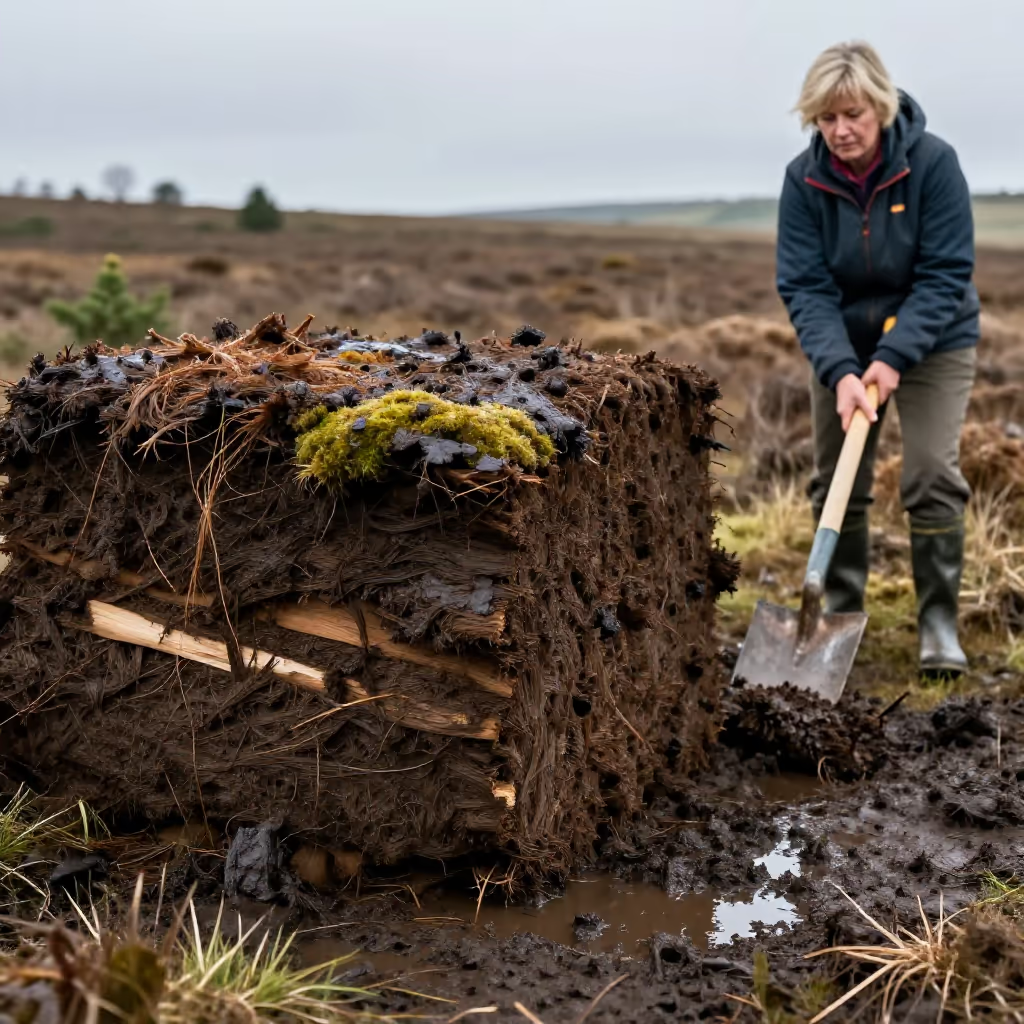
An organic substance that forms from incompletely decomposed plant remains in bogs. Peat is used as fuel, in potting soil, or to flavor whisky.
example
Früher wurde in dieser Region mit Torf geheizt.
In the past, people in this region heated with peat.
Usage tips
Use without an article
As a material or substance term, 'Torf' (peat) is often used without an article when referring to the material in general. This is especially common after prepositions.
EXAMPLE
Diese Blumenerde besteht zu einem großen Teil aus Torf.
This potting soil consists largely of peat.
Word family
The adjective 'torfig' (peaty) is derived from the noun 'der Torf' (peat). It describes a taste or smell reminiscent of peat, which is an important characteristic especially in whisky.
EXAMPLE
Dieser schottische Whisky hat ein sehr rauchiges und torfiges Aroma.
This Scottish whisky has a very smoky and peaty aroma.
Typical verb
The verb for extracting peat from a bog is 'stechen' (to cut). So the activity of extracting peat as fuel is called 'Torf stechen' (to cut peat).
EXAMPLE
Die Bauern stachen früher im Moor den Torf für den Winter.
Farmers used to cut peat in the bog for the winter.
Compare with
near_synonym · confusable
Torf vs Braunkohle
lignite
'Braunkohle' (lignite) and 'Torf' (peat) both have to do with organic material from nature and can be used as fuel. That is why they can easily be confused in texts about energy or landscapes. However, 'Braunkohle' is a type of coal and a fossil fuel that is extracted through mining. 'Torf' forms in bogs from plant remains and is also used in potting soil. When talking about power plants and coal mining, 'Braunkohle' sounds more natural. When talking about bogs, soil in the garden, or certain natural materials, 'Torf' fits better.
Torf
Für die neuen Pflanzen möchte Lisa morgen keinen Torf kaufen.
Lisa does not want to buy any peat for the new plants tomorrow.
Braunkohle
Braunkohle liefert Energie, belastet aber auch die Umwelt.
Lignite provides energy, but it also harms the environment.