

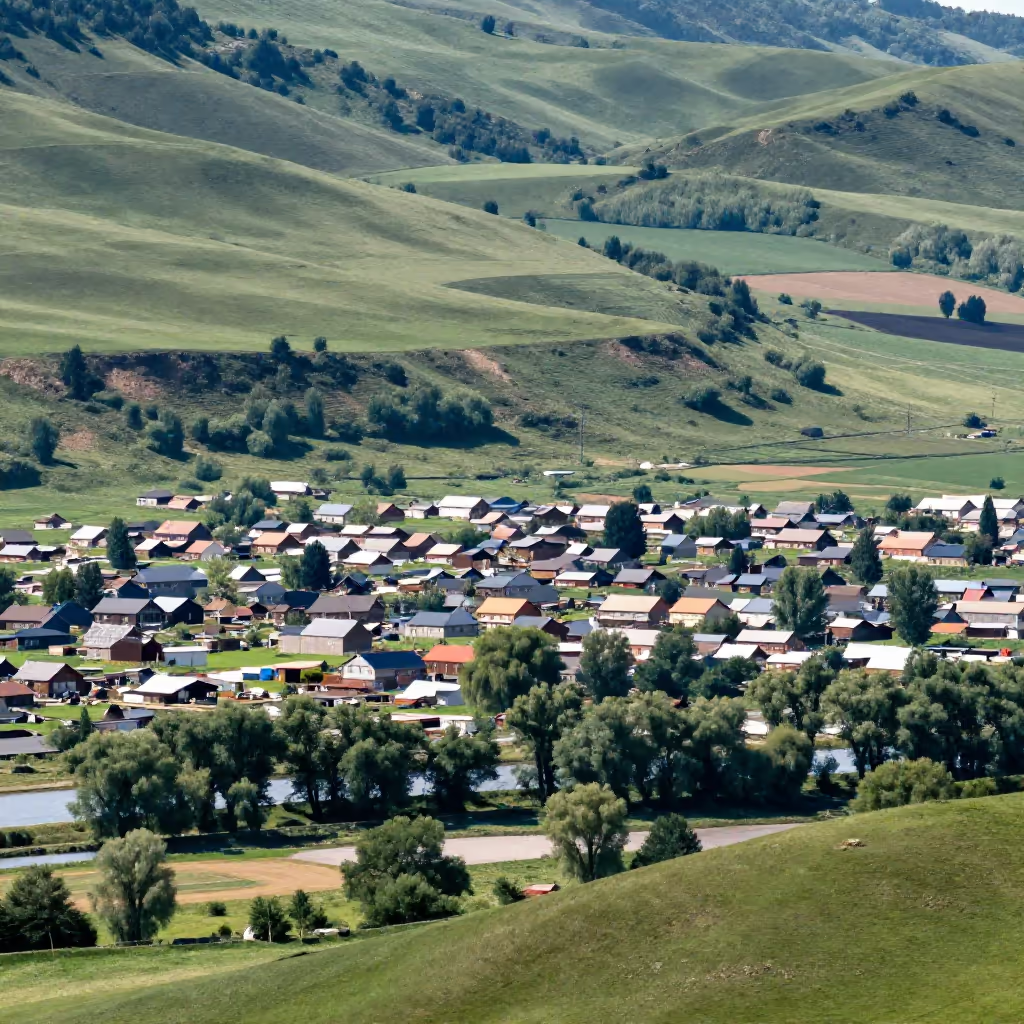
die Umgebung
surroundings
The area or landscape that surrounds a particular place.
EXAMPLE
Wir machten einen Spaziergang in der ländlichen Umgebung der Stadt.
We took a walk in the rural surroundings of the city.
surroundings / environment
Loading your saved state.
surroundings
The area or landscape that surrounds a particular place.
Wir machten einen Spaziergang in der ländlichen Umgebung der Stadt.
We took a walk in the rural surroundings of the city.

environment
The social, cultural, or personal environment in which a person lives or grows up.
Seine Arbeit wird stark von seiner künstlerischen Umgebung beeinflusst.
His work is strongly influenced by his artistic environment.

environment
In information technology, the specific configuration of hardware and software in which a program or system runs.
Die neue App läuft noch nicht stabil in der Live-Umgebung.
The new app is not yet running stably in the live environment.
The word is derived from the verb 'umgeben' (to surround), which means 'to be around something.' The prefix 'um-' signals what is surrounding, so 'Umgebung' (surroundings/environment) is literally what is around you.
Das Haus ist von einem schönen Garten umgeben.
The house is surrounded by a beautiful garden.
When referring to the landscape, 'Umgebung' (surroundings) is often combined with adjectives such as 'näher' (nearby), 'weiter' (wider/farther), 'schön' (beautiful), or 'ländlich' (rural). A typical verb is 'die Umgebung erkunden' (to explore the surroundings).
Am Wochenende erkunden wir gerne die nähere Umgebung mit dem Fahrrad.
On weekends, we like to explore the nearby surroundings by bike.
In a social context, 'Umgebung' (environment) describes a person's surroundings or environment. Common combinations are 'die soziale Umgebung' (the social environment), 'die familiäre Umgebung' (the family environment), or 'sich an eine neue Umgebung gewöhnen' (to get used to a new environment).
Für Kinder ist eine stabile familiäre Umgebung sehr wichtig.
A stable family environment is very important for children.
You can recognize the technical meaning immediately from the context. It is used almost only in IT, often in combinations such as 'Test-Umgebung' (test environment), 'Produktiv-Umgebung' (production environment), or in connection with 'Software' and 'System'.
Bevor die Software veröffentlicht wird, muss sie in der Test-Umgebung geprüft werden.
Before the software is released, it must be tested in the test environment.
medium
Here, das Medium is the substance in which an organism is directly located, such as water. Die Umgebung, by contrast, includes the external conditions around it, such as light, plants, and other living things. Use Medium for the substance and Umgebung for the conditions as a whole.

Die Fische brauchen eine ruhige Umgebung mit Pflanzen und wenig Lärm.
The fish need quiet surroundings with plants and little noise.
Wasser ist das Medium, in dem sich die Fische bewegen.
Water is the medium in which fish move.