


umkippen
to tip over
To fall sideways from an upright position; to lose balance and fall over.
EXAMPLE
Pass auf, dass das Glas auf dem wackeligen Tisch nicht umkippt.
Be careful that the glass on the wobbly table doesn't tip over.
to tip over / faint
Loading your saved state.
to tip over
To fall sideways from an upright position; to lose balance and fall over.
Pass auf, dass das Glas auf dem wackeligen Tisch nicht umkippt.
Be careful that the glass on the wobbly table doesn't tip over.
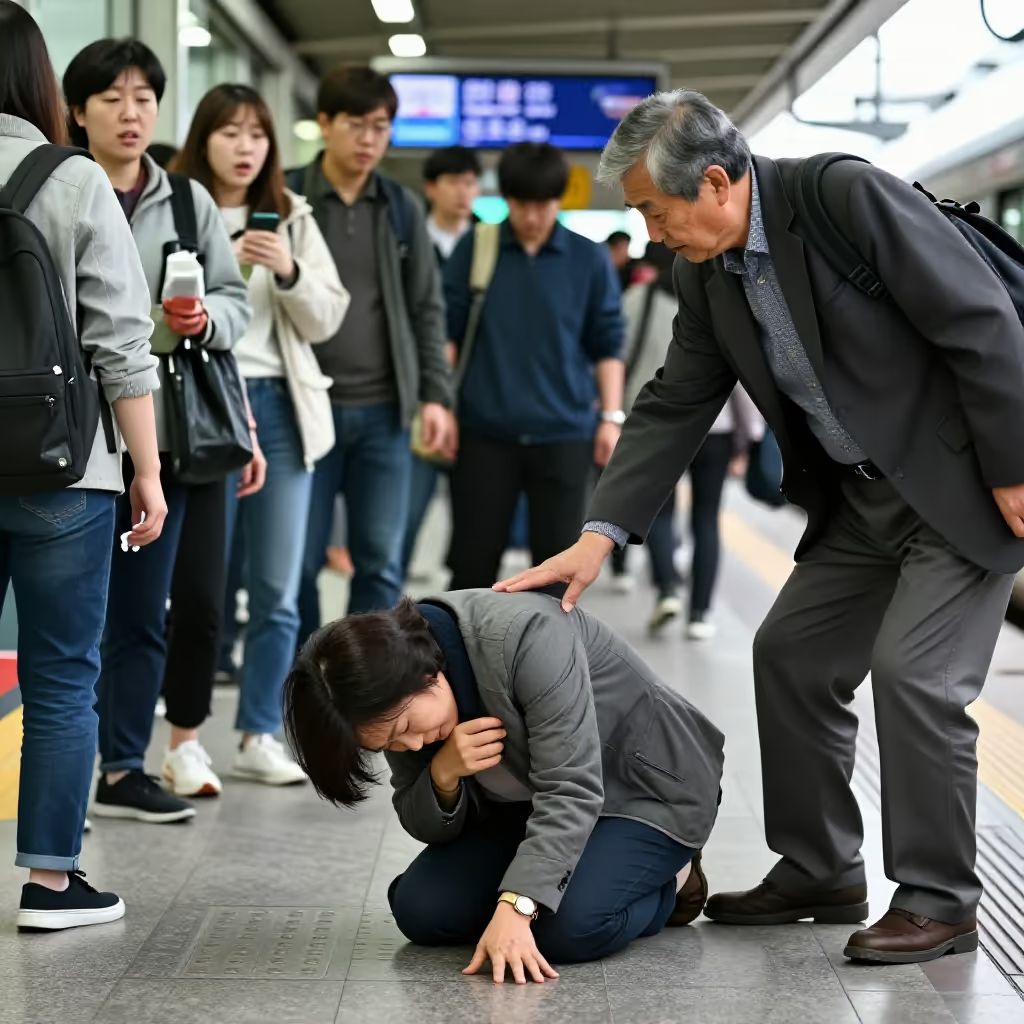
to faint
To suddenly lose consciousness; to pass out.
Wegen der Hitze und der stickigen Luft im Raum ist sie einfach umgekippt.
Because of the heat and the stuffy air in the room, she simply fainted.

to turn negative
To suddenly and unexpectedly change for the worse. Often refers to the mood, atmosphere, or a situation.
Die anfangs gute Stimmung auf der Feier kippte nach der politischen Diskussion plötzlich um.
The initially good mood at the party suddenly turned negative after the political discussion.

to collapse
The state of a body of water in which a lack of oxygen causes the biological balance to break down, leading to the death of plants and animals.
Durch die extreme Hitze und die vielen Algen droht der kleine See umzukippen.
Because of the extreme heat and the many algae, the small lake is in danger of collapsing.
'Umkippen' (to tip over / faint) is a separable verb. The prefix 'um-' goes at the end in a main clause. In subordinate clauses and in the infinitive with 'zu', the verb stays together.
Der starke Wind kippte mehrere Bäume um.
The strong wind tipped several trees over.
The perfect tense of 'umkippen' (to tip over / faint) is always formed with the auxiliary verb 'sein' because it describes a change of state or position. So it is 'ist umgekippt'.
Das volle Wasserglas ist plötzlich umgekippt.
The full water glass suddenly tipped over.
You can recognize the meaning from the subject: If the subject is an object, it falls over. If it is a person, they faint. If it is something abstract like 'Stimmung' (mood) or 'Wetter' (weather), it changes for the worse. If it is a body of water, the ecosystem collapses.
Der Radfahrer ist in der Kurve fast umgekippt.
The cyclist almost tipped over on the bend.
In the meaning 'ohnmächtig werden' (to faint), 'umkippen' (to faint) is rather colloquial. It is often used in spoken language to describe a sudden loss of consciousness.
Als er das Blut sah, ist er sofort umgekippt.
When he saw the blood, he fainted immediately.
to tip / to topple
Kippen can describe the movement from an upright to a tilted position, without the object falling all the way over. Umkippen makes it clearer that the object completely loses its balance and falls onto its side. Use kippen for an initial tilt and umkippen for falling all the way over.

Die schwere Kiste kippte zur Seite um und blieb auf dem Boden liegen.
The heavy crate tipped over onto its side and remained lying on the floor.
Die schwere Kiste begann zur Seite zu kippen, blieb aber noch stehen.
The heavy crate began to tip to the side but remained standing.