


der Unsinn
nonsense
Something that is stupid, illogical, or meaningless; a statement or action without sense or reason.
Es ist doch Unsinn zu glauben, dass schwarze Katzen Unglück bringen.
It's nonsense to believe that black cats bring bad luck.
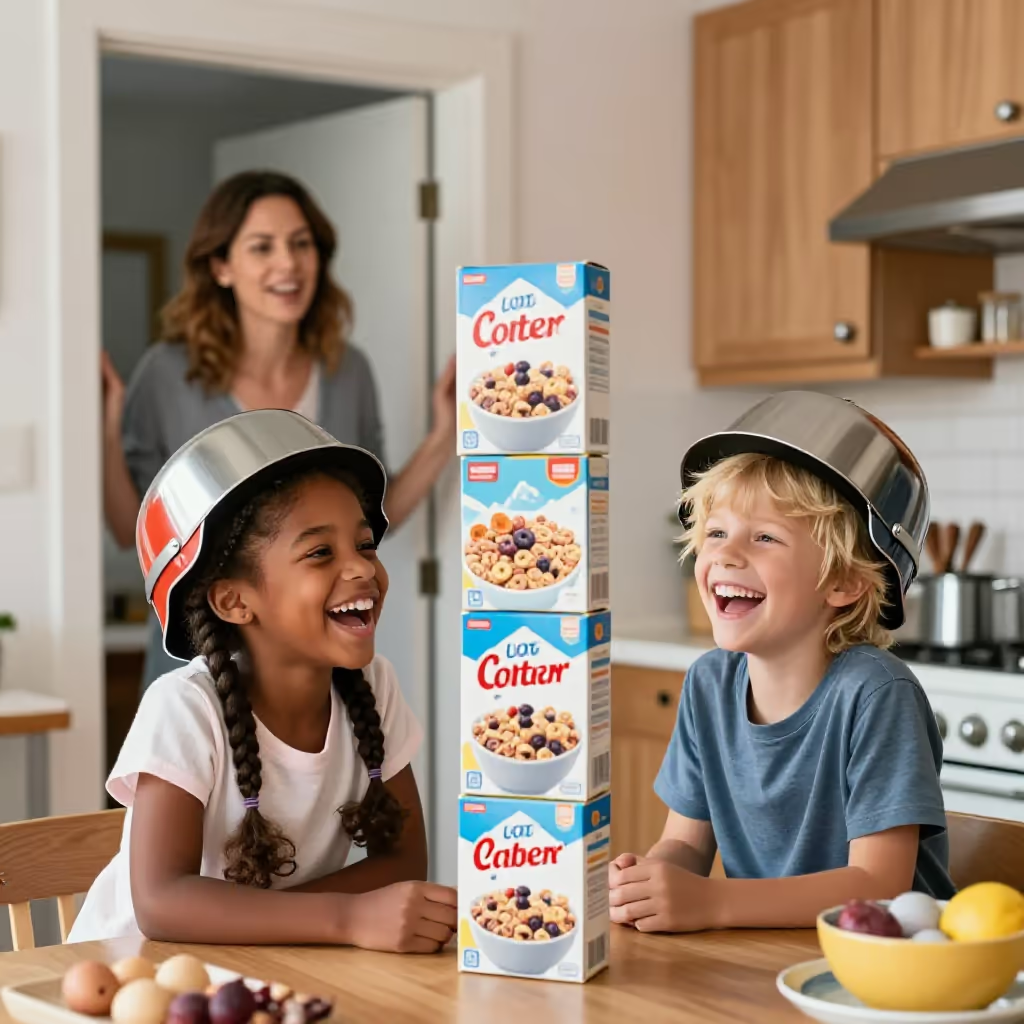

nonsense
Loading your saved state.
nonsense
Something that is stupid, illogical, or meaningless; a statement or action without sense or reason.
Es ist doch Unsinn zu glauben, dass schwarze Katzen Unglück bringen.
It's nonsense to believe that black cats bring bad luck.

'Unsinn' (nonsense) is made up of the prefix 'Un-' (which expresses negation) and the noun 'der Sinn' (sense/meaning). So it literally means 'non-sense' or 'without sense'.
Diese Regel ergibt für mich absolut keinen Sinn.
This rule makes absolutely no sense to me.
In the meaning 'Nonsens' (nonsense), 'Unsinn' (nonsense) is usually used without an article as an uncountable noun. You say 'Das ist Unsinn!' (That's nonsense!) or can intensify it with 'so ein' (such) or 'völliger' (complete/utter).
Glaub diesen Gerüchten nicht, das ist doch völliger Unsinn!
Don't believe these rumors; that's utter nonsense!
The fixed expression 'Unsinn machen' means to behave silly or play pranks. It is often used when dealing with children.
Die Kinder haben den ganzen Nachmittag im Garten Unsinn gemacht.
The children fooled around in the garden all afternoon.
When it comes to nonsensical statements, the noun is often combined with the verbs 'reden' (to talk), 'erzählen' (to tell), or 'verbreiten' (to spread).
Hör auf, solchen Unsinn zu erzählen, das glaubt dir niemand.
Stop saying such nonsense; no one will believe you.
fun / joke
'der Spaß' and 'der Unsinn' can both have to do with funny or not-serious behavior. 'Spaß' is usually positive: something is fun, funny, or meant as a joke. 'Unsinn' is more negative or critical: something is stupid, illogical, or pointless. In 'Unsinn machen' (to fool around), it can also be about silly behavior, but it often sounds as if the person should stop doing it. The confusion arises because both can sometimes occur with jokes or pranks. If you mean enjoyment, 'Spaß' fits. If something makes no sense or is too silly, 'Unsinn' fits.

Wegen des lauten Unsinns im Flur konnte die Klasse nicht weiterarbeiten.
Because of the loud fooling around in the hallway, the class could not continue working.
Beim Kochen mit Freunden steht der Spaß im Vordergrund.
When cooking with friends, the focus is on having fun.