


unten
down / below
Indicates a position or place that is on a deeper or lower level.
EXAMPLE
Die Gläser stehen im Schrank ganz unten.
The glasses are at the very bottom of the cupboard.
down / below
Loading your saved state.
down / below
Indicates a position or place that is on a deeper or lower level.
Die Gläser stehen im Schrank ganz unten.
The glasses are at the very bottom of the cupboard.

below
Refers to a later point in a text, list, or document.
Die genauen Teilnahmebedingungen finden Sie weiter unten auf dieser Seite.
You can find the exact conditions of participation further below on this page.

to be in someone's bad books
A colloquial expression meaning that someone has lost another person's respect, trust, or sympathy.
Seit er mich belogen hat, ist er bei mir unten durch.
Ever since he lied to me, he's been in my bad books.
The adverb 'unten' (down/below) always describes a static position, that is, a place where something is located. It answers the question 'Wo?' (Where?). It is not used for movement downward.
Wo ist mein Handy? – Es liegt da unten auf dem Tisch.
Where is my phone? – It's down there on the table.
'Unten' (down/below) is an adverb and often stands alone or at the end of a sentence. It does not need a noun. Don't confuse it with prepositions, which describe a relationship between two things and require a noun in the correct case.
Die Katze ist nicht hier oben, sie muss unten sein.
The cat isn't up here; it must be downstairs.
The context makes it clear whether 'unten' (down/below) means a physical place or a point in a document. In combination with words like 'Seite' (page), 'Text' (text), 'Liste' (list), or 'Link' (link), it refers to the document.
Die genauen Quellen sind unten im Text verlinkt.
The exact sources are linked below in the text.
The idiom 'bei jemandem unten durch sein' (to be in someone's bad books) is a fixed unit. It means that you have lost that person's sympathy or trust. The person whose favor you have fallen out of is used with the preposition 'bei'.
Nach dieser Lüge ist er bei seinen Freunden komplett unten durch.
After that lie, he's completely in his friends' bad books.
under
Unter denotes a lower position in relation to a stated reference and therefore usually takes a complement. Unten denotes the lower place independently. Use unter when you name the reference and unten when the location is clear from context.
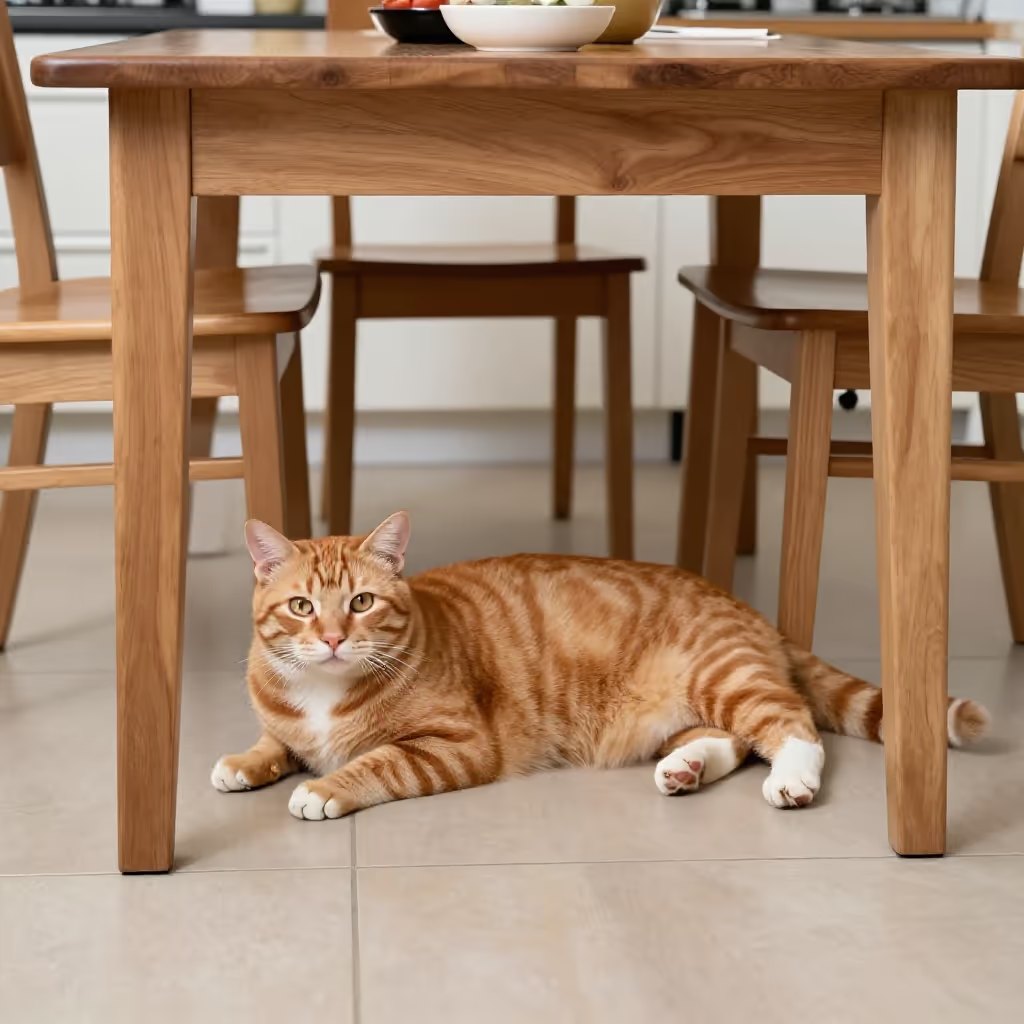
Der Ball liegt unten.
The ball is down below.
Der Ball liegt unter dem Tisch.
The ball is under the table.