

unterliegen
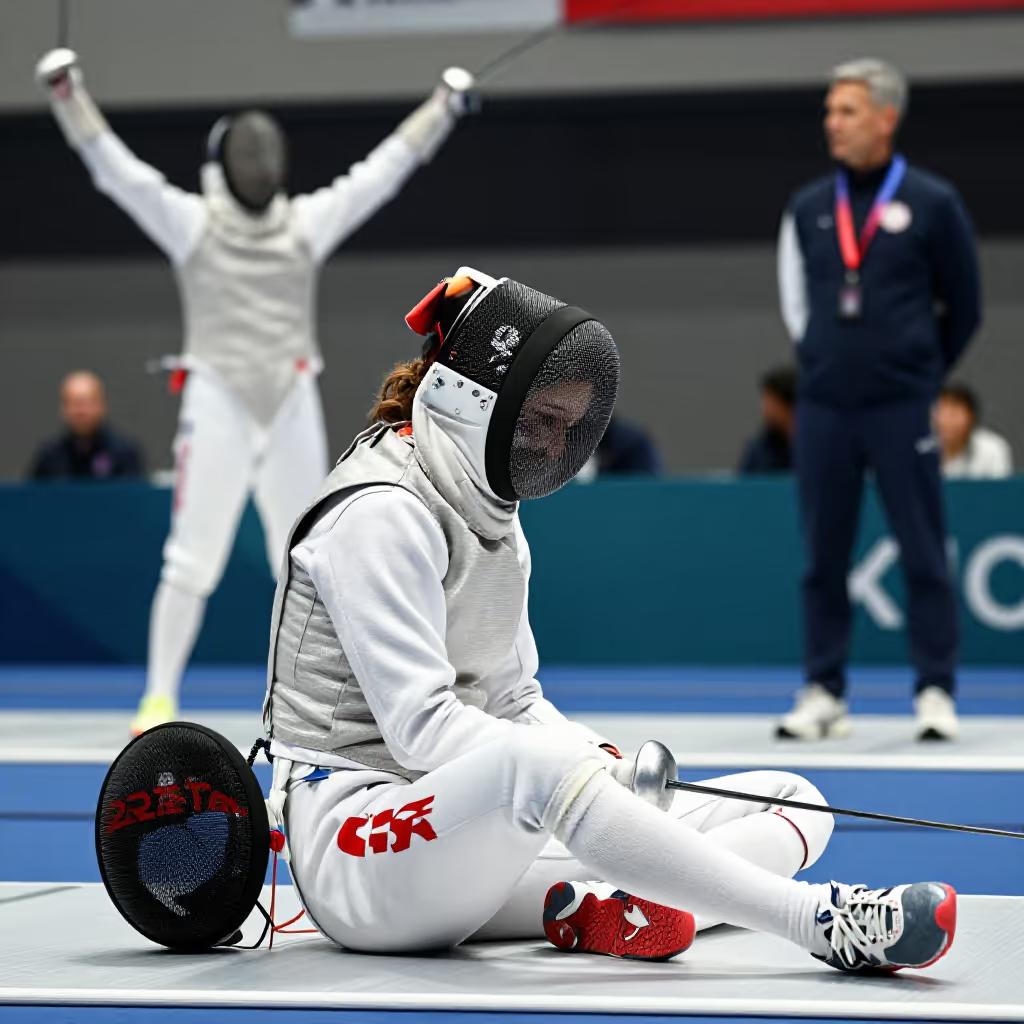
to lose
To lose or be defeated in a fight, competition, or dispute.
EXAMPLE
Im Finale unterlag die Mannschaft dem Gegner knapp mit 1:2.
In the final, the team narrowly lost to its opponent 1–2.
to lose / to be subject to
Loading your saved state.
to lose
To lose or be defeated in a fight, competition, or dispute.
Im Finale unterlag die Mannschaft dem Gegner knapp mit 1:2.
In the final, the team narrowly lost to its opponent 1–2.

to be subject to
To be subject to a particular rule, law, condition, or influence. This meaning is often used in formal or legal contexts.
Alle vertraulichen Daten unterliegen strengen Datenschutzbestimmungen.
All confidential data is subject to strict data protection regulations.
'Unterliegen' is an inseparable verb. The prefix 'unter-' remains firmly attached to the verb in all sentence forms, and the stress is on the second syllable: unter-LIE-gen.
Die Firma unterliegt den neuen europäischen Richtlinien.
The company is subject to the new European guidelines.
This verb is always used with the dative. The person one loses to, or the rule one is subject to, is in the dative.
Der Antragsteller unterliegt einer strengen Prüfung.
The applicant is subject to a strict review.
You can recognize the meaning 'to be subject to a rule' by the fact that the dative object is usually an abstract noun, e.g. a law, an obligation, or a condition. In a sports context, however, it always means 'to lose'.
Diese Produkte unterliegen einer besonderen Steuer.
These products are subject to a special tax.
In formal and legal usage, 'unterliegen' is often combined with fixed terms: 'der Schweigepflicht unterliegen' (to be bound by confidentiality), 'der Kontrolle unterliegen' (to be subject to control), 'keinem Zweifel unterliegen' (to be beyond doubt), or 'einem Wandel unterliegen' (to undergo change).
Als Arzt unterliegen Sie der Schweigepflicht.
As a doctor, you are bound by confidentiality.
to lose
Verlieren and unterliegen both express defeat. Verlieren can take the competition itself as an accusative object, whereas unterliegen often highlights the victorious opponent in the dative. So a team loses a final, but unterliegt dem Gegner (is defeated by the opponent).

Unsere Mannschaft unterlag im Finale dem Stadtmeister.
Our team was defeated by the city champion in the final.
Unsere Mannschaft verlor das Finale gegen den Stadtmeister.
Our team lost the final to the city champion.