

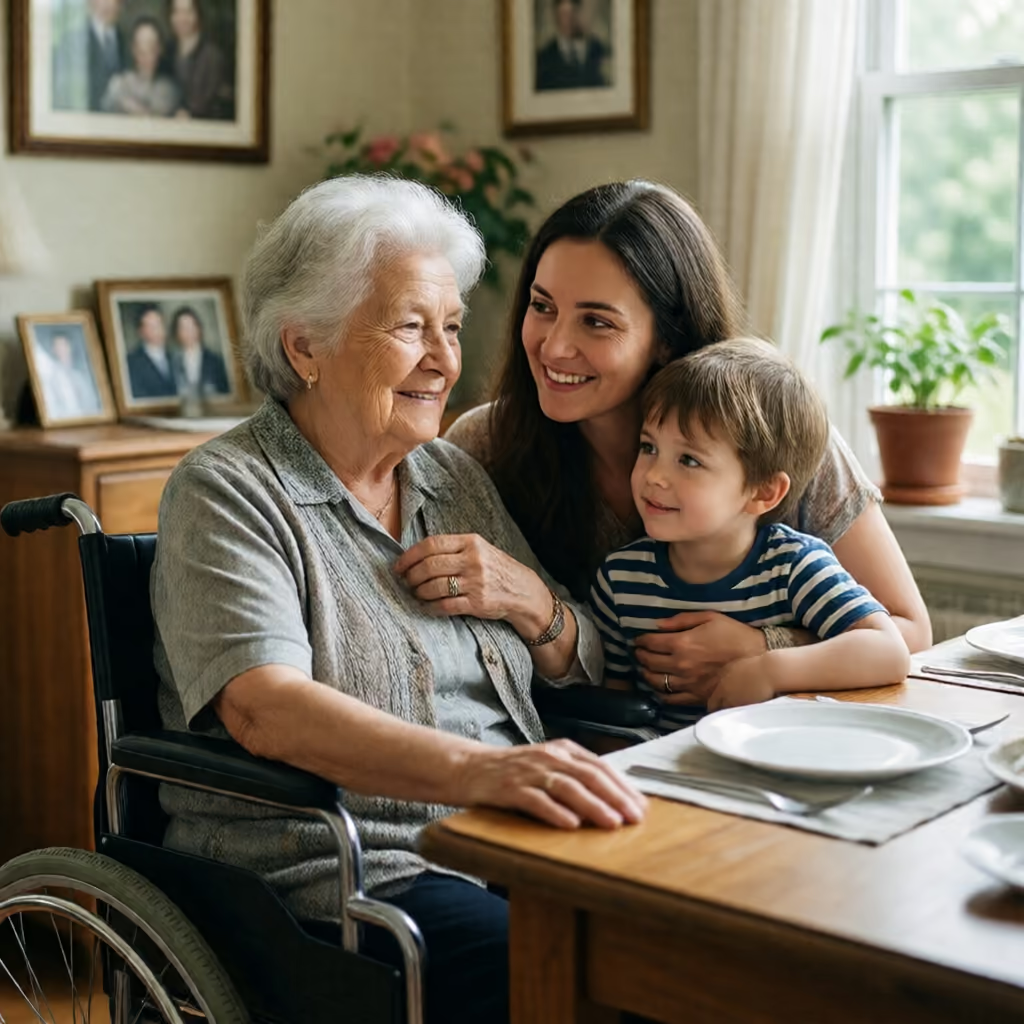
die Urgroßmutter
great-grandmother
The mother of a grandfather or grandmother.
EXAMPLE
Meine Urgroßmutter wurde 102 Jahre alt.
My great-grandmother lived to be 102.
great-grandmother
die Urgroßmutter, die Urgroßmütter
Loading your saved state.
great-grandmother
The mother of a grandfather or grandmother.
Meine Urgroßmutter wurde 102 Jahre alt.
My great-grandmother lived to be 102.
| gender | feminine die |
|---|---|
| plural | die Urgroßmütter |
| genitive | der Urgroßmutter |
| singular | plural | |
|---|---|---|
| nominative | die Urgroßmutter | die Urgroßmütter |
| accusative | die Urgroßmutter | die Urgroßmütter |
| dative | der Urgroßmutter | den Urgroßmüttern |
| genitive | der Urgroßmutter | der Urgroßmütter |
The article changes with the case; it is shown in colour.
'Urgroßmutter' (great-grandmother) consists of 'Ur-' (great-) and 'Großmutter' (grandmother). Here, 'Ur-' indicates one generation further back in the family.
Auf dem Familienfoto stehen meine Großmutter und meine Urgroßmutter nebeneinander.
In the family photo, my grandmother and my great-grandmother are standing next to each other.
You can specify whose great-grandmother you mean using the genitive or 'von' (of) with the dative. In both constructions, this information comes after 'Urgroßmutter' (great-grandmother).
Die Urgroßmutter meines Mannes lebte in Dresden.
My husband's great-grandmother lived in Dresden.
Die Urgroßmutter von meinem Mann lebte in Dresden.
My husband's great-grandmother lived in Dresden.
You can use 'mütterlicherseits' (on the mother's side) or 'väterlicherseits' (on the father's side) to specify which side of the family a great-grandmother belongs to. These expressions often come directly after the noun.
Meine Urgroßmutter mütterlicherseits hatte sieben Geschwister.
My great-grandmother on my mother's side had seven siblings.