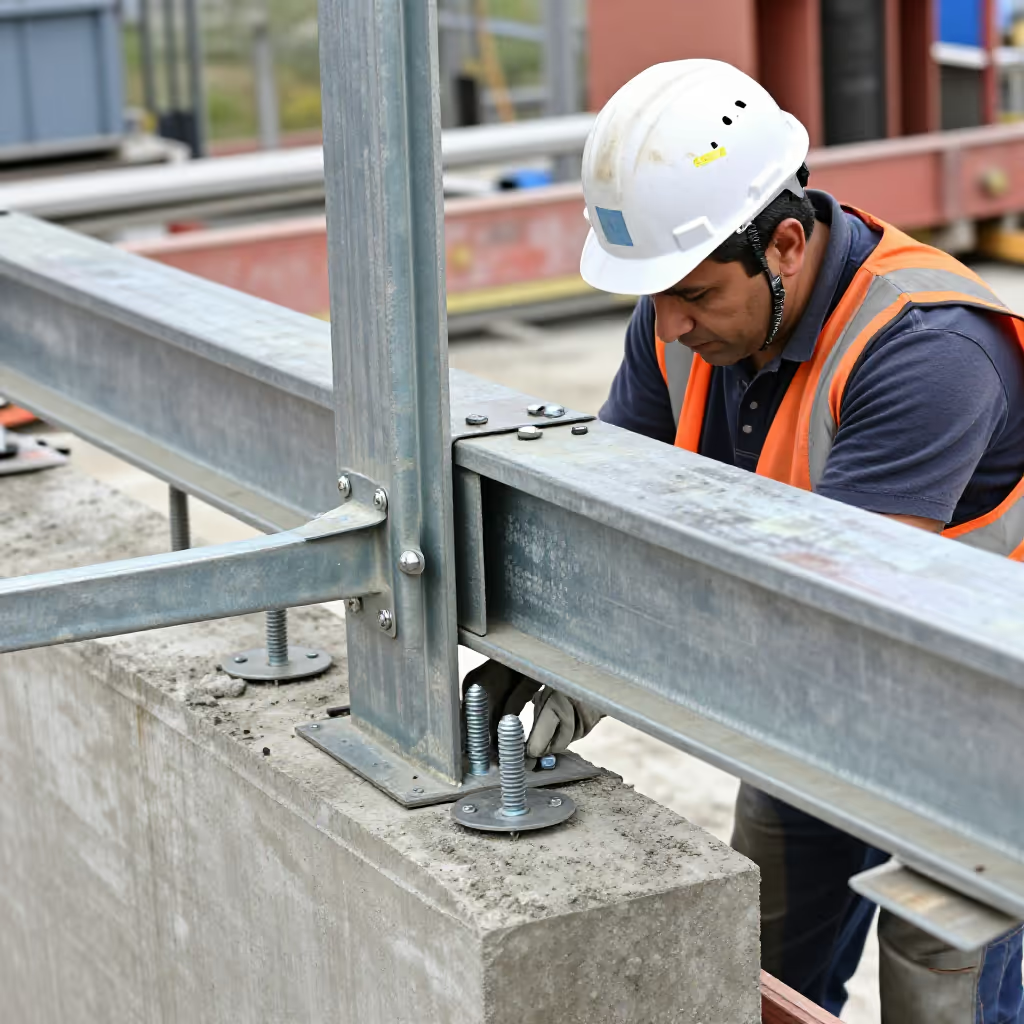
To physically fasten something firmly and securely, often in the ground or to a stable structure. This can refer to a ship with an anchor or to construction components.
example
Die Kletterwand muss fest in der Wand verankert werden.
The climbing wall must be firmly anchored in the wall.

Usage tips
Word structure
The verb 'verankern' derives from the noun 'der Anker' (the anchor). The prefix 'ver-' reinforces the idea of fastening. Literally, it means to fasten something with an anchor, which makes it easier to understand all its meanings.
EXAMPLE
Das Schiff verankerte sich sicher im Hafen.
The ship anchored itself safely in the harbor.
Inseparable verb
'Verankern' is an inseparable verb because it begins with 'ver-'. The prefix stays firmly attached to the verb in all sentence forms and tenses and is not placed at the end of the sentence.
EXAMPLE
Man verankert die neuen Regeln im Unternehmensleitbild.
The new rules are anchored in the company's mission statement.
Common passive form
'Verankern' is very often used in the passive (with 'werden') or as a stative passive (with 'sein'). This emphasizes the state of something being firmly established or fastened.
EXAMPLE
Die Sicherheitshaken werden tief im Fels verankert.
The safety hooks are anchored deep in the rock.
Typical collocations
In the figurative sense, 'verankern' is often combined with abstract concepts and systems. Typical formulations are 'im Gesetz verankern' (to enshrine in law), 'in der Verfassung verankern' (to enshrine in the constitution), or 'im Bewusstsein verankern' (to anchor in people's awareness).
EXAMPLE
Die Regierung will den Umweltschutz stärker im Gesetz verankern.
The government wants to enshrine environmental protection more strongly in law.
Reflexive use
In this meaning, the verb is always used reflexively: 'sich verankern' (to establish oneself). It describes how a person or group finds a firm position in a social or ideological environment.
EXAMPLE
Der Künstler hat sich fest in der lokalen Kulturszene verankert.
The artist has firmly established himself in the local cultural scene.
Compare with
antonym
verankern vs lösen
to solve / loosen
'lösen' and 'verankern' are opposites when it comes to firm support or secure attachment. 'verankern' means to fasten something firmly and securely so that it cannot be moved away. 'lösen', on the other hand, means to loosen, open, or separate something fixed from a fastening. In practical terms: with 'verankern' you make something secure; with 'lösen' you make it free again.
verankern
Die Arbeiter verankern das Schild fest im Boden.
The workers anchor the sign firmly in the ground.
lösen
Vor dem Transport löst der Handwerker die alten Schrauben.
Before the transport, the craftsman loosens the old screws.