

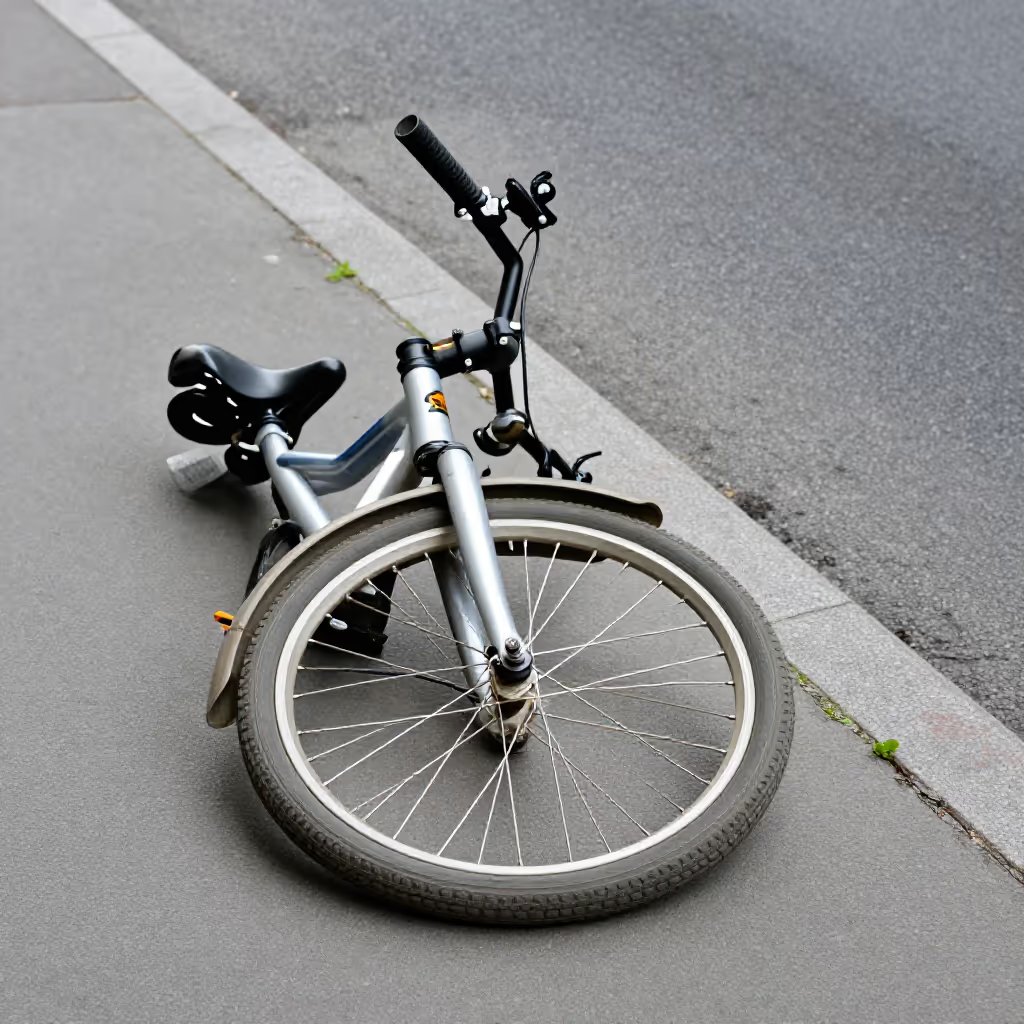
verdreht
twisted
Physically turned or deformed out of its normal shape or position.
EXAMPLE
Er hat sich das Knie verdreht und kann kaum laufen.
He twisted his knee and can hardly walk.
twisted / distorted
Loading your saved state.
twisted
Physically turned or deformed out of its normal shape or position.
Er hat sich das Knie verdreht und kann kaum laufen.
He twisted his knee and can hardly walk.

distorted
Describes information, facts, or statements that are reproduced falsely or in a way that distorts their meaning.
Die Zeitung hat seine Aussagen komplett verdreht dargestellt.
The newspaper presented his statements in a completely distorted way.

eccentric
Colloquial for a person who has strange, eccentric, or crazy ideas or behaves oddly.
Er hat manchmal etwas verdrehte Ansichten, ist aber ein guter Freund.
He sometimes has somewhat eccentric views, but he is a good friend.
'Verdreht' (twisted/distorted) is the past participle of the verb 'verdrehen' (to twist/distort). The prefix 'ver-' often points to a wrong or faulty result. So the word describes something that has been twisted in the wrong way, whether a body part, a fact, or a way of thinking.
Die verdrehte Darstellung der Ereignisse hat für viel Ärger gesorgt.
The distorted presentation of the events caused a lot of anger.
In the physical meaning, the reflexive verb form 'sich etwas verdrehen' (to twist something) is often used. The person is in the nominative, followed by the reflexive pronoun in the dative and the body part in the accusative.
Ich habe mir beim Sport den Knöchel verdreht.
I twisted my ankle while doing sports.
When it is about information, 'verdreht' (distorted) is often combined with nouns such as 'Tatsachen' (facts), 'Worte' (words), 'Aussagen' (statements), or 'die Wahrheit' (the truth). It describes an intentionally falsified reproduction.
Er hat meine Worte im Gespräch völlig verdreht.
He completely distorted my words in the conversation.
Describing a person or their ideas as 'verdreht' (eccentric/odd) is colloquial. It expresses that someone is perceived as eccentric, strange, or not quite normal.
Manche halten den Künstler für etwas verdreht, aber seine Bilder sind genial.
Some people think the artist is a bit eccentric, but his paintings are brilliant.
crazy
Both words can describe a person with unusual behavior. „Verdreht“ usually sounds milder and emphasizes an eccentric or quirky manner, while „verrückt“ can sound more strongly unreasonable or mentally abnormal. „Verdreht“ is therefore often a good choice for a rather harmless description.

Paul wirkt verdreht, weil er seine Blumen jeden Abend mit einem Regenschirm schützt.
Paul seems eccentric because he protects his flowers with an umbrella every evening.
Paul wirkt verrückt, weil er überzeugt ist, dass alle Nachbarn ihn beobachten.
Paul seems crazy because he is convinced that all the neighbors are watching him.