


verschlingen
to devour
To eat something very quickly and greedily, without chewing much.
EXAMPLE
Der hungrige Wolf verschlang das gefundene Aas in wenigen Minuten.
The hungry wolf devoured the carrion it had found within a few minutes.
to devour / consume
Loading your saved state.
to devour
To eat something very quickly and greedily, without chewing much.
Der hungrige Wolf verschlang das gefundene Aas in wenigen Minuten.
The hungry wolf devoured the carrion it had found within a few minutes.

to consume
To use up a large amount of something, often figuratively for money, time, or resources.
Der Bau der neuen Autobahn hat Unsummen an Steuergeldern verschlungen.
The construction of the new highway consumed enormous amounts of taxpayers' money.

to devour
To read a book or text very quickly and with great enthusiasm.
Ich habe die Krimi-Reihe von der ersten bis zur letzten Seite verschlungen.
I devoured the crime series from the first page to the last.
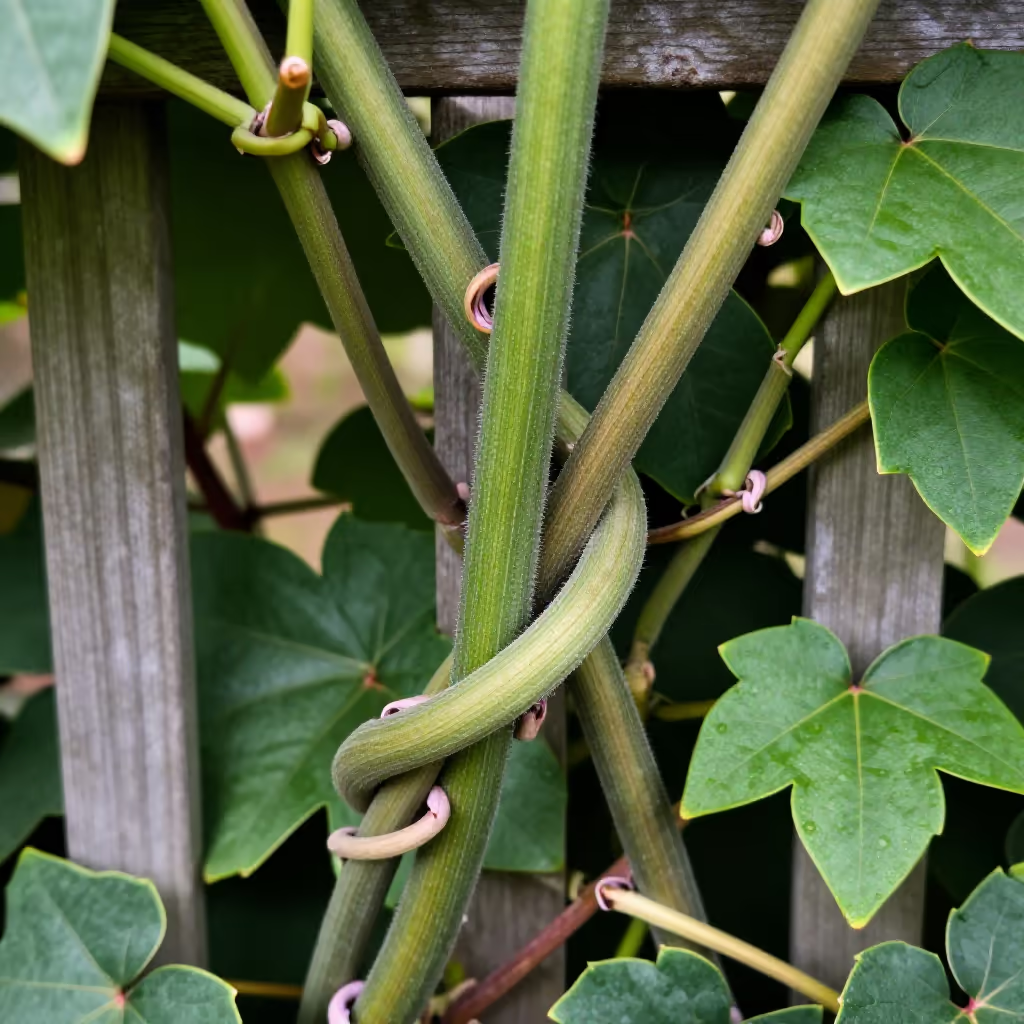
to intertwine
To twist into or around each other so that separation becomes difficult.
Die beiden Schlangen hatten sich so ineinander verschlungen, dass man sie kaum unterscheiden konnte.
The two snakes had intertwined so much that you could hardly tell them apart.
'Verschlingen' (to devour / consume) is an inseparable verb. The prefix 'ver-' always stays attached to the stem 'schlingen' and is not placed at the end of the sentence.
Er hat das ganze Buch an einem Wochenende verschlungen.
He devoured the entire book in one weekend.
The exact meaning of 'verschlingen' (to devour / consume) depends on the object. If it refers to food, it means to eat greedily. With books, it means to read enthusiastically, and with money or time, it means to use up or consume.
Er war so hungrig, dass er die Pizza in fünf Minuten verschlang.
He was so hungry that he devoured the pizza in five minutes.
In connection with food, 'verschlingen' (to devour) is a very vivid and expressive word. It emphasizes speed and greed while eating and is stronger than simply 'essen' (to eat).
Nach der langen Wanderung haben wir unsere Sandwiches regelrecht verschlungen.
After the long hike, we practically devoured our sandwiches.
In the meaning 'to twist into each other', the verb is always used reflexively: 'sich verschlingen' (to intertwine). It often describes a complex, tangled connection that cannot easily be undone.
Die Efeuranken hatten sich um den ganzen Baum verschlungen.
The ivy tendrils had intertwined around the entire tree.
to cost / taste
Both words can express that a project uses up a lot of money, time, or other resources. „Kosten“ describes the expense more neutrally, while „verschlingen“ emphasizes an excessively large amount and usually conveys a negative evaluation. Use „kosten“ for factual statements and „verschlingen“ when the consumption seems particularly high.

Der Bau verschlingt viel Zeit und Geld.
The construction consumes a lot of time and money.
Der Bau kostet viel Zeit und Geld.
The construction takes a lot of time and money.