

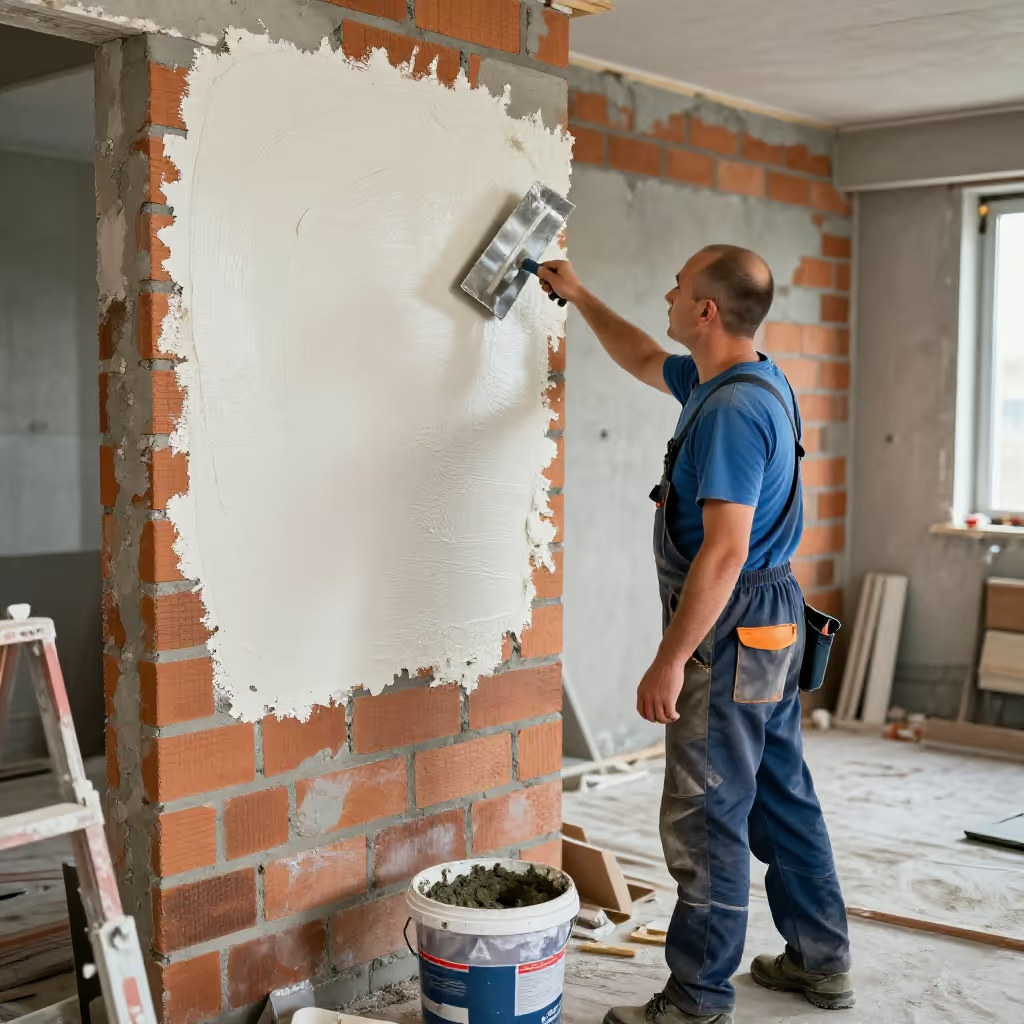
verputzen
to plaster
To cover a wall or ceiling with a layer of plaster (mortar) in order to smooth or protect it.
EXAMPLE
Der Maurer wird morgen die Außenwand des Hauses verputzen.
The mason will plaster the outside wall of the house tomorrow.
to plaster / to polish off
Loading your saved state.
to plaster
To cover a wall or ceiling with a layer of plaster (mortar) in order to smooth or protect it.
Der Maurer wird morgen die Außenwand des Hauses verputzen.
The mason will plaster the outside wall of the house tomorrow.

to polish off
(Colloquial) To eat something completely, often greedily or quickly.
Die Kinder haben den ganzen Kuchen in fünf Minuten verputzt.
The children polished off the whole cake in five minutes.
The verb 'verputzen' (to plaster/to polish off) is inseparable. The prefix 'ver-' remains firmly attached to the stem 'putzen' (to clean) in all sentence forms and is not placed at the end of the sentence.
Er verputzt die Wand im Wohnzimmer.
He is plastering the wall in the living room.
The two meanings are easy to distinguish. If it is about construction work, walls, or houses, it means smoothing with mortar. If it is about food, it means eating something up quickly.
Wir müssen die Garage noch von außen verputzen.
We still have to plaster the outside of the garage.
The meaning 'to eat something up quickly' is used only in colloquial language. In a formal context, this choice of words would be inappropriate.
Nach dem Sport habe ich eine ganze Pizza verputzt.
After exercising, I polished off a whole pizza.
In a trade or construction context, the verb is often combined with the objects 'eine Wand' (a wall), 'eine Decke' (a ceiling), or 'eine Fassade' (a facade).
Die Handwerker haben die Fassade des alten Gebäudes neu verputzt.
The workers replastered the facade of the old building.
to devour / consume
Verschlingen and verputzen can both mean that someone eats a dish quickly and with great appetite. Verschlingen places more emphasis on the hurried, greedy way of eating, while verputzen is colloquial and mainly highlights eating something up completely. Verschlingen is suitable when the haste is emphasized; verputzen works for a casual reference to an empty plate.

Nach dem langen Training verputzte er die ganze Pizza.
After the long training session, he polished off the whole pizza.
Nach dem langen Training verschlang er die Pizza in wenigen Minuten.
After the long training session, he devoured the pizza in just a few minutes.