

verspannen
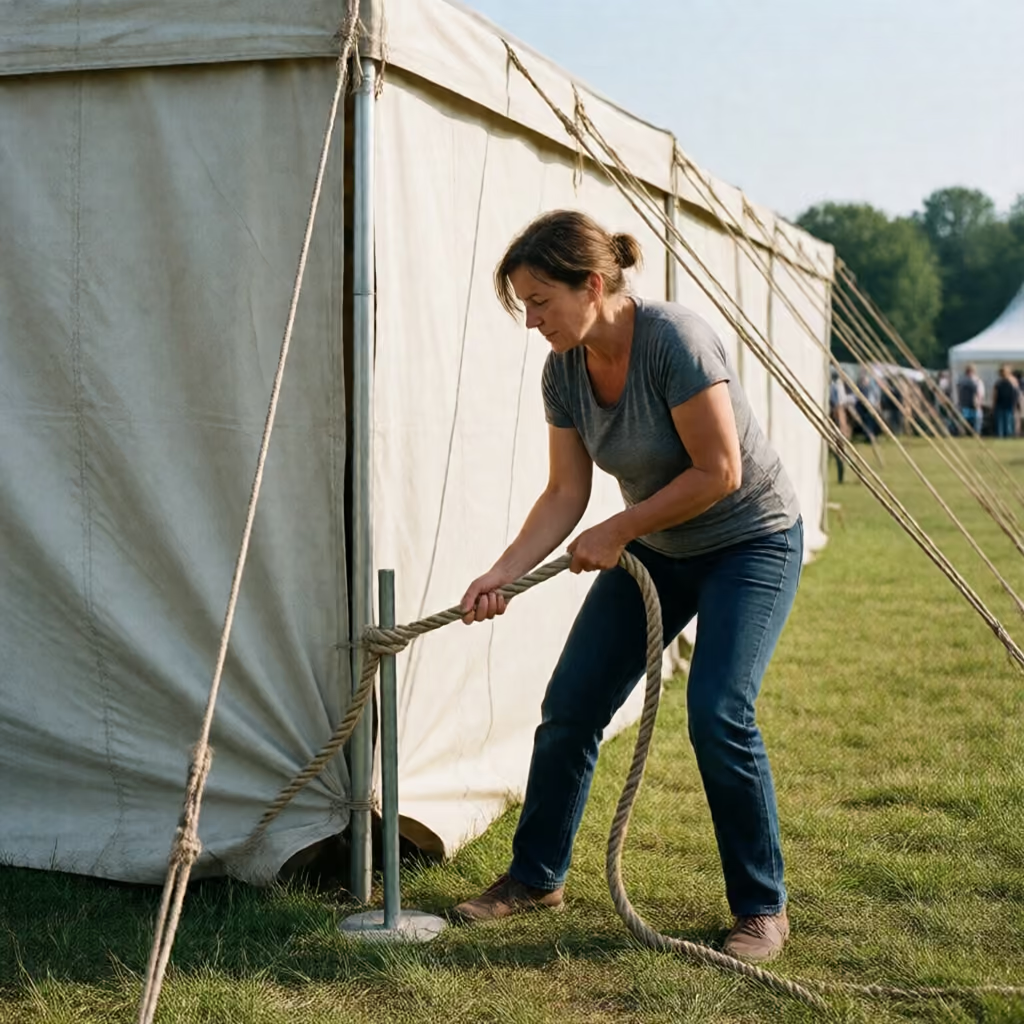
to secure under tension
To attach or secure something firmly using tension or pressure so that it is taut.
EXAMPLE
Das Festzelt wird mit starken Seilen am Boden verspannt.
The marquee is secured to the ground with strong ropes.
to tension
verspannen – verspannte – hat verspannt
Loading your saved state.
to secure under tension
To attach or secure something firmly using tension or pressure so that it is taut.
Das Festzelt wird mit starken Seilen am Boden verspannt.
The marquee is secured to the ground with strong ropes.

to become tense
To become stiff and painful as a result of poor posture, strain, or exertion; especially referring to muscles or parts of the body.
Nach stundenlanger Arbeit am Computer hat sich mein Nacken verspannt.
After working at the computer for hours, my neck became tense.
| ich | verspanne |
|---|---|
| du | verspannst |
| er/sie/es | verspannt |
| wir | verspannen |
| ihr | verspannt |
| sie | verspannen |
| ich | verspannte |
|---|---|
| du | verspanntest |
| er/sie/es | verspannte |
| wir | verspannten |
| ihr | verspanntet |
| sie | verspannten |
| ich | habe verspannt |
|---|---|
| du | hast verspannt |
| er/sie/es | hat verspannt |
| wir | haben verspannt |
| ihr | habt verspannt |
| sie | haben verspannt |
| du | verspann! verspanne! |
|---|---|
| ihr | verspannt! |
| Sie | verspannen Sie! |
| ich | hatte verspannt |
|---|---|
| du | hattest verspannt |
| er/sie/es | hatte verspannt |
| wir | hatten verspannt |
| ihr | hattet verspannt |
| sie | hatten verspannt |
| ich | werde verspannen |
|---|---|
| du | wirst verspannen |
| er/sie/es | wird verspannen |
| wir | werden verspannen |
| ihr | werdet verspannen |
| sie | werden verspannen |
| ich | verspanne |
|---|---|
| du | verspannest |
| er/sie/es | verspanne |
| wir | verspannen |
| ihr | verspannet |
| sie | verspannen |
Used for reported speech.
| ich | verspannte |
|---|---|
| du | verspanntest |
| er/sie/es | verspannte |
| wir | verspannten |
| ihr | verspanntet |
| sie | verspannten |
Used for wishes and “would”.
| infinitive | verspannen |
|---|---|
| with zu | zu verspannen |
| present participle | verspannend |
| past participle | verspannt |
'Verspannen' begins with the inseparable prefix 'ver-'. Therefore, the prefix remains attached to the verb in both main clauses and subordinate clauses.
Die Techniker verspannen die Seile sorgfältig.
The technicians tension the ropes carefully.
Der Ingenieur erklärt, warum die Arbeiter die Seile verspannen.
The engineer explains why the workers tension the ropes.
When referring to a technical action, 'verspannen' is usually used with a concrete object such as a rope or a structure. When referring to physical discomfort, it is often used reflexively with 'sich' (oneself) and a part of the body.
Die Arbeiter verspannen ein Sicherungsseil zwischen den Pfosten.
The workers tension a safety rope between the posts.
Wenn sie gestresst ist, verspannt sie sich sofort.
When she is stressed, she immediately becomes tense.
In the sense of securing something using tension, 'verspannen' is often used with 'zwischen' (between) and two locations or attachment points. It frequently refers to ropes, wires, or straps.
Die Feuerwehr verspannte ein Seil zwischen zwei Bäumen.
The firefighters tensioned a rope between two trees.
When referring to physical discomfort, a part of the body itself can be the subject of 'sich verspannen' (to become tense). Common collocations include 'der Nacken hat sich verspannt' (the neck has become tense), 'die Schultern haben sich verspannt' (the shoulders have become tense), and 'die Rückenmuskeln haben sich verspannt' (the back muscles have become tense).
Beim Umzug haben sich seine Rückenmuskeln verspannt.
His back muscles became tense while he was moving house.