A medical condition in which a person has difficulty emptying the bowels. Bowel movements are infrequent and often painful.
example
Eine ballaststoffreiche Ernährung kann helfen, einer Verstopfung vorzubeugen.
A high-fiber diet can help prevent constipation.

Usage tips
Word family
The noun 'die Verstopfung' (constipation / blockage) comes from the verb 'verstopfen' (to block/clog). This verb is made up of the prefix 'ver-' and 'stopfen' (to stuff). It describes the process in which something is stuffed in such a way that it becomes blocked.
EXAMPLE
Alte Blätter haben den Abfluss auf der Straße verstopft.
Old leaves clogged the drain in the street.
Context clue
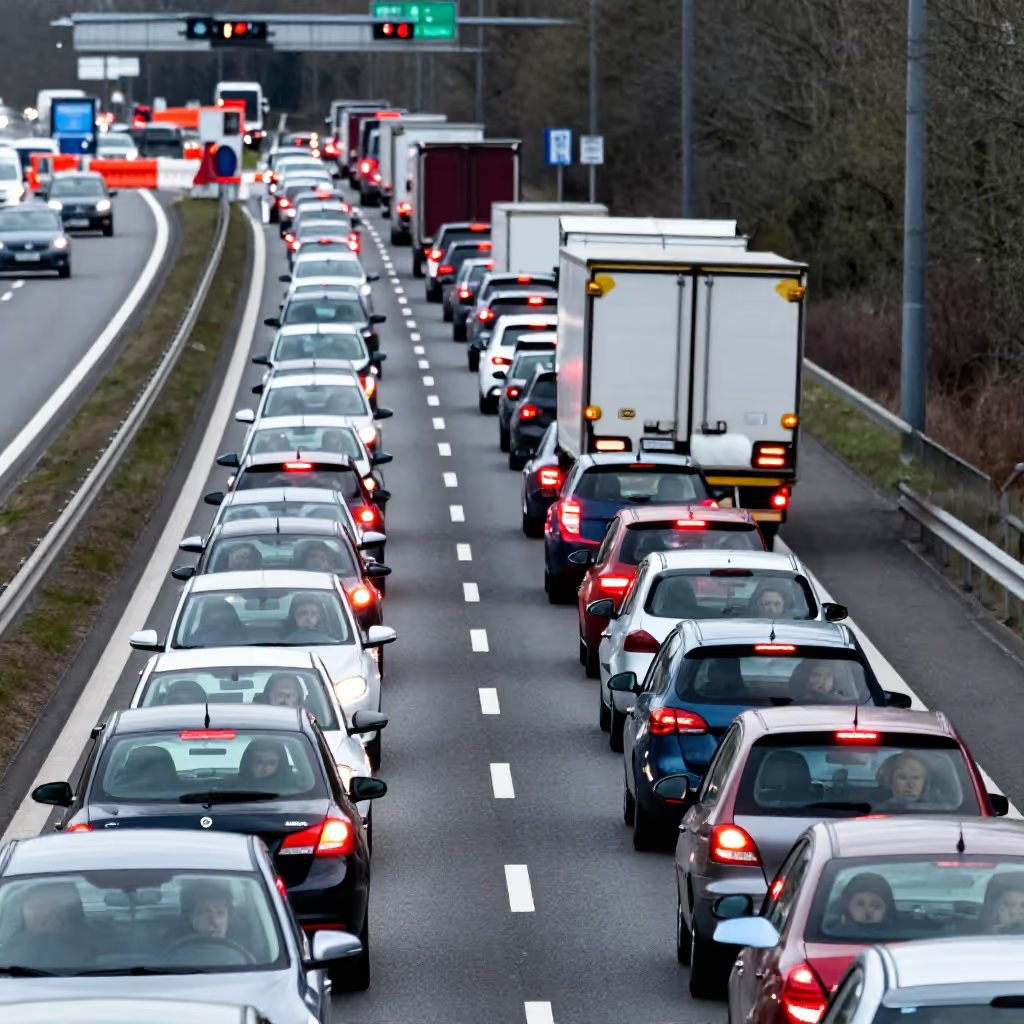
You can recognize which meaning is intended from the context. In a medical context, it is about the body ('an Verstopfung leiden' — to suffer from constipation). In a technical context, it is about pipes or channels ('die Verstopfung im Abfluss' — the blockage in the drain). In a traffic context, it is about roads ('Verstopfung der Innenstadt' — congestion in the city center).
EXAMPLE
Der Arzt gab ihm Tipps gegen seine Verstopfung.
The doctor gave him tips for his constipation.
Typical collocations
In the medical sense, 'Verstopfung' (constipation) is often used with the verbs 'haben' (to have) or 'leiden an' (to suffer from). You can also 'etwas gegen Verstopfung tun' (do something for/against constipation) or 'ihr vorbeugen' (prevent it).
EXAMPLE
Viele Menschen leiden auf Reisen an Verstopfung.
Many people suffer from constipation when traveling.
Typical collocations
When it is about a blockage in a pipe, typical verbs are 'beseitigen' (to remove/clear) or 'lösen' (to clear/loosen). People often speak of the 'Verstopfung im Abfluss' (blockage in the drain) or 'in der Leitung' (in the pipe).
EXAMPLE
Mit einem speziellen Mittel konnte er die Verstopfung im Waschbecken lösen.
With a special product, he was able to clear the blockage in the sink.
Compare with
near_synonym · confusable
Verstopfung vs Stau
traffic jam / backlog
'der Stau' and 'die Verstopfung' can both mean that something can no longer get through properly. In traffic, 'Stau' is the normal word when many vehicles are moving slowly or are stopped. 'Verstopfung' can also refer to traffic, but there it sounds stronger or more technical and is less common in everyday language than 'Stau'. 'Verstopfung' is very typical for pipes, channels, or similar passages. Learners may confuse the words because both describe a blockage. As a simple rule: for roads, usually 'Stau'; for a pipe or channel, usually 'Verstopfung'.
Verstopfung
Nach dem starken Regen gab es eine Verstopfung im Abfluss.
After the heavy rain, there was a blockage in the drain.
Stau
Wegen einer Baustelle bildete sich am Morgen ein langer Stau.
Because of construction work, a long traffic jam formed in the morning.