


verstreuen
to scatter
To distribute or throw something (often small pieces) irregularly over an area.
EXAMPLE
Die Kinder haben ihre Spielsachen im ganzen Zimmer verstreut.
The children scattered their toys all over the room.
to scatter
Loading your saved state.
to scatter
To distribute or throw something (often small pieces) irregularly over an area.
Die Kinder haben ihre Spielsachen im ganzen Zimmer verstreut.
The children scattered their toys all over the room.

to disperse
A group of people breaks up and the individual people go in different directions.
Nach dem Konzert verstreute sich die Menge langsam.
After the concert, the crowd slowly dispersed.
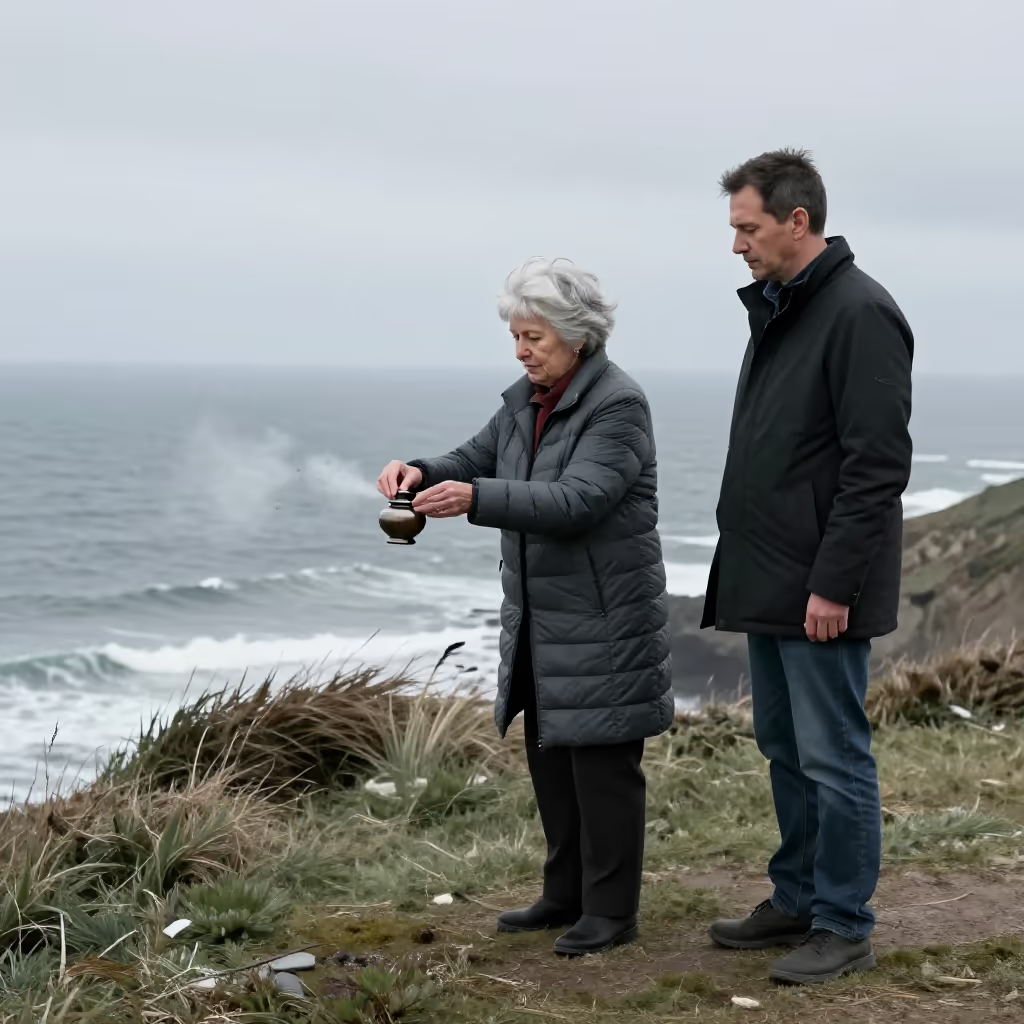
to scatter
To spread the ashes of a deceased person in a specific place.
Sein letzter Wunsch war es, seine Asche im Meer zu verstreuen.
His final wish was to have his ashes scattered in the sea.
'Verstreuen' (to scatter) is an inseparable verb. The prefix 'ver-' always stays at the beginning of the verb, even in a main clause.
Der Wind verstreute die trockenen Blätter auf der ganzen Straße.
The wind scattered the dry leaves all over the street.
The verb is based on 'streuen' (to sprinkle/scatter). The prefix 'ver-' intensifies the meaning and emphasizes a wide, often disordered distribution.
Im Frühling verstreut der Bauer die Samen auf dem Feld.
In spring, the farmer scatters the seeds across the field.
Used transitively, 'verstreuen' (to scatter) means that someone actively distributes things. Used reflexively, 'sich verstreuen' (to disperse) means that a group breaks up and the members go in different directions.
Er hat die Brotkrumen für die Vögel im Garten verstreut.
He scattered the breadcrumbs for the birds in the garden.
In the context of death and burial, the word has a very specific meaning. The object here is almost always 'die Asche' (the ashes) of a deceased person.
Sie erfüllte seinen letzten Wunsch und verstreute seine Asche an der Küste.
She fulfilled his final wish and scattered his ashes on the coast.
to distribute / spread
Verteilen can refer to deliberately arranging small parts over a surface, usually as evenly as possible. Verstreuen, by contrast, emphasizes that the parts lie loosely and irregularly spread out. Verteilen fits planned coverage; Verstreuen fits spatial scattering.

Der Gärtner verstreut die Samen locker und ungeordnet auf dem Beet.
The gardener scatters the seeds loosely and irregularly over the flower bed.
Der Gärtner verteilt die Samen gleichmäßig auf dem Beet.
The gardener distributes the seeds evenly over the flower bed.