

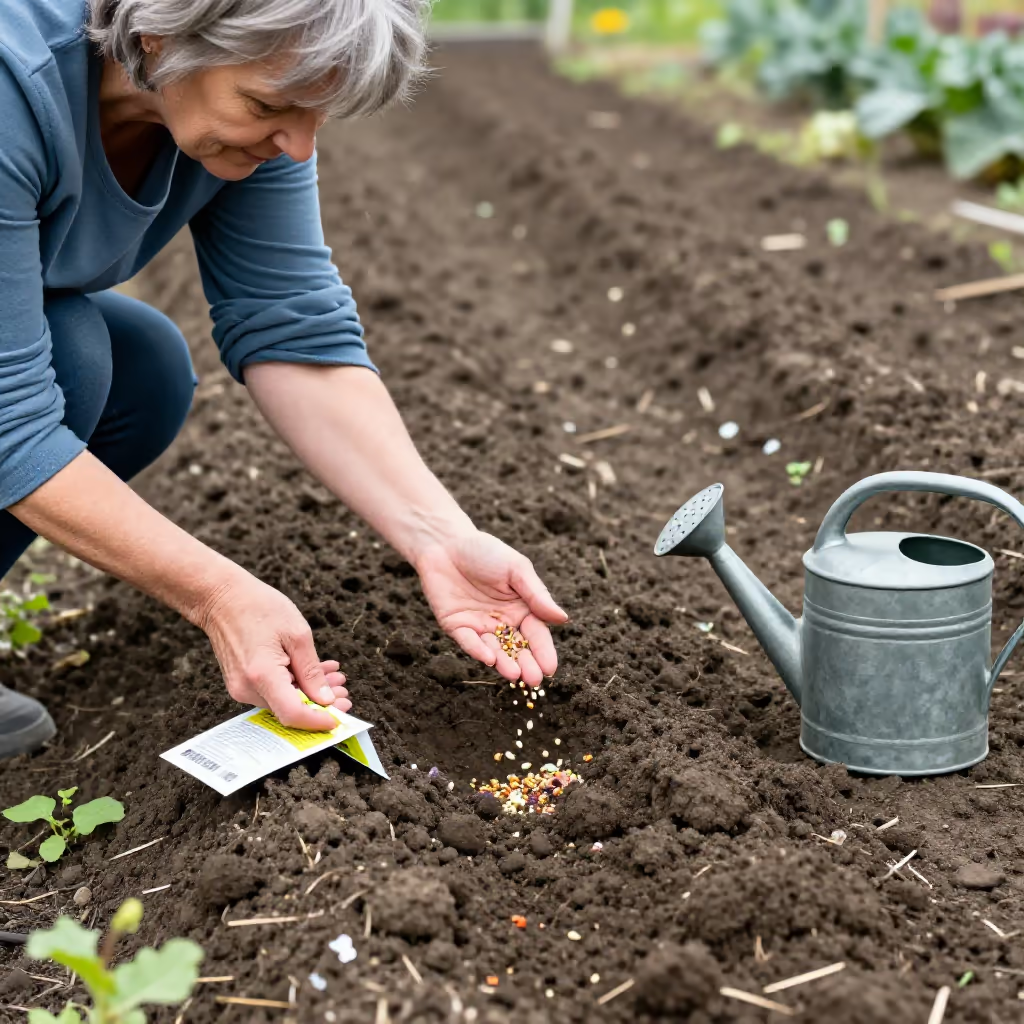
streuen
to scatter
To distribute small things, such as powder, seeds, or sand, over a surface.
EXAMPLE
Im Winter müssen die Straßenwärter bei Glatteis Salz streuen.
In winter, road maintenance workers have to scatter salt when there is black ice.
to scatter / spread
Loading your saved state.
to scatter
To distribute small things, such as powder, seeds, or sand, over a surface.
Im Winter müssen die Straßenwärter bei Glatteis Salz streuen.
In winter, road maintenance workers have to scatter salt when there is black ice.

to spread
To spread information, rumors, or ideas deliberately or unintentionally.
Jemand hat das Gerücht gestreut, dass die Firma bald schließt.
Someone spread the rumor that the company will be closing soon.

to scatter
In physics, the deflection of light or particles in different directions when they hit an obstacle.
Die Milchglasscheibe streut das einfallende Licht und sorgt für eine weiche Beleuchtung.
The frosted glass pane scatters the incoming light and creates soft lighting.

to scatter
With firearms, the deviation of impacts from the target point, so that the shots hit a larger area.
Das alte Gewehr streut so stark, dass man auf 50 Meter kaum noch die Scheibe trifft.
The old rifle scatters so badly that at 50 meters you can hardly hit the target anymore.
The verb 'streuen' (to scatter/spread) is often used with an accusative object that indicates what is being distributed. With a preposition like 'auf' (onto) or 'über' (over) (+ accusative), you can indicate the place or surface.
Die Kinder streuen Brotkrumen für die Vögel auf den Boden.
The children scatter breadcrumbs for the birds on the ground.
In its literal meaning, 'streuen' (to scatter/sprinkle) is often used with small, loose materials. Typical combinations are: 'Salz streuen' (to scatter salt), 'Zucker streuen' (to sprinkle sugar), 'Samen streuen' (to sow/scatter seeds), or 'Blumen streuen' (to scatter flowers).
Für den Salat streue ich noch ein paar Kräuter darüber.
For the salad, I'll sprinkle a few more herbs over it.
In a figurative sense, 'streuen' (to spread) is used for spreading immaterial things. Common combinations are 'Gerüchte streuen' (to spread rumors), 'Informationen streuen' (to spread information), or 'Zweifel streuen' (to sow doubt), and they often have a negative connotation.
Die Opposition versuchte, gezielt Falschinformationen zu streuen.
The opposition tried to deliberately spread false information.
In physics, 'streuen' (to scatter) describes the deflection of light or particles. In this context, the subject is often an object that causes the scattering.
Der Nebel streut das Licht der Autoscheinwerfer.
The fog scatters the light from the car headlights.
to spread
Both words work when a rumor or piece of information is put into circulation. „Streuen“ places more emphasis on deliberately or casually planting it in various places, while „verbreiten“ neutrally refers to passing it on to many people. Choose „streuen“ for the way something is put into circulation and „verbreiten“ for the general process.

Jemand streute das Gerücht gezielt in mehreren Chatgruppen.
Someone deliberately planted the rumor in several chat groups.
Die Zeitung verbreitet die Information an viele Menschen.
The newspaper spreads the information to many people.