


verzweifelt
desperate
Describes a person who has no hope left and no longer knows what to do.
EXAMPLE
Nachdem er seinen Job verloren hatte, war er völlig verzweifelt.
After he had lost his job, he was completely desperate.
desperate
Loading your saved state.
desperate
Describes a person who has no hope left and no longer knows what to do.
Nachdem er seinen Job verloren hatte, war er völlig verzweifelt.
After he had lost his job, he was completely desperate.

desperately
Describes an action taken out of hopelessness as a last attempt.
Sie suchte verzweifelt nach ihren verlorenen Schlüsseln.
She searched desperately for her lost keys.
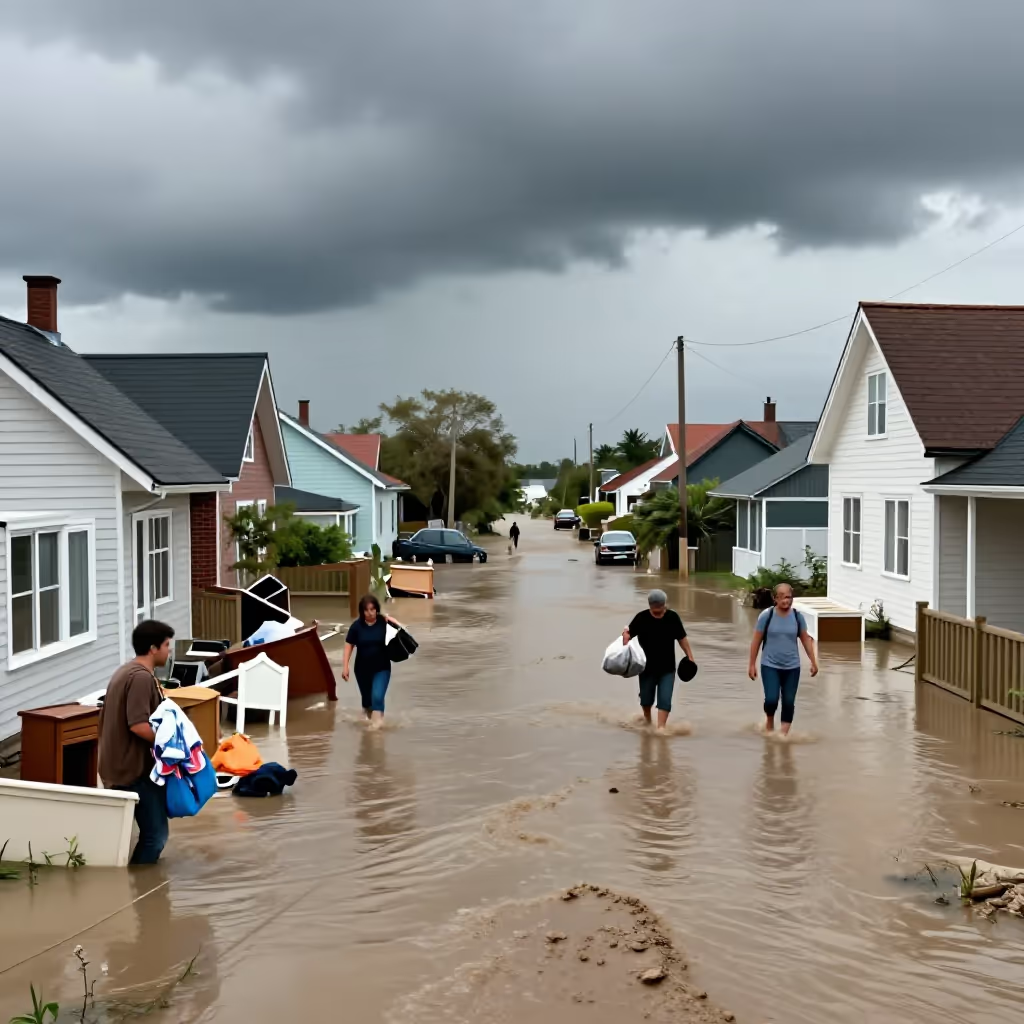
desperate
Describes a situation or condition that seems hopeless or very bad.
Die Lage der eingeschlossenen Bergleute war verzweifelt.
The situation of the trapped miners was desperate.
The word 'verzweifelt' (desperate) is derived from the verb 'verzweifeln' (to despair), which in turn comes from the noun 'der Zweifel' (doubt). So it describes a state in which you are overwhelmed by doubts and no longer see a solution.
Aus reiner Verzweiflung rief sie die Polizei an.
Out of sheer desperation, she called the police.
'Verzweifelt' (desperate/desperately) can describe a person (adjective) or the manner of an action (adverb). Pay attention to its position in the sentence: before a noun or after 'sein' (to be), it describes a person; with a verb, it describes the action.
Ein verzweifelter Vater bat im Fernsehen um Hilfe.
A desperate father asked for help on television.
When 'verzweifelt' (desperately) describes an action, it often appears with verbs that express effort or searching. Common combinations are: 'verzweifelt suchen' (to search desperately), 'verzweifelt versuchen' (to try desperately), 'verzweifelt rufen' (to call desperately), or 'verzweifelt kämpfen' (to fight desperately).
Die Rettungskräfte kämpften verzweifelt gegen die Fluten.
The rescue workers fought desperately against the floods.
helpless
Both words can describe a person in a difficult situation. “Hilflos” emphasizes that the person sees no way or ability to act independently and needs support. “Verzweifelt” focuses more strongly on a lack of hope and inner distress; a person can be both helpless and desperate at the same time.

Nach dem Verlust ihrer Wohnung war die Familie verzweifelt und wusste nicht mehr weiter.
After losing their home, the family was desperate and no longer knew what to do.
Nach dem Verlust ihrer Wohnung stand die Familie hilflos vor den verschlossenen Türen.
After losing their home, the family stood helplessly in front of the locked doors.