

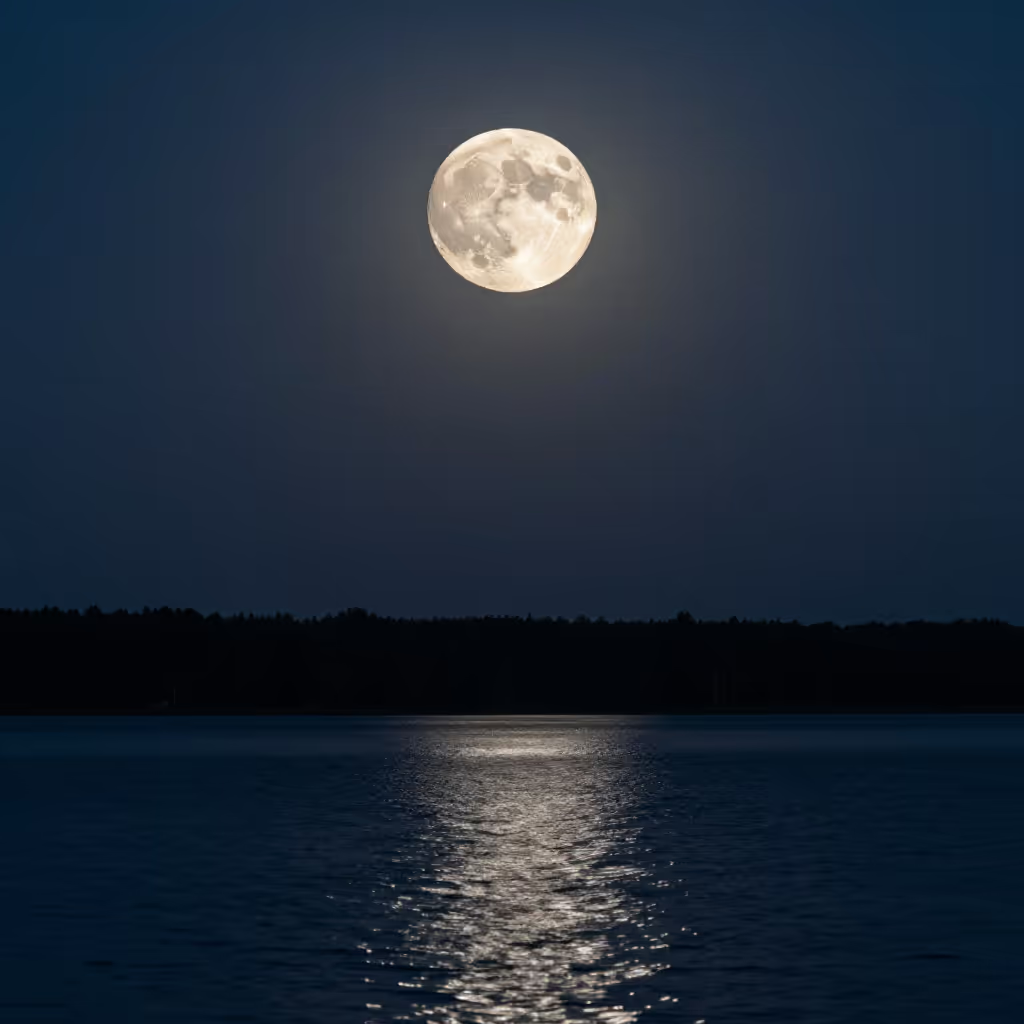
The phase of the moon in which, as seen from Earth, it is fully illuminated by the sun and appears as a round disk in the sky.
example
Bei Vollmond kann man nachts oft auch ohne Lampe gut sehen.
During a full moon, you can often see well at night even without a lamp.
Usage tips
Word composition
The word is simply made up of 'voll' (full) and 'Mond' (moon). So it literally describes the state when the moon can be seen as 'full'.
EXAMPLE
Die nächste Vollmond-Nacht ist in zwei Wochen.
The next full-moon night is in two weeks.
Typical sentences
To talk about a full moon, people often use the fixed expressions 'Es ist Vollmond' (It is a full moon) or 'Wir haben Vollmond' (We have a full moon).
EXAMPLE
Heute Nacht haben wir Vollmond.
Tonight we have a full moon.
Correct preposition
When something happens on the night of the full moon, the preposition 'bei' is used. So: 'bei Vollmond' (during a full moon).
EXAMPLE
Die Party am Strand findet bei Vollmond statt.
The party on the beach takes place during a full moon.
Compare with
confusable
Vollmond vs Mond
moon
'der Mond' and 'der Vollmond' do not mean exactly the same thing, although they are closely related. 'der Mond' is the celestial body that orbits Earth. 'der Vollmond' is only a particular phase of this moon, namely when it appears completely round and bright from Earth. The words can be confused because you see the same celestial body in the sky. When speaking about it in general, you say 'der Mond'. When you mean the round, fully illuminated phase, 'der Vollmond' is more precise.
Vollmond
Der Vollmond macht die Nacht heute ungewöhnlich hell.
The full moon is making the night unusually bright today.
Mond
Am Abend stand der Mond klar über den Häusern.
In the evening, the moon stood clearly above the houses.