

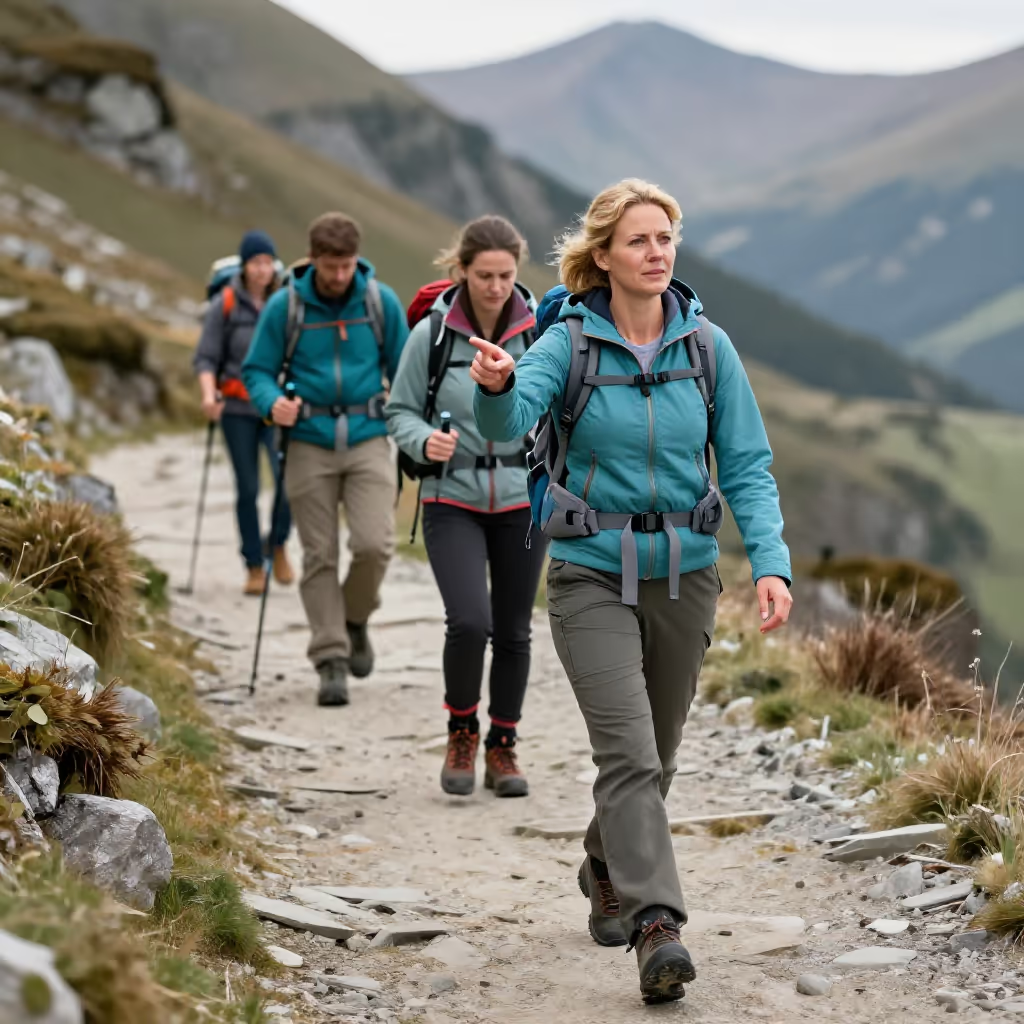
voran
ahead
Expresses movement forward or a position at the front.
EXAMPLE
Der Reiseführer ging voran und die Gruppe folgte ihm.
The tour guide went ahead and the group followed him.
ahead
Loading your saved state.
ahead
Expresses movement forward or a position at the front.
Der Reiseführer ging voran und die Gruppe folgte ihm.
The tour guide went ahead and the group followed him.

ahead / forward
Describes progress or positive development in a process or project.
Mit dem Bau des neuen Hauses geht es gut voran.
Construction of the new house is coming along well.
'Voran' (ahead/forward) very often functions as a separable prefix for verbs like 'vorangehen' (to go ahead), 'vorankommen' (to make progress / get ahead), or 'voranbringen' (to move forward / advance). In a main clause, the prefix stands at the end of the sentence.
Der Kapitän geht auf dem Schiff immer voran.
The captain always goes ahead on the ship.
When a person is the subject, 'voran' (ahead/forward) usually means movement forward. When the subject is 'es' (it) or a project, 'voran' describes abstract progress.
Bitte geh du voran, du kennst den Weg am besten.
Please go ahead, you know the way best.
To express progress, 'voran' (ahead/forward) is often used in the expressions 'es geht voran' (things are moving forward / progress is being made) or '(gut) vorankommen' (to make good progress). These are very common in everyday life and at work.
Endlich geht es mit dem Bauprojekt wieder voran.
Finally, the construction project is moving forward again.
at the front / forward
„Vorne“ refers to a position at the front of a group and can also be used without movement. „Voran“ emphasizes more strongly that someone is moving at the head of the group or leading it. So „vorne“ is usually more suitable for simply stating a location.

Bei der Wanderung geht Mia der Gruppe voran und zeigt den Weg.
During the hike, Mia is leading the group and showing the way.
Bei der Wanderung läuft Mia vorne in der Gruppe.
During the hike, Mia is walking at the front of the group.