

vorangehen
to go ahead
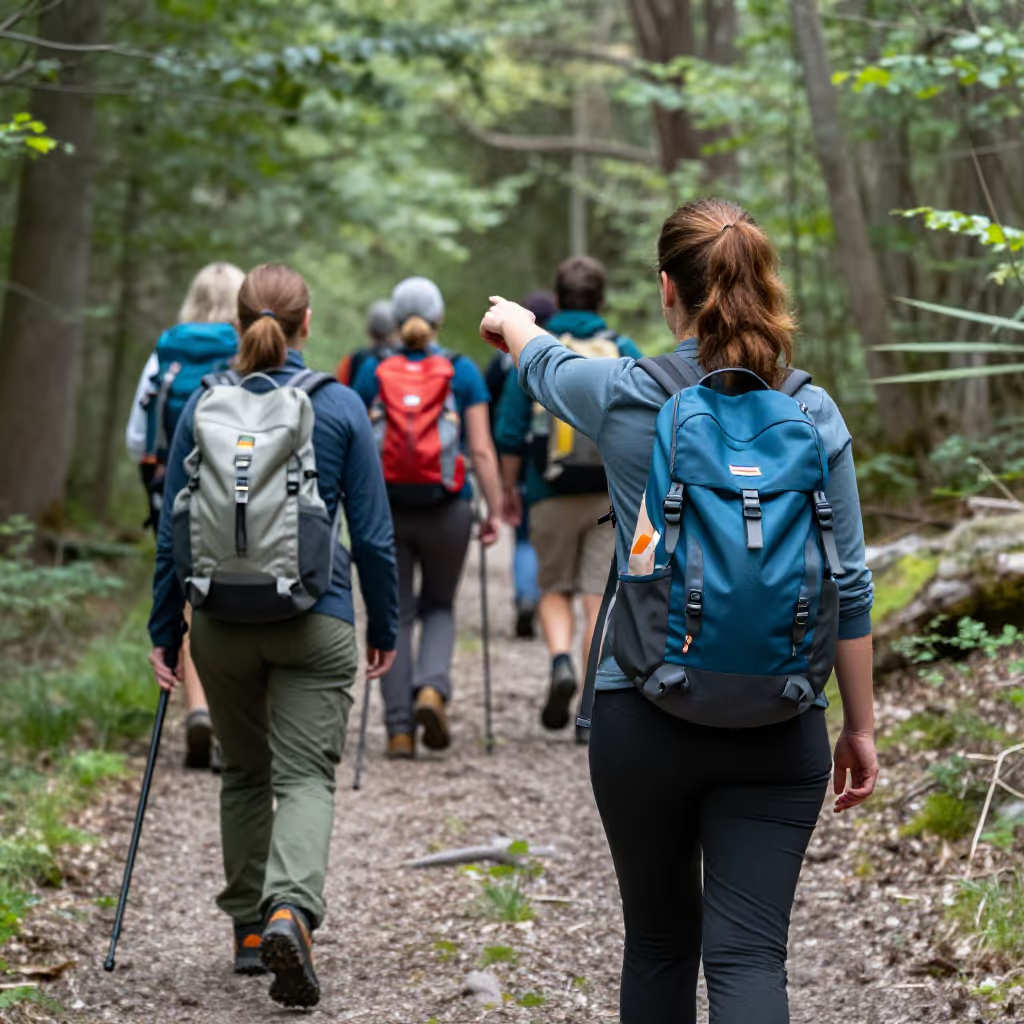
To walk or travel ahead of someone else in a physical sense; to take the lead of a group.
EXAMPLE
Geh du schon mal voran, ich komme gleich nach.
You go ahead, I'll follow in a moment.
to go ahead / progress / happen
Loading your saved state.
to go ahead
To walk or travel ahead of someone else in a physical sense; to take the lead of a group.
Geh du schon mal voran, ich komme gleich nach.
You go ahead, I'll follow in a moment.

to progress
To make progress; to develop further.
Die Bauarbeiten am neuen Flughafen gehen nur langsam voran.
Construction work on the new airport is progressing only slowly.

to happen
To occur, take place, or happen. Often used in the question 'Was geht hier vor?' (What's going on here?) or in reference to past events.
Die Polizei versucht zu rekonstruieren, was in der Tatnacht im Haus vorgegangen ist.
The police are trying to reconstruct what happened in the house on the night of the crime.

to lead by example
To behave in a way that makes you a role model for others.
Als Kapitän der Mannschaft muss er immer mit gutem Beispiel vorangehen.
As the captain of the team, he must always lead by example.
'Vorangehen' (to go ahead/progress/happen) is a separable verb. The prefix 'voran' stands at the end in a main clause, but remains attached to the verb in a subordinate clause.
Die Arbeit geht gut voran.
The work is progressing well.
The subject of the sentence helps you recognize the meaning. A person goes ahead physically (meaning 1), a project makes progress (meaning 2), and an impersonal 'es' or 'was' asks what is happening (meaning 3).
Der Reiseführer ging der Gruppe voran.
The tour guide went ahead of the group.
In the meaning 'Fortschritte machen' (to make progress), 'vorangehen' (to progress) is often accompanied by adverbs that describe the speed or quality of the progress. Common examples are 'gut' (well), 'schnell' (quickly), 'langsam' (slowly), or 'zügig' (swiftly).
Mit dem neuen Team geht das Projekt endlich zügig voran.
With the new team, the project is finally progressing swiftly.
In the meaning 'geschehen' (to happen) or 'passieren' (to happen), the verb is often used in the question 'Was geht hier vor?' (What's going on here?). It expresses curiosity or confusion about a situation.
Als die Polizei kam, fragte ein Nachbar: „Was geht hier eigentlich vor?“
When the police arrived, a neighbor asked, 'What is actually going on here?'
The idiom 'mit gutem Beispiel vorangehen' (to lead by example) is a fixed combination. It means to behave in an exemplary way so that others follow your behavior.
Die Chefin geht immer mit gutem Beispiel voran und macht selten Überstunden.
The boss always leads by example and rarely works overtime.
to lead
Führen and vorangehen can both describe bringing a group to a destination. With führen, the group is the direct object: someone leads the others. Vorangehen, by contrast, mainly describes the fact that the person leading walks or travels in front. Choose führen for the leadership relationship and vorangehen for the position at the front.

Die Bergführerin ging den Wanderern sicher durch den Wald voran.
The mountain guide safely went ahead of the hikers through the forest.
Die Bergführerin führte die Wanderer sicher durch den Wald.
The mountain guide safely led the hikers through the forest.