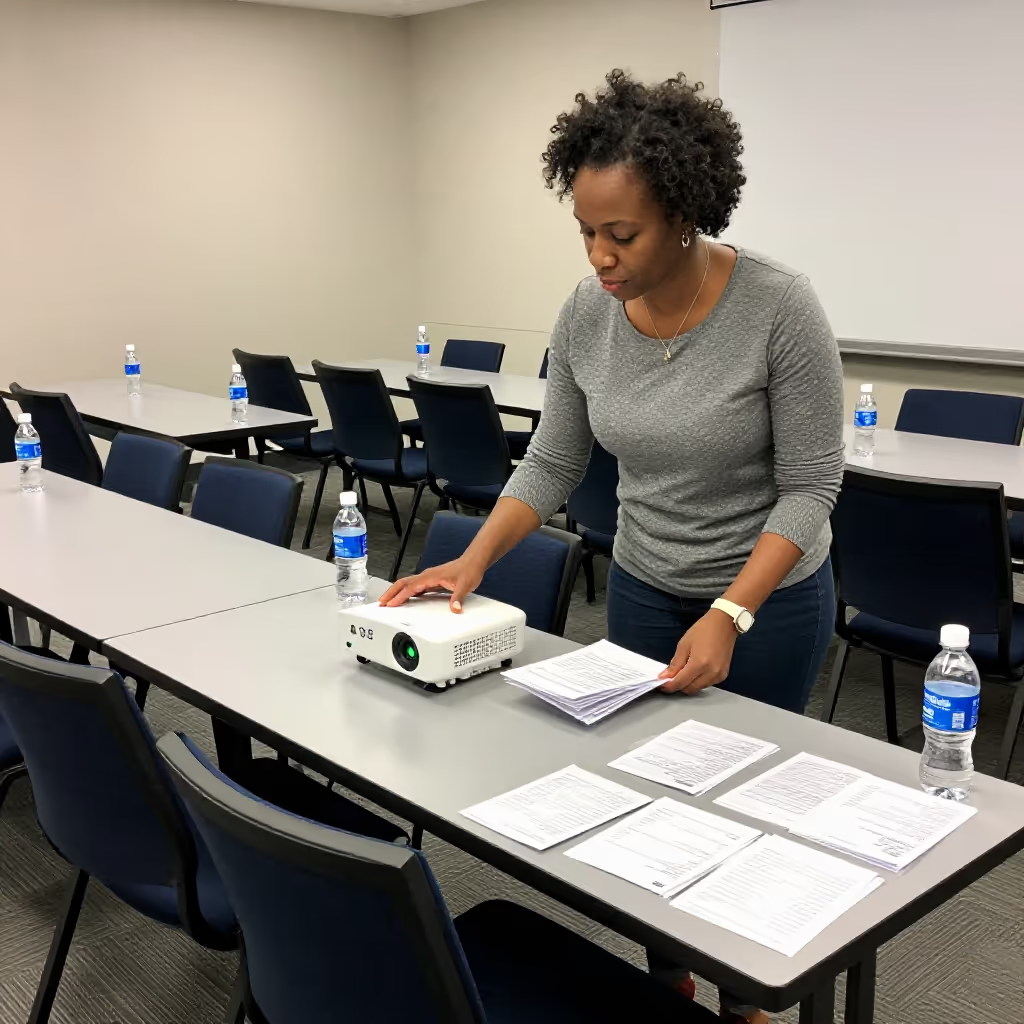
To do work in advance in order to have less to do later or to be able to take time off.
example
Ich muss heute Abend vorarbeiten, weil ich morgen früher gehen will.
I have to work ahead tonight because I want to leave earlier tomorrow.

Usage tips
Separable verb
'vorarbeiten' (to work ahead) is a separable verb. In a main clause, the prefix 'vor' goes at the end. In a subordinate clause, the verb stays together, and in the infinitive with 'zu', 'zu' goes in the middle.
EXAMPLE
Ich arbeite heute eine Stunde vor.
I'm working one hour ahead today.
Word structure
The verb is made up of the prefix 'vor-' and the verb 'arbeiten' (to work). The prefix 'vor' here has the meaning of 'in advance' or 'forward', which explains the different meanings of the verb.
EXAMPLE
Wenn du jetzt vorarbeitest, hast du am Wochenende frei.
If you work ahead now, you'll have the weekend off.
Reflexive use
In the meaning of 'sich nach vorne bewegen' (to move forward) or 'Karriere machen' (to make a career), the verb is used reflexively with 'sich' in the accusative. The direction is often indicated with prepositions such as 'bis zu' (up to) or 'durch' (through).
EXAMPLE
Sie hat sich in der Firma bis zur Managerin vorgearbeitet.
She worked her way up in the company to manager.
Dative construction
When you do preparatory work for someone else, that person is put in the dative. The structure is: 'jemandem vorarbeiten' (to do preparatory work for someone).
EXAMPLE
Die Praktikantin arbeitet der Projektleiterin für die Präsentation vor.
The intern is doing preparatory work for the project manager for the presentation.
Compare with
near_synonym · confusable
vorarbeiten vs vorbereiten
to prepare
'vorbereiten' and 'vorarbeiten' both have to do with something being done before a later point in time. 'vorbereiten' is used when you get yourself, a thing, or a situation ready, for example for an exam, a conversation, or a celebration. 'vorarbeiten' means doing work earlier so that there is less work left later, or helping someone by doing the first steps of the work. Learners may confuse the words because both begin with 'vor-' and point toward the future. In practice: for studying, planning, and getting things ready, 'vorbereiten' usually fits; for work that you do in advance, 'vorarbeiten' fits.
vorarbeiten
Heute arbeitet der Chef vor, damit er am Freitag früher gehen kann.
The boss is working ahead today so that he can leave earlier on Friday.
vorbereiten
Adam bereitet sich am Abend auf das Gespräch mit der Ärztin vor.
In the evening, Adam prepares for the conversation with the doctor.