

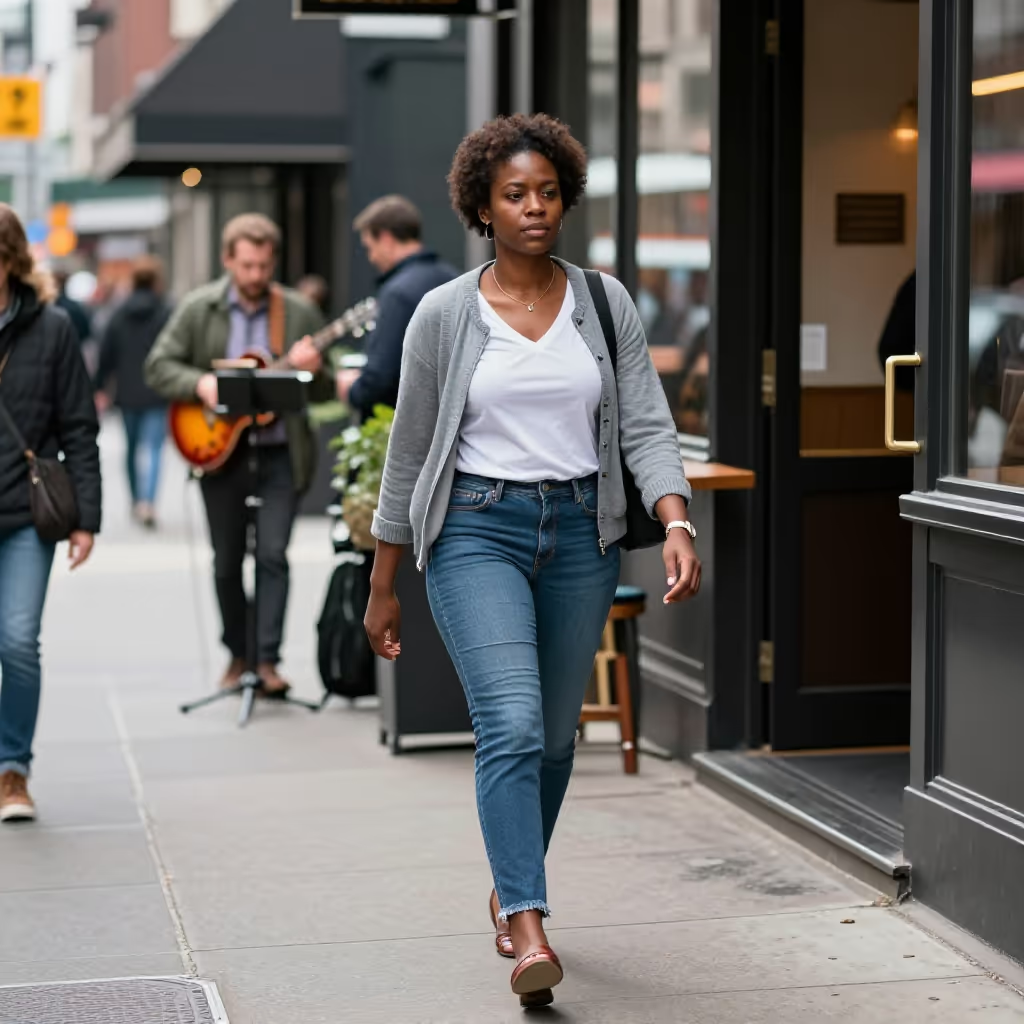
vorbeigehen
to pass by
To move past something or someone in a direction without stopping there.
EXAMPLE
Ich bin gestern an deinem Haus vorbeigegangen, aber du warst nicht da.
I passed by your house yesterday, but you weren't there.
to pass by / pass
Loading your saved state.
to pass by
To move past something or someone in a direction without stopping there.
Ich bin gestern an deinem Haus vorbeigegangen, aber du warst nicht da.
I passed by your house yesterday, but you weren't there.

to pass
To move toward its end and stop; to pass. Usually used for time, events, or states.
Der Schmerz wird mit der Zeit schon wieder vorbeigehen.
The pain will pass again with time.

to drop by
To visit someone for a short time, often spontaneously and on the way to another place. A synonym of 'vorbeikommen' (to come by/drop by).
Wenn ich in der Nähe bin, gehe ich später noch kurz bei dir vorbei.
If I'm nearby, I'll drop by your place briefly later.
'Vorbeigehen' (to pass by / pass) is a separable verb. The prefix 'vorbei-' goes to the end of the main clause. In subordinate clauses and infinitive constructions, the verb stays together.
Ich gehe jeden Morgen an der Bäckerei vorbei.
I pass by the bakery every morning.
The perfect tense of 'vorbeigehen' (to pass by / pass) is always formed with 'sein' (to be), because the base verb 'gehen' (to go) expresses movement. So it is 'ich bin vorbeigegangen' (I passed by / I went by).
Der Sturm ist zum Glück schnell vorbeigegangen.
Fortunately, the storm passed quickly.
The preposition changes the meaning: 'an jemandem/etwas vorbeigehen' (dative) means to move past someone/something. 'Bei jemandem vorbeigehen' (dative) means to visit that person briefly.
Der Bus ist direkt an der Haltestelle vorbeigegangen.
The bus went right past the stop.
In the meaning 'vergehen' (to pass), 'vorbeigehen' is used for abstract things. The subject is then often time, a feeling, an event, or an opportunity.
Die schlimmste Zeit wird auch vorbeigehen.
The worst time will pass too.
In the meaning 'kurz besuchen' (to visit briefly), 'vorbeigehen' is rather colloquial and is often used for spontaneous, unplanned visits.
Sollen wir auf dem Rückweg noch bei Oma vorbeigehen?
Should we drop by Grandma's on the way back?
to drop by / pass by
Vorbeikommen and vorbeigehen can both refer to a short visit. Vorbeikommen describes the visit neutrally, while vorbeigehen places more emphasis on walking there or passing by. If the means of transport does not matter, vorbeikommen is appropriate; for a short visit on foot, vorbeigehen is especially natural.

Ich gehe heute nach der Arbeit zu Fuß kurz bei dir vorbei.
I’ll walk over to your place for a quick visit after work today.
Ich komme heute nach der Arbeit kurz bei dir vorbei.
I’ll drop by your place briefly after work today.