
To allow another person, out of politeness or because of rules, to go, drive, or do something before oneself.
example
Er hielt die Tür auf und ließ der älteren Dame den Vortritt.
He held the door open and let the elderly lady go first.
Usage tips
Word composition
The word consists of 'vor' (in front, before) and 'Tritt' (step). So it literally describes the idea of being allowed to take a step before someone else.
EXAMPLE
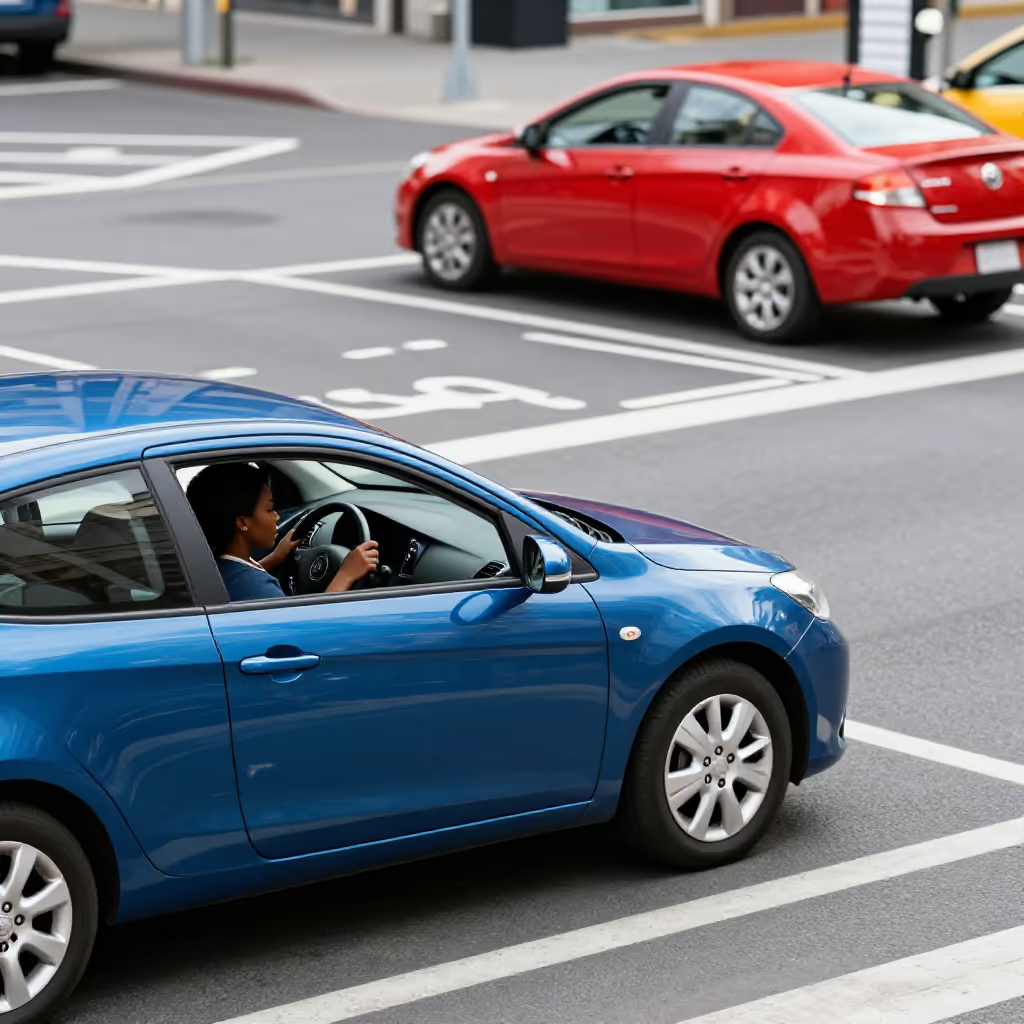
Im Straßenverkehr ist es wichtig zu wissen, wer den Vortritt hat.
In road traffic, it is important to know who has right of way.
Dative construction
In the expression 'jemandem den Vortritt lassen' (to let someone go first), the person you give priority to is always in the dative. This is a fixed grammatical structure.
EXAMPLE
Der junge Mann ließ mir an der Kasse den Vortritt.
The young man let me go first at the checkout.
Context: traffic rules
The expression 'den Vortritt haben' (to have right of way) is used very often in the context of traffic rules. It is closely connected to the term 'Vorfahrt haben' (to have right of way).
EXAMPLE
An Kreuzungen ohne Ampel haben die von rechts kommenden Autos den Vortritt.
At intersections without traffic lights, cars coming from the right have right of way.
Figurative meaning
When you 'einer Sache den Vortritt geben' (give something priority), the concept is transferred to abstract ideas or priorities. The thing being prioritized is in the dative.
EXAMPLE
Bei diesem Projekt geben wir der Qualität den Vortritt vor der Geschwindigkeit.
In this project, we are giving quality priority over speed.
Compare with
near_synonym · confusable
Vortritt vs Priorität
priority
'Priorität' and 'Vortritt' both have to do with precedence. You use 'Priorität' mainly for tasks, goals, or topics that are more important than others and should come first. 'Vortritt' is often used with people or in traffic: someone is allowed to go, drive, or act first. In a figurative sense, you can also give something 'den Vortritt', but that sounds somewhat more metaphorical. Learners may confuse the words because both can mean 'first'. In practice: for planning and importance, 'Priorität' usually fits; for order, politeness, or traffic rules, 'Vortritt' usually fits.
Vortritt
An der Kreuzung lässt der Autofahrer dem Radfahrer den Vortritt.
At the intersection, the driver lets the cyclist go first.
Priorität
Nach dem Gespräch hat die Sicherheit der Kinder für uns klare Priorität.
After the conversation, the children's safety is a clear priority for us.