

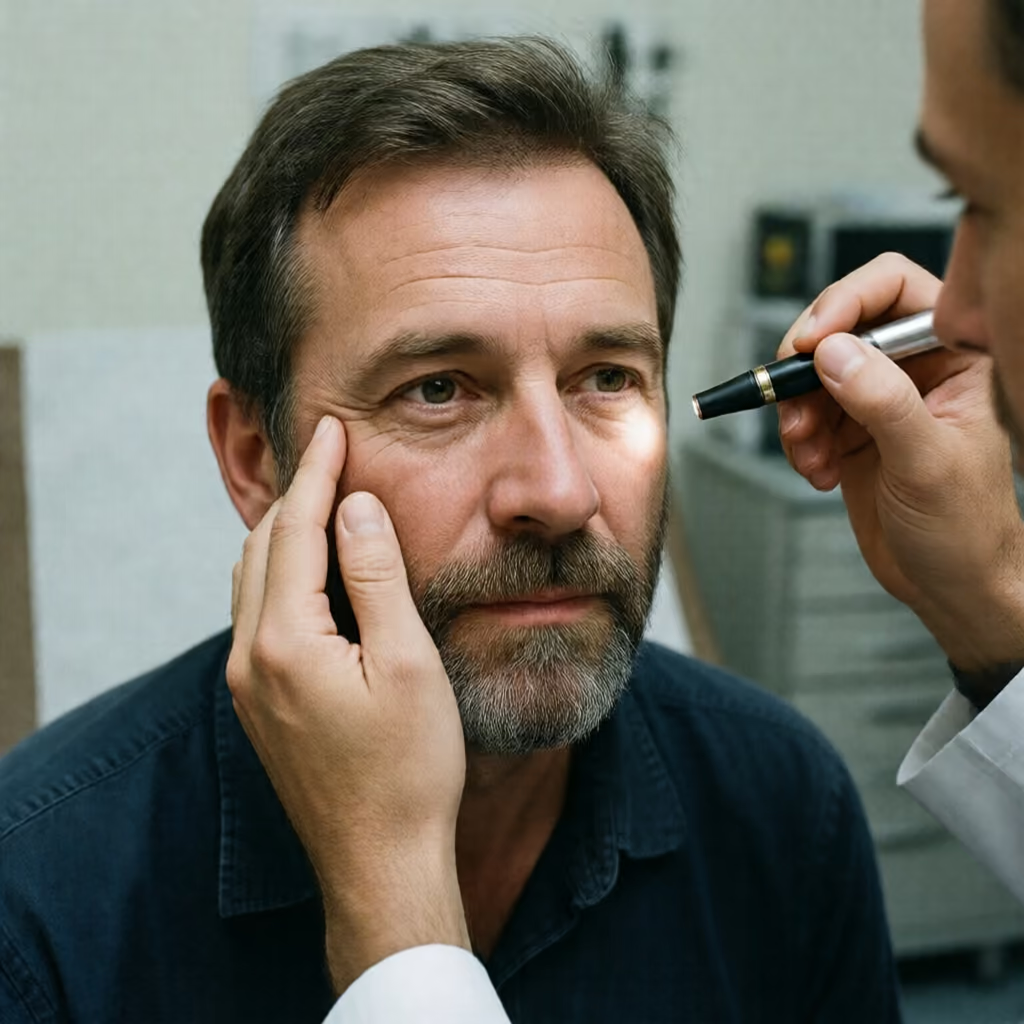
der Wangenknochen
cheekbone
A bone of the facial skeleton that forms the cheek and helps form the eye socket, among other functions.
EXAMPLE
Der Schlag traf ihn direkt am Wangenknochen.
The blow hit him directly on the cheekbone.
cheekbone
der Wangenknochen, die Wangenknochen
Loading your saved state.
cheekbone
A bone of the facial skeleton that forms the cheek and helps form the eye socket, among other functions.
Der Schlag traf ihn direkt am Wangenknochen.
The blow hit him directly on the cheekbone.
| gender | masculine der |
|---|---|
| plural | die Wangenknochen |
| genitive | des Wangenknochens |
| singular | plural | |
|---|---|---|
| nominative | der Wangenknochen | die Wangenknochen |
| accusative | den Wangenknochen | die Wangenknochen |
| dative | dem Wangenknochen | den Wangenknochen |
| genitive | des Wangenknochens | der Wangenknochen |
The article changes with the case; it is shown in colour.
'Wangenknochen' (cheekbone) is made up of 'Wange' (cheek), the linking element '-n-', and 'Knochen' (bone). The first component refers to the part of the body, while the second specifies the type of body part.
Die Ärztin tastete vorsichtig den Wangenknochen ab.
The doctor carefully felt the patient's cheekbone.
When describing someone's appearance, 'hohe Wangenknochen' (high cheekbones) and 'ausgeprägte Wangenknochen' (prominent cheekbones) are typical collocations. The word often appears in the plural because both sides of the face are meant.
Auf dem Foto fallen ihre hohen Wangenknochen besonders auf.
Her high cheekbones are particularly noticeable in the photo.
For describing your own injury, the pattern 'sich den Wangenknochen brechen' (to break one's cheekbone) is commonly used. The injured person is indicated by a dative pronoun such as 'mir' (to me), 'dir' (to you), or 'sich' (oneself); the body part takes the definite article in the accusative.
Beim Zusammenstoß habe ich mir den Wangenknochen gebrochen.
I broke my cheekbone in the collision.