

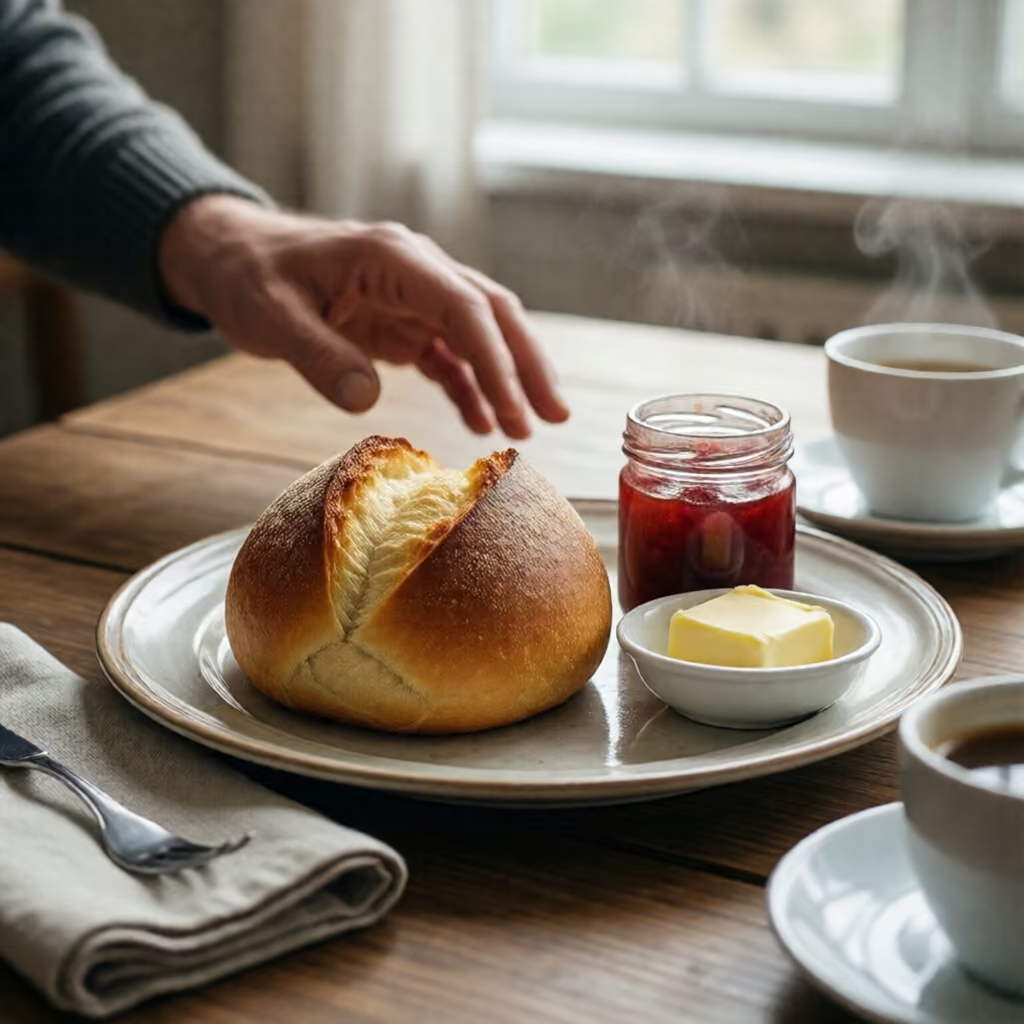
der Weck
bread roll
Regionally, especially in southwestern German-speaking areas, a small round or elongated bread roll.
EXAMPLE
Zum Frühstück esse ich einen Weck mit Butter und Marmelade.
For breakfast, I eat a bread roll with butter and jam.
bread roll
der Weck, die Wecke
Loading your saved state.
bread roll
Regionally, especially in southwestern German-speaking areas, a small round or elongated bread roll.
Zum Frühstück esse ich einen Weck mit Butter und Marmelade.
For breakfast, I eat a bread roll with butter and jam.
| gender | masculine der |
|---|---|
| plural | die Wecke |
| genitive | des Wecks |
| singular | plural | |
|---|---|---|
| nominative | der Weck | die Wecke |
| accusative | den Weck | die Wecke |
| dative | dem Weck | den Wecken |
| genitive | des Wecks | der Wecke |
The article changes with the case; it is shown in colour.
'Weck' (bread roll) is especially common in southwestern German-speaking areas and is part of the everyday vocabulary used at the bakery there. In other regions, the word may sound unfamiliar.
In unserer Gegend kauft man morgens beim Bäcker frische Wecke.
In our area, people buy fresh bread rolls at the bakery in the morning.
The verbs 'kaufen' (to buy), 'holen' (to get), 'bestellen' (to order), and 'essen' (to eat) are often used with 'Weck'. Toppings or ingredients are also frequently mentioned directly, such as butter, jam, or cheese.
Auf dem Heimweg holt sie noch zwei Wecke mit Käse.
On her way home, she gets two bread rolls with cheese.
When ordering, 'Weck' is usually used with a quantity or an additional description. This makes it clear how many pieces are meant or what should be on or inside them.
Ich hätte gern zwei Wecke und einen mit Schinken.
I would like two bread rolls and one with ham.