


die Welle
wave
A mass of water rising and moving along the surface of a body of water such as the sea or a lake.
EXAMPLE
Die Kinder sprangen lachend in die Wellen.
The children jumped laughing into the waves.
wave
Loading your saved state.
wave
A mass of water rising and moving along the surface of a body of water such as the sea or a lake.
Die Kinder sprangen lachend in die Wellen.
The children jumped laughing into the waves.

wave
A sudden, widespread occurrence of a phenomenon or feeling that spreads quickly.
Nach dem Skandal gab es eine Welle der Empörung in der Bevölkerung.
After the scandal, there was a wave of outrage among the population.

wave
In physics, the propagation of an oscillation through space, for example with sound, light, or radio signals.
Dieser Radiosender sendet auf einer anderen Welle.
This radio station broadcasts on a different wave.

wave
A hairstyle in which the hair is arranged in curved lines.
Für die Party ließ sie sich beim Friseur eine Wasserwelle machen.
For the party, she had the hairdresser give her finger waves.
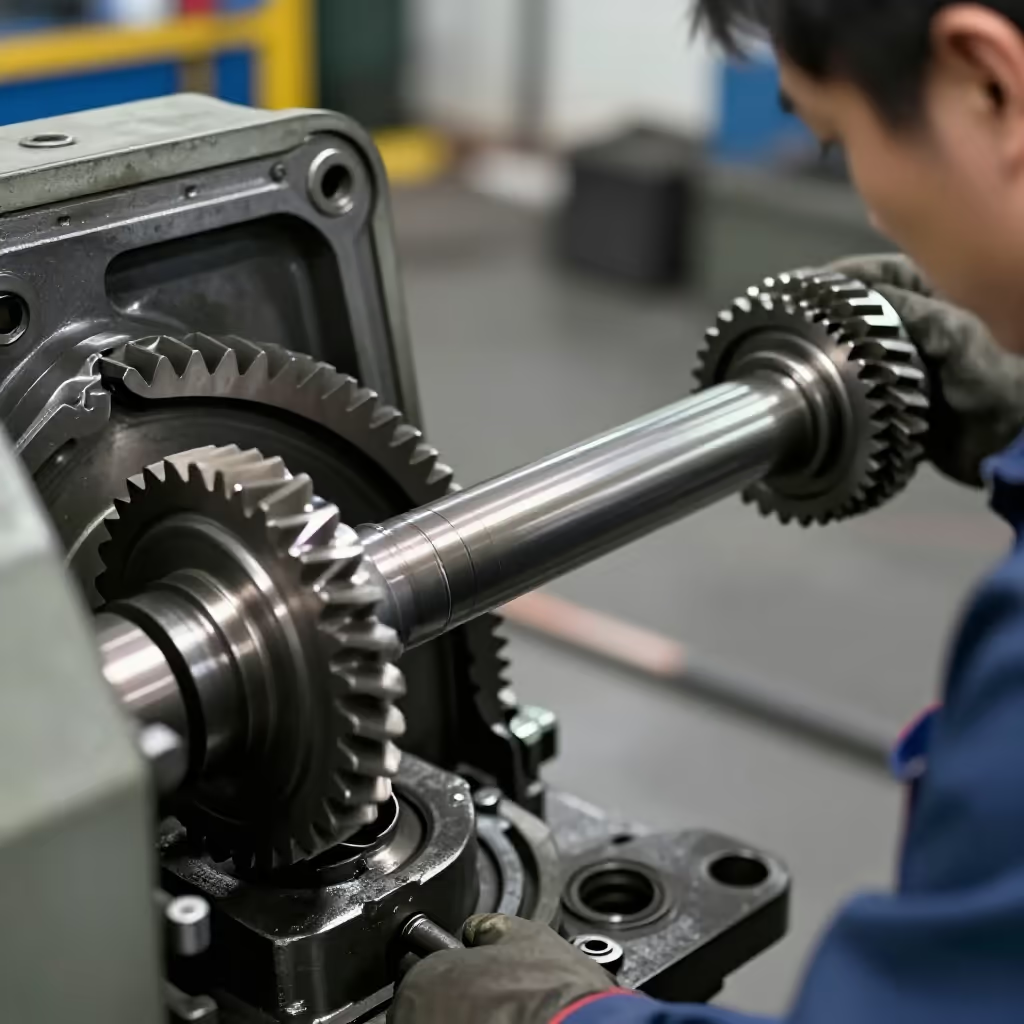
shaft
A machine component in the form of a rod that serves to transmit rotational motion; an axle.
Der Mechaniker musste die defekte Welle im Getriebe austauschen.
The mechanic had to replace the defective shaft in the transmission.
The basic meaning of the water wave is often used figuratively. A 'Welle' (wave) then describes a phenomenon that spreads quickly, like a wave in water. This helps you understand the different meanings.
Eine Grippewelle breitete sich im ganzen Land aus.
A wave of flu spread throughout the whole country.
When referring to water, 'Welle' (wave) is often combined with adjectives that describe its size or strength. Common phrases are 'hohe Wellen' (high waves), 'sanfte Wellen' (gentle waves), or 'riesige Wellen' (huge waves).
Trotz der hohen Wellen gingen die Surfer ins Wasser.
Despite the high waves, the surfers went into the water.
In the figurative meaning, 'Welle' (wave) often follows the structure 'eine Welle der/des + [abstract noun]' (a wave of + [abstract noun]). This creates fixed combinations such as 'eine Welle der Begeisterung' (a wave of enthusiasm), 'eine Welle der Gewalt' (a wave of violence), or 'eine Welle der Hilfsbereitschaft' (a wave of helpfulness).
Der Sieg der Mannschaft löste eine Welle der Begeisterung aus.
The team's victory triggered a wave of enthusiasm.
You can recognize this meaning from the technical or scientific context. Signal words here are 'Radio' (radio), 'Schall' (sound), 'Licht' (light), 'Frequenz' (frequency), or verbs like 'senden' (to broadcast/transmit) and 'empfangen' (to receive).
Schall breitet sich in Wellen aus.
Sound spreads in waves.
This very specific meaning occurs only in technical contexts. You can recognize it from words like 'Motor' (engine), 'Getriebe' (transmission), 'Maschine' (machine), 'Achse' (axle), or 'Mechaniker' (mechanic).
Die Welle im Motor war gebrochen und musste ersetzt werden.
The shaft in the engine was broken and had to be replaced.
axis / axle
A Welle and an Achse can both be technical rod-like components. Welle is used especially when the component transmits rotational motion, whereas Achse is used especially when it carries or connects wheels. For a component, its main function therefore determines which term is more appropriate.

Die Welle überträgt die Drehbewegung vom Motor auf das Getriebe.
The shaft transmits the rotational motion from the engine to the gearbox.
Die Achse verbindet die beiden Räder und trägt das Gewicht des Wagens.
The axle connects the two wheels and supports the weight of the vehicle.