

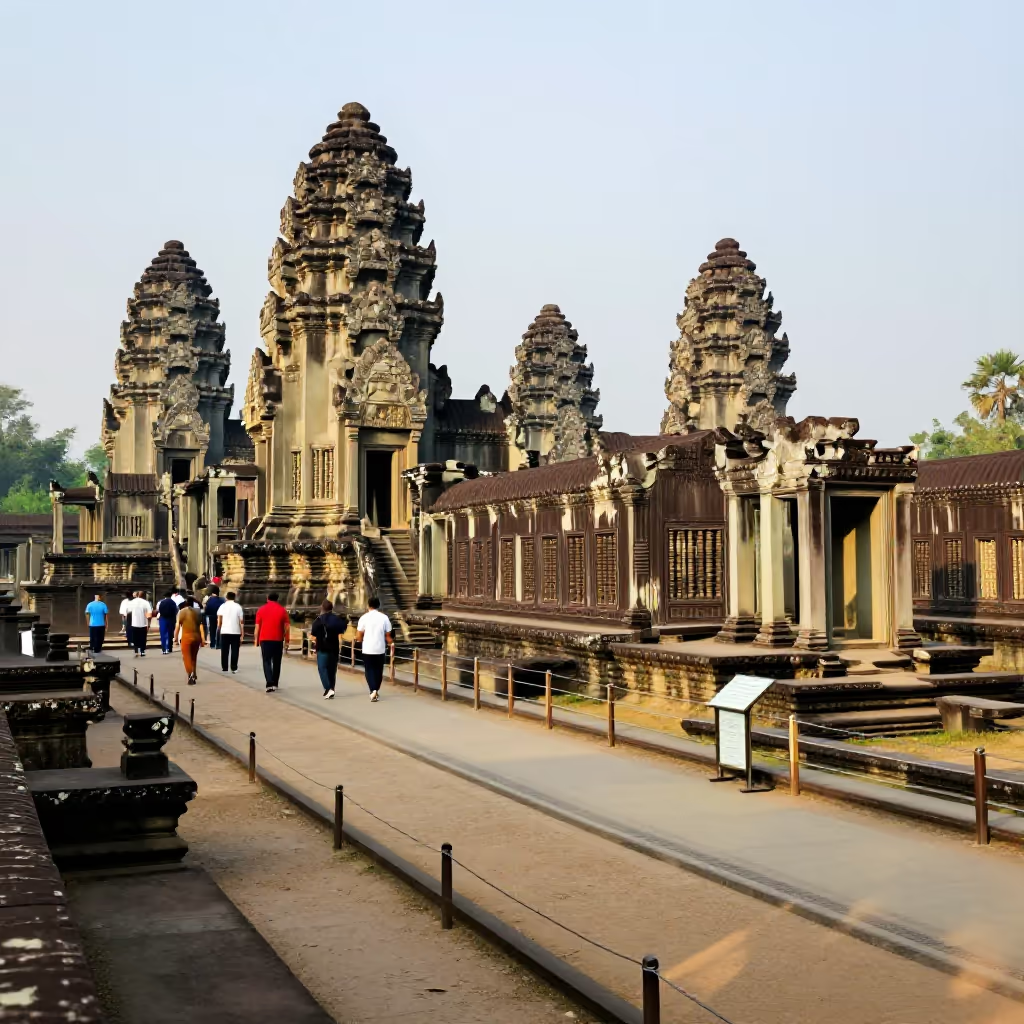
A place, site, or monument of outstanding universal value for all humanity that is officially recognized and protected by UNESCO. It can refer to buildings, cities, or even natural landscapes.
example
Der Kölner Dom wurde 1996 zum UNESCO-Weltkulturerbe erklärt.
Cologne Cathedral was declared a UNESCO World Heritage Site in 1996.
Usage tips
Compound structure
The word is made up of three parts: 'Welt' (world), 'Kultur' (culture), and 'Erbe' (heritage). So it literally describes a heritage of cultural value for the whole world.
EXAMPLE
Das Wattenmeer ist ein einzigartiges Weltnaturerbe, nicht nur ein Weltkulturerbe.
The Wadden Sea is a unique World Natural Heritage Site, not just a World Heritage Site.
Typical verbs
Certain verbs are often used in connection with 'Weltkulturerbe' (World Heritage Site): A site is 'zum Weltkulturerbe erklärt' (declared a World Heritage Site) or 'als Weltkulturerbe anerkannt' (recognized as a World Heritage Site). Something can also 'zum Weltkulturerbe gehören' (belong to the World Heritage) or 'auf der Liste des Weltkulturerbes stehen' (be on the World Heritage list).
EXAMPLE
Viele Länder hoffen, dass ihre Denkmäler als Weltkulturerbe anerkannt werden.
Many countries hope that their monuments will be recognized as World Heritage Sites.
Fixed combination
Since UNESCO decides on recognition, the word is very often used as 'UNESCO-Weltkulturerbe' (UNESCO World Heritage Site). This combination is very common in texts and news reports.
EXAMPLE
Die Speicherstadt in Hamburg ist das jüngste UNESCO-Weltkulturerbe in Deutschland.
The Speicherstadt in Hamburg is the newest UNESCO World Heritage Site in Germany.
Compare with
near_synonym · confusable
Weltkulturerbe vs Welterbe
world heritage
'Weltkulturerbe' and 'Welterbe' are both connected to UNESCO sites that are especially worthy of protection. 'Welterbe' is the broader term: it includes culturally important places, but also natural sites. 'Weltkulturerbe' is more specific when the topic is culture, for example old cities, buildings, or monuments. Learners may confuse the words because many well-known places relate to both in the broader sense. If you do not know whether culture or nature is meant, 'Welterbe' often fits better. If it is clearly a cultural place, 'Weltkulturerbe' is more precise.
Weltkulturerbe
Die Altstadt von Bamberg gehört zum Weltkulturerbe.
The old town of Bamberg is part of the World Cultural Heritage.
Welterbe
Auf der Reise besuchen wir mehrere Orte, die zum Welterbe der UNESCO gehören.
On the trip, we visit several places that are part of UNESCO world heritage.