

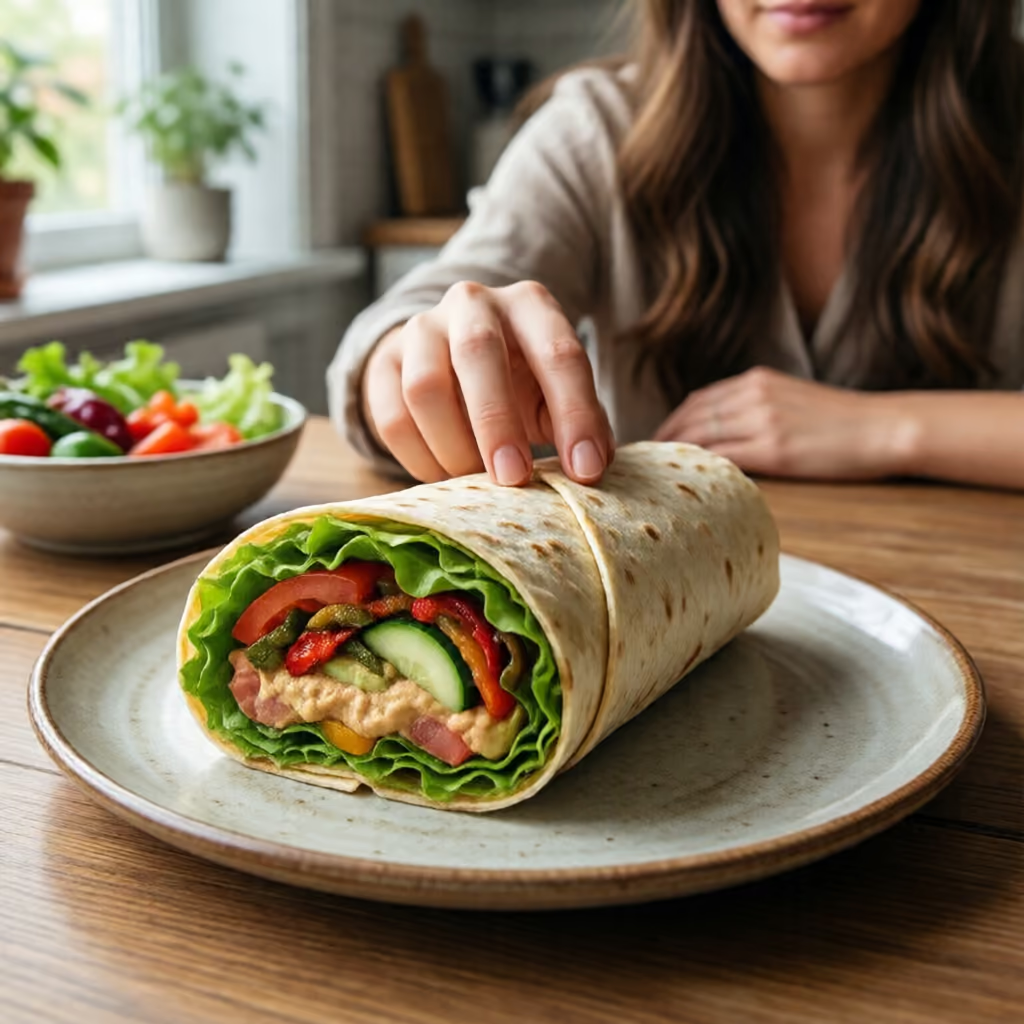
der Wrap
wrap
A thin flatbread filled with ingredients and rolled up.
EXAMPLE
Zum Mittagessen habe ich einen Wrap mit Gemüse und Hummus gegessen.
For lunch, I ate a wrap with vegetables and hummus.
wrap
der Wrap, die Wraps
Loading your saved state.
wrap
A thin flatbread filled with ingredients and rolled up.
Zum Mittagessen habe ich einen Wrap mit Gemüse und Hummus gegessen.
For lunch, I ate a wrap with vegetables and hummus.
| gender | masculine der |
|---|---|
| plural | die Wraps |
| genitive | des Wraps |
| singular | plural | |
|---|---|---|
| nominative | der Wrap | die Wraps |
| accusative | den Wrap | die Wraps |
| dative | dem Wrap | den Wraps |
| genitive | des Wraps | der Wraps |
The article changes with the case; it is shown in colour.
The verbs 'essen' (to eat), 'bestellen' (to order), 'zubereiten' (to prepare), and 'füllen' (to fill) are often used with 'Wrap'. The phrase 'einen Wrap mit …' is also particularly common when naming the filling.
Für die Zugfahrt habe ich zwei Wraps mit Salat und Käse zubereitet.
I prepared two wraps with lettuce and cheese for the train journey.
With 'Wrap', the filling is often introduced with 'mit' (with), followed by a noun phrase in the dative. This lets you name the ingredients directly in the sentence.
Ich bestelle einen Wrap mit gebratenem Gemüse und Avocado.
I'm ordering a wrap with fried vegetables and avocado.
'Wrap' often comes at the end of compound nouns that describe the filling or occasion in more detail. Typical examples include 'Gemüse-Wrap' (vegetable wrap), 'Hähnchen-Wrap' (chicken wrap), and 'Frühstücks-Wrap' (breakfast wrap).
Auf der Speisekarte gibt es heute einen Gemüse-Wrap und einen Frühstücks-Wrap.
Today's menu includes a vegetable wrap and a breakfast wrap.