

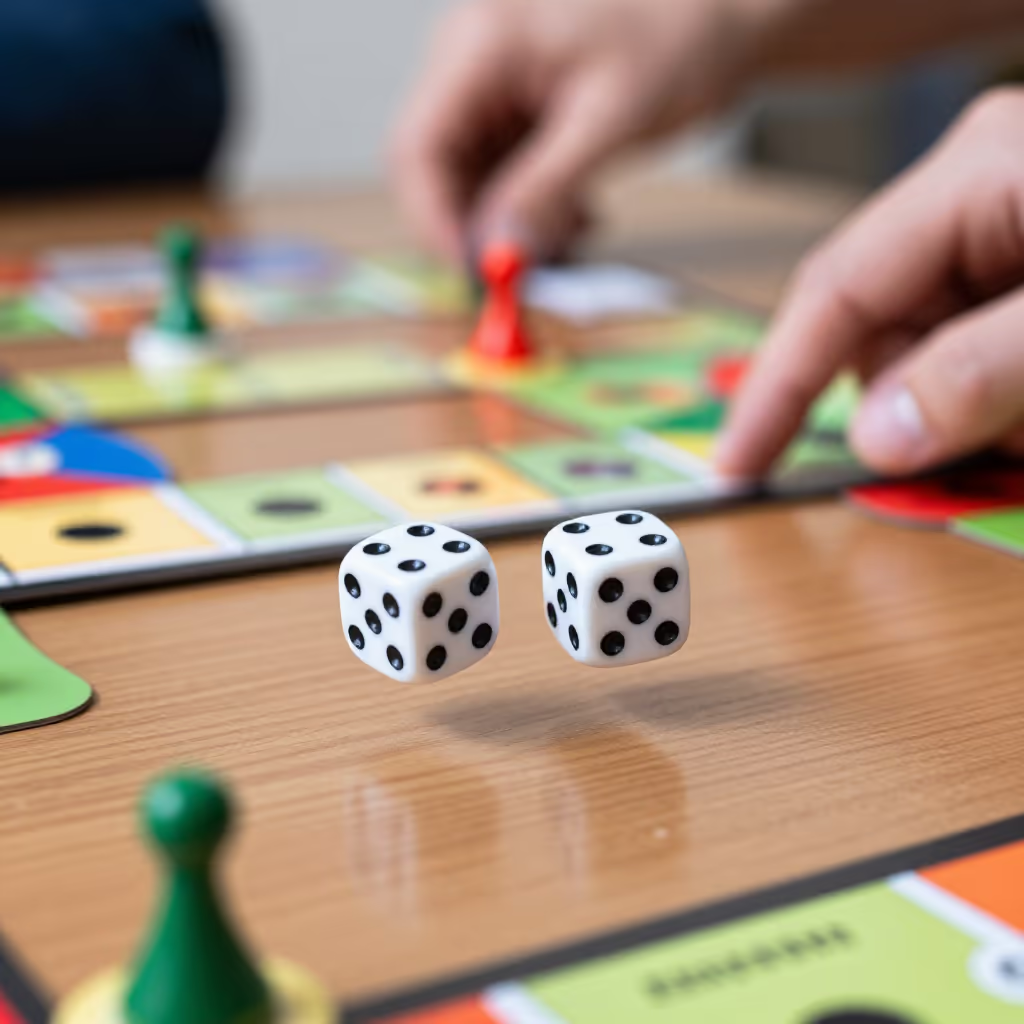
der Würfel
die
A small, usually six-sided object with numbers or symbols, used in games to produce a random result.
EXAMPLE
Du bist dran, wirf bitte den Würfel!
It's your turn; please roll the die!
die / cube
Loading your saved state.
die
A small, usually six-sided object with numbers or symbols, used in games to produce a random result.
Du bist dran, wirf bitte den Würfel!
It's your turn; please roll the die!

cube
A geometric solid bounded by six squares of equal size.
Im Mathematikunterricht haben wir das Volumen eines Würfels berechnet.
In math class, we calculated the volume of a cube.

cube
A small piece of something cut into the shape of a cube, often food.
Für den Salat schneide ich den Käse in kleine Würfel.
For the salad, I cut the cheese into small cubes.
The word 'Würfel' (die/cube) is related to the verb 'werfen' (to throw), because a game die is an object that you throw. The verb 'würfeln' (to roll dice/play with dice) is derived directly from the noun.
Wer ist dran mit Würfeln?
Whose turn is it to roll the dice?
The context makes the meaning clear: in connection with games, it refers to the game die. In mathematics, it refers to the geometric shape. In cooking, it means small, cut pieces.
Für das Brettspiel brauchen wir zwei Würfel.
We need two dice for the board game.
The idiom 'Die Würfel sind gefallen' (the die is cast) means that a final decision has been made and can no longer be undone. It is often used in important or dramatic situations.
Nachdem er den Vertrag unterschrieben hatte, wusste er: Die Würfel sind gefallen.
After he had signed the contract, he knew: the die was cast.
In the kitchen, the phrase 'in Würfel schneiden' (to cut into cubes/dice) is often used. In addition, 'Würfel' (cube) is often part of compounds here, such as 'Zuckerwürfel' (sugar cube), 'Speckwürfel' (bacon cubes), or 'Brühwürfel' (bouillon cube).
Für das Gulasch muss man das Fleisch in gleichmäßige Würfel schneiden.
For the goulash, you have to cut the meat into even cubes.
cube
Both words can refer to a cube-shaped object or solid. Würfel is the usual German term, whereas Cube is used particularly in modern, technical, or design-related contexts. In everyday situations, Würfel is therefore usually the better choice; in a design context, Cube may sound more appropriate.

Der geometrische Würfel hat sechs gleich große quadratische Flächen.
The geometric cube has six equally sized square faces.
Für den modernen Messestand entwarf die Designerin einen leuchtenden Cube.
For the modern trade fair stand, the designer created a glowing cube.