

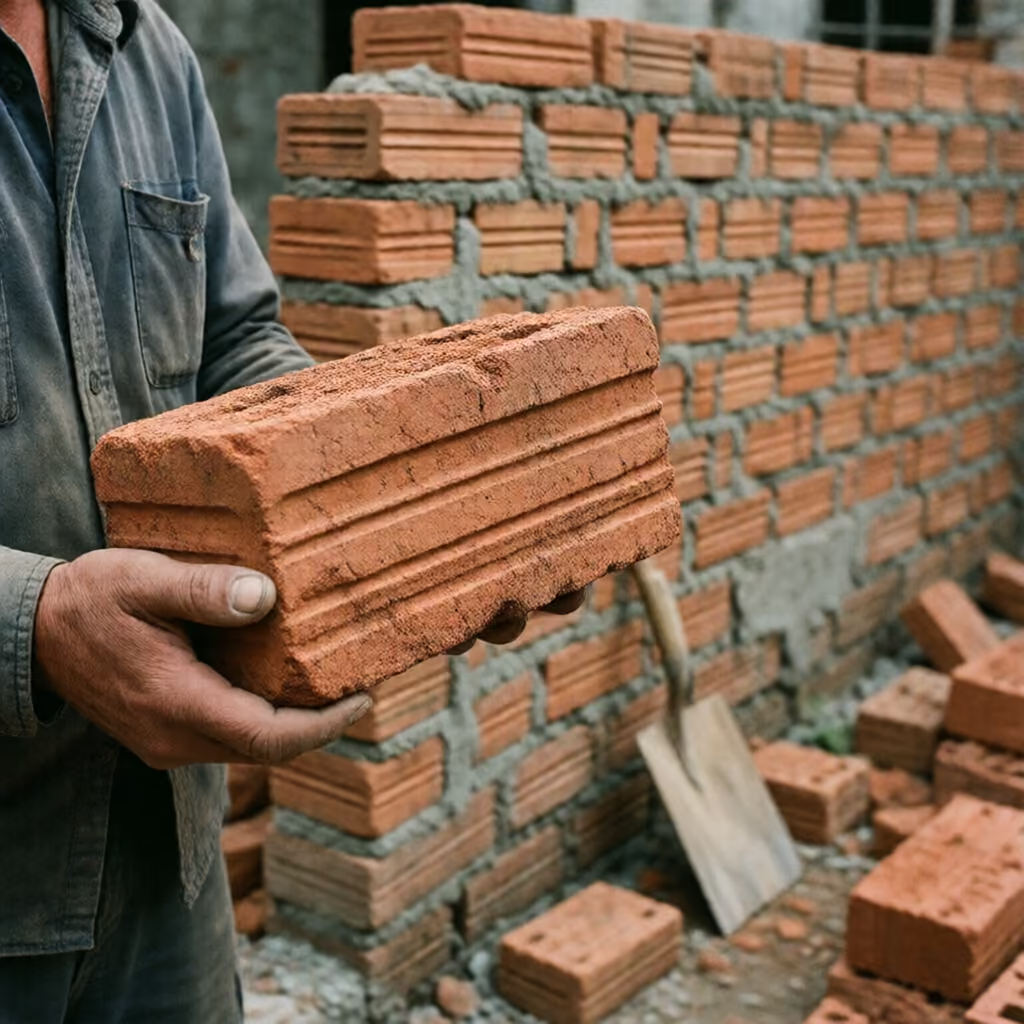
der Ziegelstein
brick
A usually rectangular, fired building block made of clay, used to construct walls and buildings.
EXAMPLE
Die alte Mauer wurde aus roten Ziegelsteinen gebaut.
The old wall was built from red bricks.
brick
der Ziegelstein, die Ziegelsteine
Loading your saved state.
brick
A usually rectangular, fired building block made of clay, used to construct walls and buildings.
Die alte Mauer wurde aus roten Ziegelsteinen gebaut.
The old wall was built from red bricks.
| gender | masculine der |
|---|---|
| plural | die Ziegelsteine |
| genitive | des Ziegelsteins |
| singular | plural | |
|---|---|---|
| nominative | der Ziegelstein | die Ziegelsteine |
| accusative | den Ziegelstein | die Ziegelsteine |
| dative | dem Ziegelstein | den Ziegelsteinen |
| genitive | des Ziegelsteins des Ziegelsteines | der Ziegelsteine |
The article changes with the case; it is shown in colour.
'Ziegelstein' (brick) is made up of 'Ziegel' (brick / tile) and 'Stein' (stone). The first part refers to the material, while the second refers to its solid form as a building block.
Die Arbeiter stapelten die Ziegelsteine neben der Baustelle.
The workers stacked the bricks next to the construction site.
The phrase 'aus Ziegelsteinen' (made of bricks) is often used to indicate the material. After 'aus' (from / made of), the dative plural is used here.
Viele alte Fabrikgebäude im Ruhrgebiet bestehen aus Ziegelsteinen.
Many old factory buildings in the Ruhr area are made of bricks.
Common collocations include 'rote Ziegelsteine' (red bricks), 'Ziegelsteine verlegen' (to lay bricks), and 'eine Mauer aus Ziegelsteinen bauen' (to build a wall out of bricks). The word occurs especially often in connection with walls, houses, and construction sites.
Für die neue Gartenmauer wurden rote Ziegelsteine verwendet.
Red bricks were used for the new garden wall.