


der Zinken
tine
An elongated, usually pointed projection on a tool, especially on a fork or rake.
EXAMPLE
Ein Zinken der Gabel ist verbogen.
One of the fork's tines is bent.
tine / nose / cornett
der Zinken, die Zinken
Loading your saved state.
tine
An elongated, usually pointed projection on a tool, especially on a fork or rake.
Ein Zinken der Gabel ist verbogen.
One of the fork's tines is bent.

nose
Colloquial and often mocking: a large or conspicuous nose.
Auf der Karikatur hat der Politiker einen riesigen Zinken mitten im Gesicht.
In the caricature, the politician has a huge nose right in the middle of his face.

cornett
A historical wind instrument with finger holes and a mouthpiece that is blown similarly to a trumpet. It is usually made of wood and often has a curved shape.
Bei dem Konzert mit Musik der Renaissance spielte sie einen Zinken.
At the concert of Renaissance music, she played a cornett.
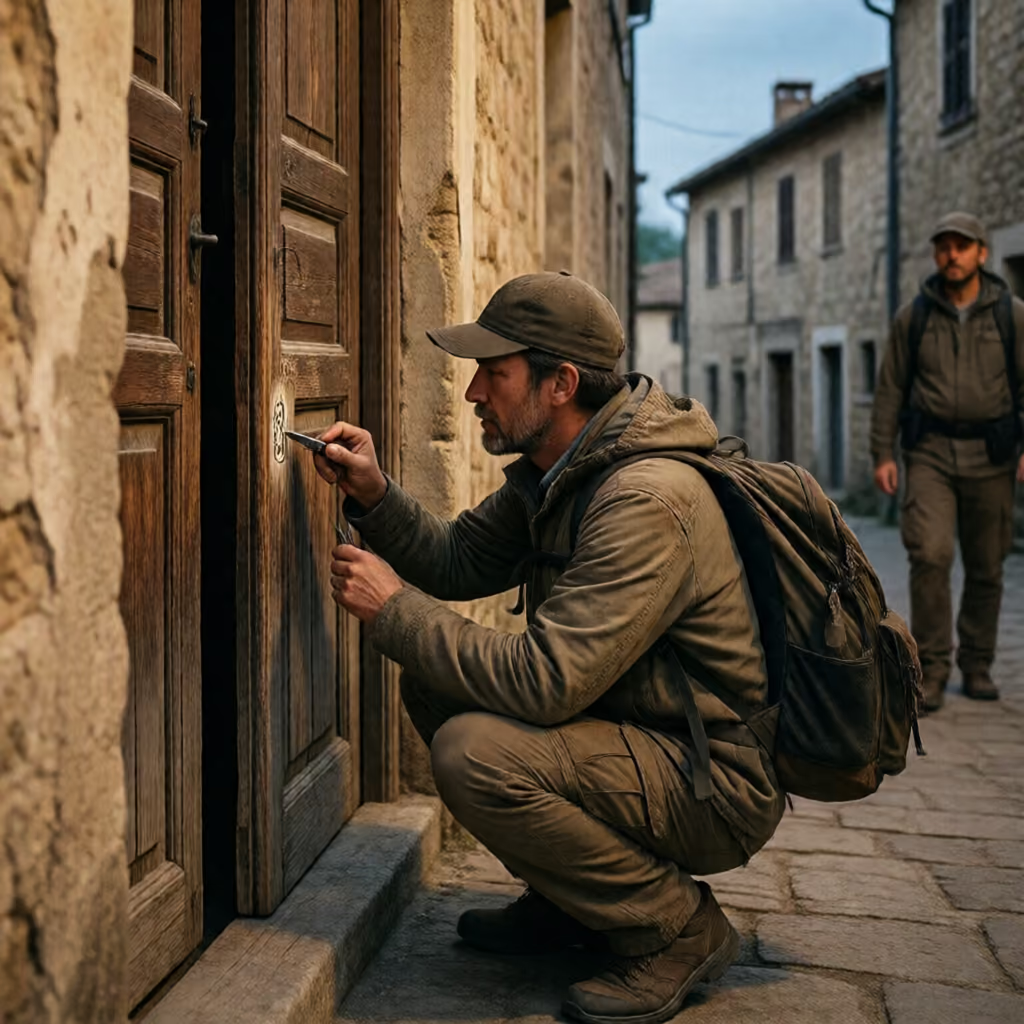
secret sign
A secret mark used particularly by traveling people, beggars, or criminals to communicate with one another. Such marks were sometimes placed on houses to leave information for others.
Der Bettler ritzte einen Zinken in den Türpfosten, um andere auf die hilfsbereiten Bewohner hinzuweisen.
The beggar carved a secret sign into the doorpost to alert others that the residents were helpful.
| gender | masculine der |
|---|---|
| plural | die Zinken |
| genitive | des Zinkens |
| singular | plural | |
|---|---|---|
| nominative | der Zinken | die Zinken |
| accusative | den Zinken | die Zinken |
| dative | dem Zinken | den Zinken |
| genitive | des Zinkens | der Zinken |
The article changes with the case; it is shown in colour.
The meaning of “Zinken” can usually be recognized from the surrounding words: with forks and rakes, it refers to a part of a tool; when referring to a conspicuous nose, it is colloquial; in texts about Renaissance music, it is an instrument; and on house walls, it is a historical secret sign.
Ein Zinken am Rechen ist abgebrochen.
A tine on the rake has broken off.
Die Musikerin spielte auf einem Zinken.
The musician played a cornett.
An der alten Tür war ein Zinken eingeritzt.
A secret sign had been carved into the old door.
In this meaning, “Zinken” often appears with tools such as “Gabel” (fork) or “Rechen” (rake). Typical combinations are “ein Zinken der Gabel” (one of the fork's tines), “Rechenzinken” (rake tine), as well as “einen Zinken verbiegen” (to bend a tine) or “einen Zinken abbrechen” (to break off a tine).
Beim Graben ist ein Zinken des Rechens abgebrochen.
One of the rake's tines broke off while digging.
The meaning referring to a nose belongs to colloquial language and often sounds mocking or humorous. The word is especially often used with intensifiers such as “groß” (large), “auffällig” (conspicuous), or “riesig” (huge).
Mit seinem auffälligen Zinken war er auf dem alten Foto sofort zu erkennen.
With his conspicuous nose, he was immediately recognizable in the old photograph.
As the name of the historical instrument, “Zinken” mainly appears in texts about Renaissance and Baroque music and about historical performance practice. A typical combination is “auf einem Zinken spielen” (to play a cornett).
Im Museum erklärte der Musiker, wie man auf einem Zinken spielt.
At the museum, the musician explained how to play a cornett.
The meaning of a secret sign is now mainly found in historical accounts or stories. Typical combinations are “einen Zinken ritzen” (to carve a secret sign), “einen Zinken anbringen” (to place a secret sign), and “einen Zinken an einer Tür hinterlassen” (to leave a secret sign on a door).
Der Historiker entdeckte einen Zinken am Türpfosten des alten Hauses.
The historian discovered a secret sign on the doorpost of the old house.