

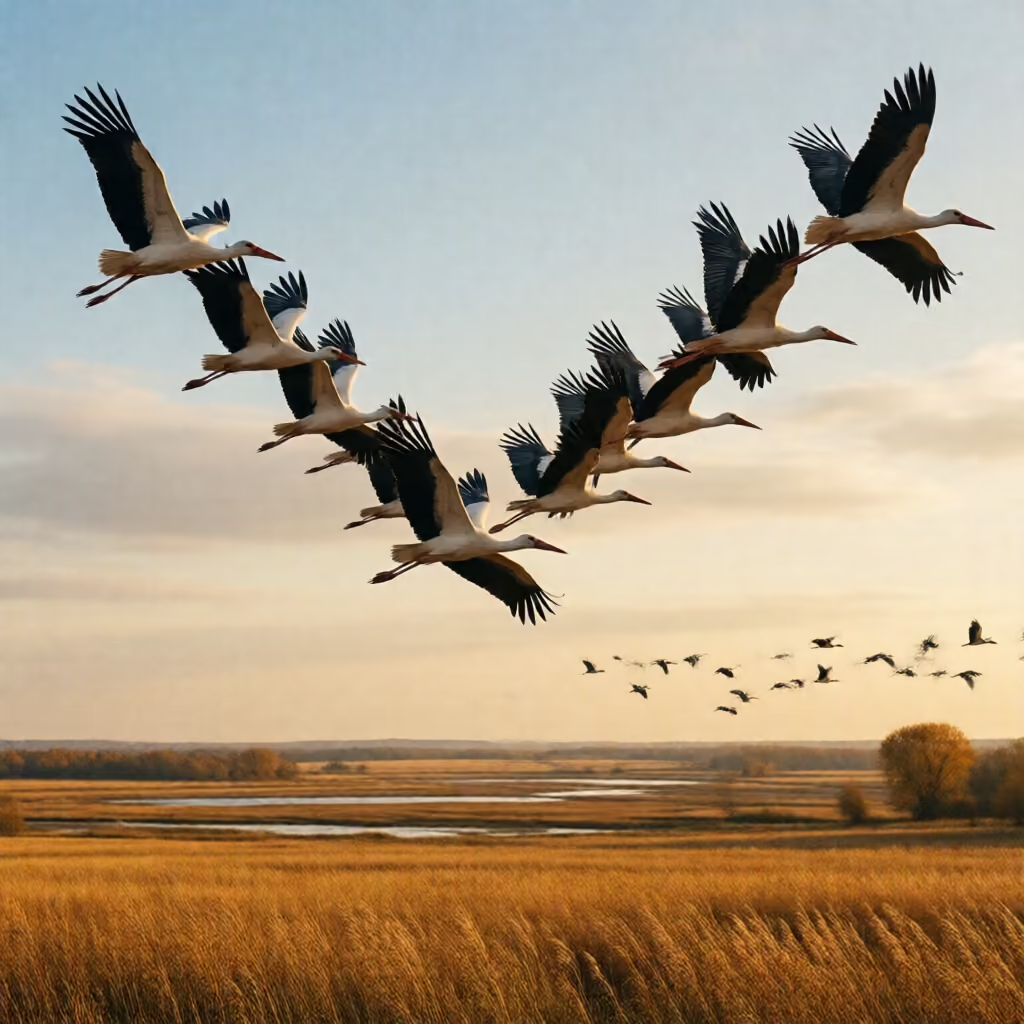
der Zugvogel
migratory bird
A bird that regularly migrates between different areas, usually between a breeding ground and a wintering ground.
Der Zugvogel fliegt im Herbst in wärmere Regionen.
The migratory bird flies to warmer regions in autumn.

migratory bird / nomad
der Zugvogel, die Zugvögel
Loading your saved state.

migratory bird
A bird that regularly migrates between different areas, usually between a breeding ground and a wintering ground.
Der Zugvogel fliegt im Herbst in wärmere Regionen.
The migratory bird flies to warmer regions in autumn.

nomad
A person who frequently changes their place of residence or whereabouts.
Als Zugvogel zieht er jedes Jahr in eine andere Stadt.
As a nomad, he moves to a different city every year.
| gender | masculine der |
|---|---|
| plural | die Zugvögel |
| genitive | des Zugvogels |
| singular | plural | |
|---|---|---|
| nominative | der Zugvogel | die Zugvögel |
| accusative | den Zugvogel | die Zugvögel |
| dative | dem Zugvogel | den Zugvögeln |
| genitive | des Zugvogels | der Zugvögel |
The article changes with the case; it is shown in colour.
'Zugvogel' (migratory bird) is made up of 'Zug' (migration) and 'Vogel' (bird). Here, 'Zug' refers to the regular migration of birds between different areas.
Viele Zugvögel verlassen im September ihre Brutgebiete.
Many migratory birds leave their breeding grounds in September.
With 'Zugvogel' (migratory bird / nomad), the context shows whether a bird or a person is meant: words from nature point to the bird meaning, while changes of location and lifestyle point to the figurative meaning referring to a person.
Die Zugvögel sammeln sich vor ihrer Reise nach Süden.
The migratory birds gather before their journey south.
Wegen seiner Arbeit lebt er wie ein Zugvogel und bleibt nie lange an einem Ort.
Because of his work, he lives like a nomad and never stays in one place for long.
In its meaning referring to birds, 'Zugvogel' (migratory bird) often occurs with verbs such as 'ziehen' (to migrate), 'zurückkehren' (to return), and 'beobachten' (to observe). The phrases 'die Rückkehr der Zugvögel' (the return of the migratory birds) and 'der Flug der Zugvögel' (the flight of the migratory birds) are also common.
Im Frühling kehren viele Zugvögel in ihre Brutgebiete zurück.
In spring, many migratory birds return to their breeding grounds.
When referring to a person, 'Zugvogel' (nomad) is usually used figuratively and describes a lifestyle involving frequent changes of location. The expression can sound neutral or slightly approving when the person is portrayed as independent and fond of traveling.
Meine Tante ist ein echter Zugvogel und hat schon in sieben Ländern gewohnt.
My aunt is a real nomad and has already lived in seven countries.