


abgeben
to hand in
To hand something over to someone or leave it at a particular place; to submit.
EXAMPLE
Die Studierenden müssen ihre Hausarbeiten bis Freitag abgeben.
The students have to hand in their term papers by Friday.
to hand in / give off
Loading your saved state.
to hand in
To hand something over to someone or leave it at a particular place; to submit.
Die Studierenden müssen ihre Hausarbeiten bis Freitag abgeben.
The students have to hand in their term papers by Friday.

to give off
To emit or release something, for example heat, light, a smell, or a sound.
Der Motor gibt bei hoher Drehzahl eine seltsame Wärme ab.
At high RPM, the engine gives off a strange heat.

to cast a vote
To make one's decision known in an election or vote; to vote.
Jeder wahlberechtigte Bürger kann seine Stimme abgeben.
Every eligible citizen can cast their vote.

to share
To give part of something to others; to share something.
Würdest du mir von deinem Kuchen etwas abgeben?
Would you share some of your cake with me?

to sell / give away
To sell or give something away, often at a low price or for free.
Ich möchte mein altes Fahrrad günstig abgeben.
I want to sell my old bicycle cheaply.
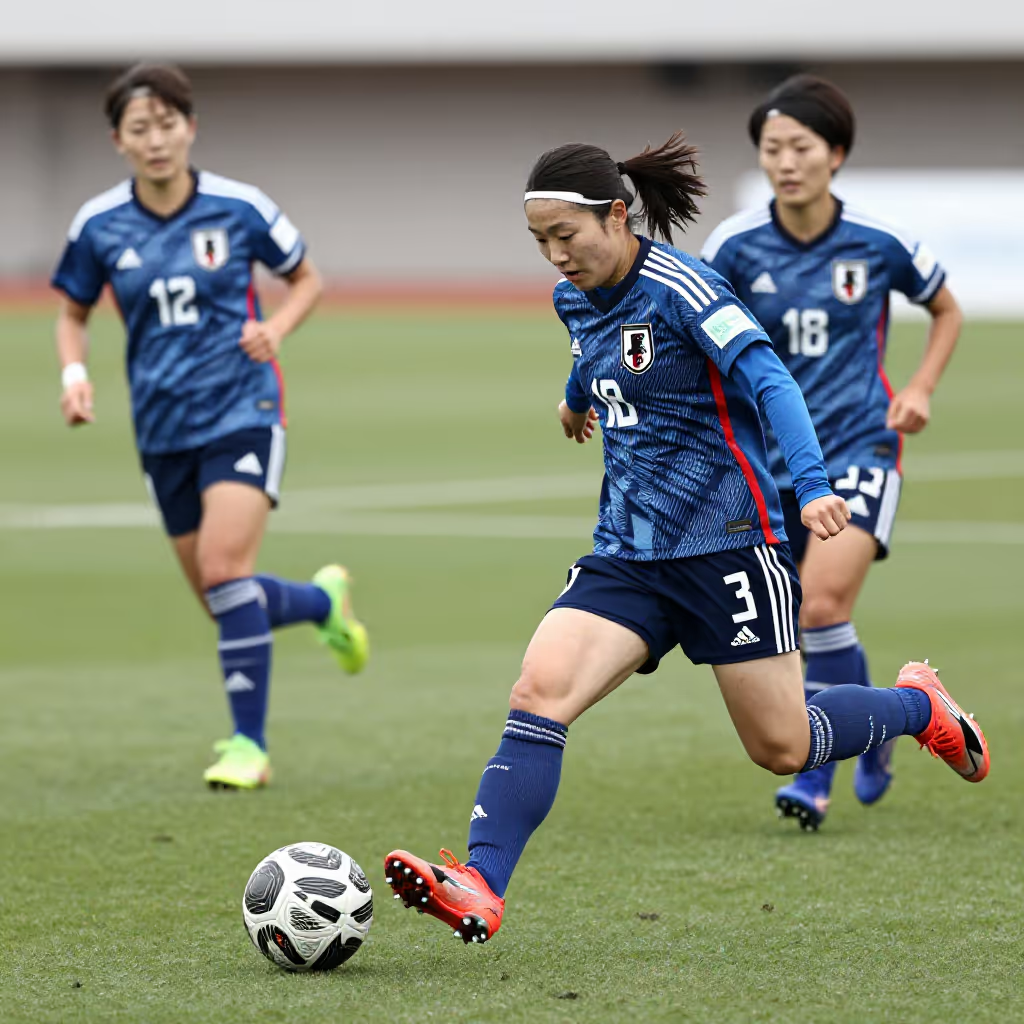
to pass
In sports, to pass the ball to a teammate.
Er hätte den Ball früher abgeben müssen, anstatt selbst zu schießen.
He should have passed the ball earlier instead of shooting himself.
'Abgeben' (to hand in/give off) is a separable verb. The prefix 'ab-' goes at the end in a main clause. In subordinate clauses and in the infinitive with 'zu', the verb stays together.
Ich gebe das Formular morgen beim Amt ab.
I will hand in the form at the office tomorrow.
The verb consists of the prefix 'ab-' and the base verb 'geben' (to give). The prefix 'ab-' often has the meaning of 'away', 'down', or 'completed', which can be recognized in most meanings of 'abgeben' (to hand in/give off).
Kannst du mir bitte die Fernbedienung abgeben?
Can you please hand me the remote control?
In the context of submitting something, 'abgeben' (to hand in) is often used with official documents or assignments. Typical combinations are: 'eine Hausarbeit abgeben' (to hand in a term paper), 'einen Antrag abgeben' (to submit an application), 'Unterlagen abgeben' (to hand in documents), or 'eine Steuererklärung abgeben' (to file a tax return).
Bis wann müssen wir den Antrag für das Stipendium abgeben?
By when do we have to submit the application for the scholarship?
In the meaning 'to emit', the subject is often a technical device or a natural object. It is usually about physical or chemical processes.
Der alte Ofen gibt nicht mehr viel Wärme ab.
The old stove doesn't give off much heat anymore.
In a political context, 'seine Stimme abgeben' (to cast one's vote) is a fixed expression. It is almost always used in this form to describe the act of voting.
Bei der letzten Wahl haben über 70 Prozent der Bürger ihre Stimme abgegeben.
In the last election, over 70 percent of citizens cast their vote.
When you share part of something, the person who receives something is in the dative. The thing being shared often appears with the preposition 'von' (of/from).
Gibst du mir bitte etwas von deiner Schokolade ab?
Will you please share some of your chocolate with me?
When selling or giving something away, 'abgeben' (to sell/give away) is often combined with adverbs like 'günstig' (cheaply), 'billig' (cheaply), or 'kostenlos' (for free).
Er hat seine alten Möbel an Studierende abgegeben.
He gave his old furniture to students.
In a sports context, the ball (accusative object) is passed to a teammate (preposition 'an' + accusative).
Der Stürmer hätte den Ball an seinen Mitspieler abgeben sollen.
The striker should have passed the ball to his teammate.
to fit / suit / pass
In sports, passen and abgeben can refer to the same act of passing the ball on. Passen emphasizes the deliberate pass to a teammate. Abgeben focuses more on the fact that a player does not keep the ball but plays it on.

Unter starkem Druck gibt die Spielerin den Ball sofort an ihre Mitspielerin ab.
Under heavy pressure, the player immediately passes the ball to her teammate.
Die Spielerin passt den Ball gezielt zu ihrer freien Mitspielerin.
The player deliberately passes the ball to her teammate, who is unmarked.