


wenden
to turn over
To turn something onto the other side.
EXAMPLE
Du musst den Pfannkuchen jetzt wenden, sonst brennt er an.
You need to turn the pancake over now, or it will burn.
to turn / contact
Loading your saved state.
to turn over
To turn something onto the other side.
Du musst den Pfannkuchen jetzt wenden, sonst brennt er an.
You need to turn the pancake over now, or it will burn.
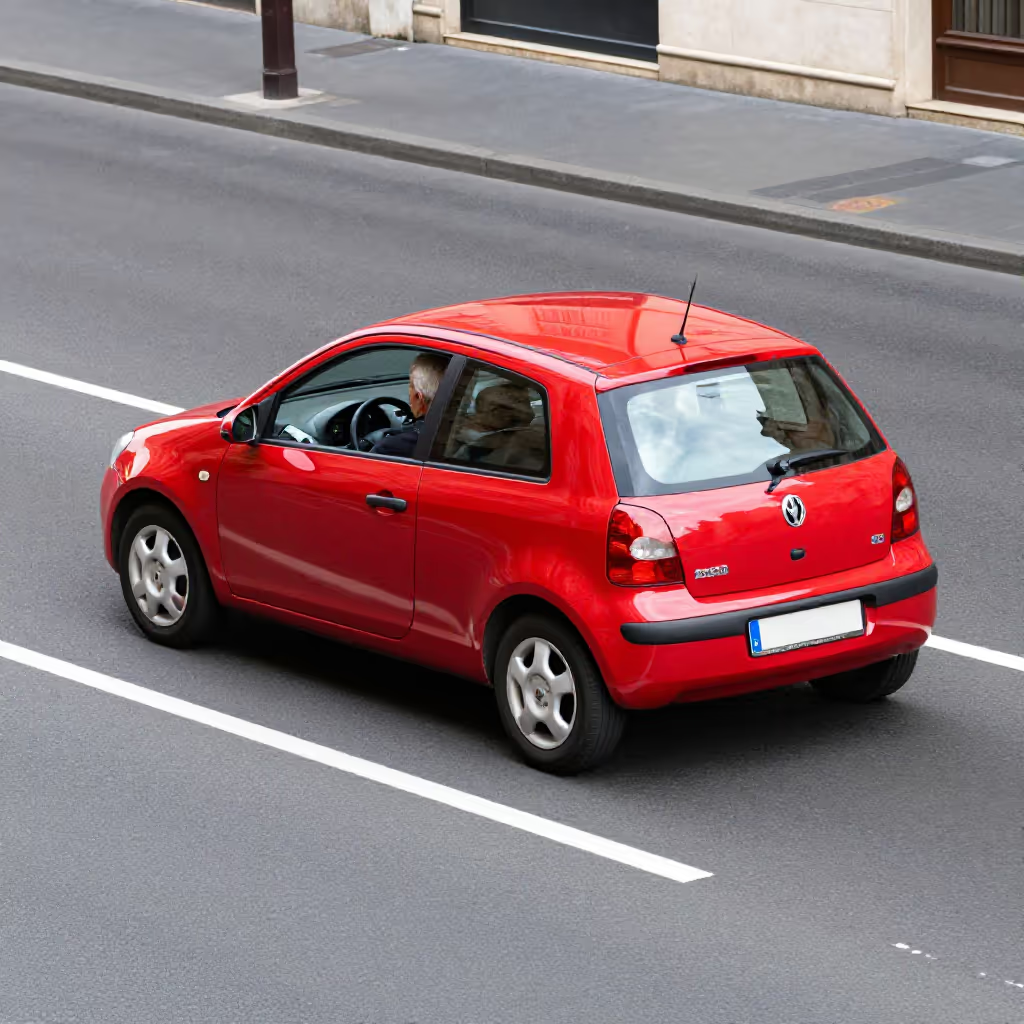
to turn around
To change direction and drive or go in the opposite direction; to turn back.
In dieser engen Straße kann man nur schwer wenden.
It's difficult to turn around in this narrow street.

to contact
To contact someone in order to get help, advice, or information.
Bei technischen Problemen wenden Sie sich bitte an den Support.
For technical problems, please contact support.

to turn
To change or develop in a certain direction. Often used in the expression 'zum Guten/Schlechten wenden' (to take a turn for the better/worse).
Nach einem langen Gespräch hat sich die Situation doch noch zum Guten gewendet.
After a long conversation, the situation did take a turn for the better after all.
'Wenden' (to turn/contact) has two past-tense forms. For concrete actions (turning something over), the regular form 'wendete' is usually used. For abstract or reflexive meanings ('sich an jemanden wenden' — to contact someone), the irregular form 'wandte' is common.
Der Koch wendete das Steak in der Pfanne.
The cook turned the steak over in the pan.
Without 'sich', 'wenden' (to turn) means that you turn an object around (e.g. a car). With 'sich', it means that the subject itself changes direction or contacts someone.
Der Fahrer muss hier wenden, die Straße ist gesperrt.
The driver has to turn around here; the road is closed.
When 'wenden' means 'to contact', it is always reflexive and is used with the fixed preposition 'an' and the accusative: 'sich an jemanden wenden' (to contact someone).
Wenden Sie sich mit Ihrer Beschwerde bitte schriftlich an die Geschäftsleitung.
Please address your complaint in writing to the management.
The idiom 'etwas wendet sich zum Guten/Schlechten' (something takes a turn for the better/worse) is very common. It describes a situation developing in a positive or negative direction.
Alle dachten, wir verlieren das Spiel, aber am Ende hat sich alles zum Guten gewendet.
Everyone thought we were going to lose the game, but in the end everything took a turn for the better.
In the kitchen, the verb is often used with 'den Pfannkuchen' (the pancake), 'das Omelett' (the omelet), or 'das Fleisch' (the meat). You can also turn a page in a book or turn over a sheet of paper.
Er wendete das Fleisch auf dem Grill, damit es nicht verbrennt.
He turned the meat over on the grill so that it wouldn't burn.
to arise
Both words can describe a change in a situation, but „entstehen“ refers to a situation newly emerging. „Sich wenden“, on the other hand, describes a change in the direction things have been taking, often for better or worse. Use „entstehen“ for the beginning and „sich wenden“ for the change in direction.

Nach dem Gespräch wendete sich die schwierige Lage zum Guten.
After the conversation, the difficult situation took a turn for the better.
Aus dem Streit entstand eine schwierige Lage.
The argument led to a difficult situation.