


abrechnen
to bill
To calculate the costs for a service or product and arrange for or receive payment.
EXAMPLE
Der Handwerker wird die erledigten Arbeiten nächste Woche abrechnen.
The tradesman will bill for the completed work next week.
to bill / settle accounts
Loading your saved state.
to bill
To calculate the costs for a service or product and arrange for or receive payment.
Der Handwerker wird die erledigten Arbeiten nächste Woche abrechnen.
The tradesman will bill for the completed work next week.

to settle scores with someone
To take revenge on someone for wrongs suffered; to settle an old score.
In seiner Autobiografie nutzte er die Gelegenheit, um mit seinen alten Rivalen abzurechnen.
In his autobiography, he used the opportunity to settle scores with his old rivals.

to deduct
To subtract an amount from a total sum, for example in payroll accounting.
Die Kosten für die Kantine werden direkt vom Lohn abgerechnet.
The cafeteria costs are deducted directly from wages.
'Abrechnen' (to bill / settle accounts) is a separable verb. In a main clause, the prefix 'ab' comes at the end. In subordinate clauses and in the infinitive with 'zu', the verb stays together.
Die Firma rechnet die Reisekosten am Monatsende ab.
The company settles the travel expenses at the end of the month.
The verb 'abrechnen' (to bill / settle accounts) is closely connected with the nouns 'die Abrechnung' (statement/settlement) and 'die Rechnung' (bill/invoice). When you 'abrechnen' something, you create a statement or settle a bill.
Nach dem Projekt müssen wir eine detaillierte Abrechnung erstellen.
After the project, we have to prepare a detailed statement of costs.
In the financial meaning, people often specify what is being billed, for example 'Kosten' (costs), 'Leistungen' (services), or 'Stunden' (hours), and with whom one settles the bill, for example 'mit dem Kunden' (with the customer) or 'mit der Versicherung' (with the insurance company).
Der Arzt rechnet die Behandlung direkt mit der Krankenkasse ab.
The doctor bills the treatment directly to the health insurance provider.
The expression 'mit jemandem abrechnen' (to settle scores with someone) has a figurative, negative meaning: to take revenge. The preposition 'mit' and a person in the dative are fixed parts of the expression here.
Er schwor, dass er eines Tages mit seinen Feinden abrechnen würde.
He swore that one day he would settle scores with his enemies.
When an amount is deducted from a sum, this is often expressed with the preposition 'von' (from). The sentence is often in the passive.
Die Vorauszahlung wird von der Endsumme abgerechnet.
The advance payment is deducted from the final total.
to calculate / charge
Both verbs can express that money is charged for a service. Berechnen refers mainly to setting the specific amount, while abrechnen refers to the entire process involving the invoice and payment. Use berechnen for the price and abrechnen for handling the payment.
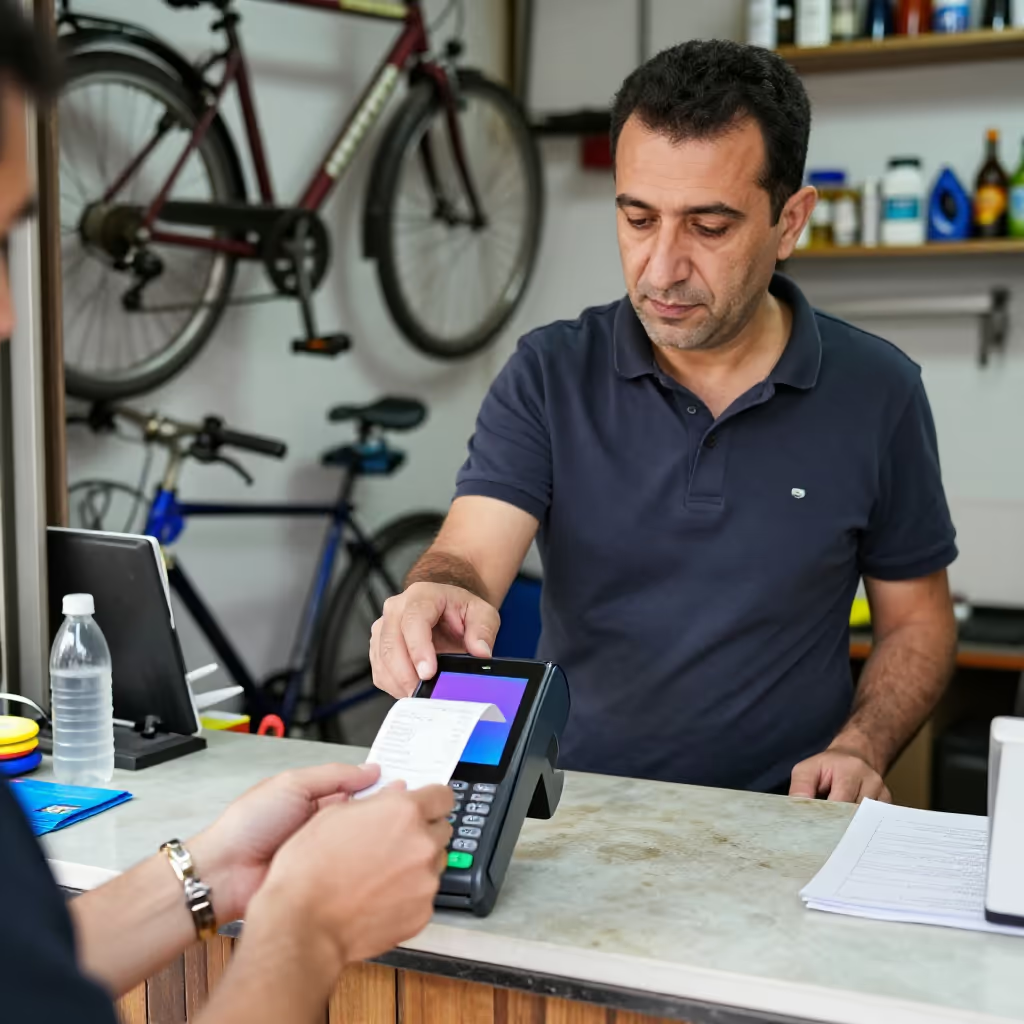
Die Werkstatt rechnet den Reifenwechsel direkt mit der Versicherung ab.
The garage bills the insurance company directly for changing the tires.
Die Werkstatt berechnet für den Reifenwechsel 80 Euro.
The garage charges 80 euros for changing the tires.