
To determine a number, quantity, or result through a mathematical operation; to work something out or calculate it.
example
Können Sie bitte berechnen, wie hoch die Gesamtkosten sein werden?
Could you please calculate how high the total costs will be?
Usage tips
Inseparable verb
The prefix 'be-' is inseparable. It stays firmly attached to the verb stem 'rechnen' (to calculate) in all conjugations and sentence types.
EXAMPLE
Er berechnete schnell, wie viel Trinkgeld er geben sollte.
He quickly calculated how much tip he should give.
Sentence structure with accusative
The base verb is 'rechnen' (to calculate). Through the prefix 'be-', the verb becomes transitive, so it always needs a direct accusative object. You always calculate *something*.
EXAMPLE
Ich muss noch die genaue Entfernung für unsere Wanderung berechnen.
I still need to calculate the exact distance for our hike.
Context clue
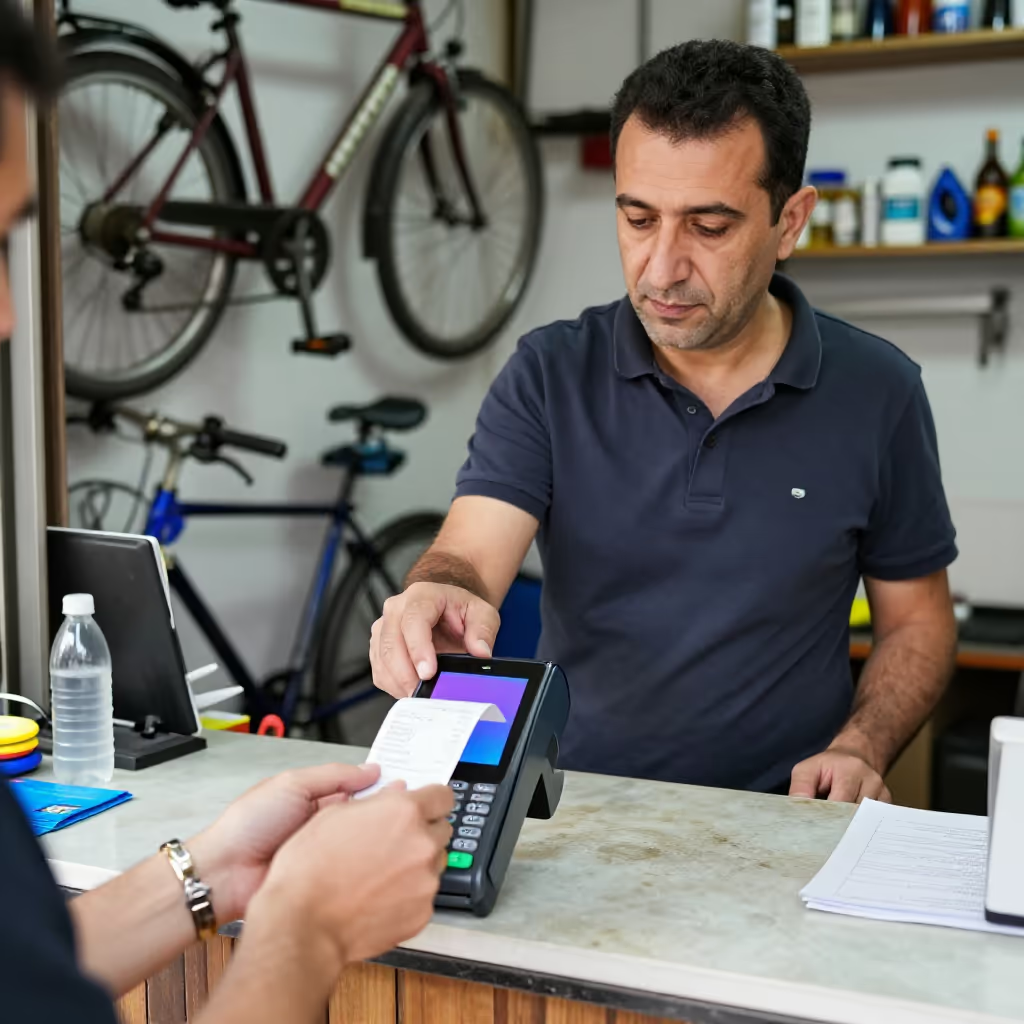
Whether 'berechnen' means 'to calculate' or 'to charge' can be recognized from the context. If it is about mathematics or planning, it means 'to calculate'. If it is about money, invoices, or services, it means 'to charge'.
EXAMPLE
Der Architekt berechnet die Statik des Hauses.
The architect calculates the structural stability of the house.
Dative construction
When 'berechnen' means 'to charge', it is often used with a dative object (the person who has to pay) and an accusative object (the amount or goods). The structure is: jemandem (dative) etwas (accusative) berechnen.
EXAMPLE
Der Handwerker hat mir 100 Euro für die Anfahrt berechnet.
The tradesman charged me 100 euros for the travel costs.
Negative meaning
When the verb describes a person's behavior, it has a negative meaning. It means that someone acts coolly and strategically in order to gain their own advantages.
EXAMPLE
Sie ist eine Person, die ihre Freundschaften nur nach dem Nutzen berechnet.
She is a person who calculates her friendships only according to their usefulness.
Compare with
near_synonym · confusable
berechnen vs rechnen
to calculate / to expect
'rechnen' and 'berechnen' can both have to do with mathematics and numbers. 'rechnen' is more general: you solve problems or work with numbers. 'berechnen' is more specific when you find a particular result through a calculation, for example a price, an area, or a time. Learners can easily confuse the words because both fit when dealing with numbers. In practical terms: you 'rechnen' in class or in your head; you 'berechnen' a concrete result.
berechnen
Die Firma berechnet die Kosten für die Reparatur.
The company calculates the costs for the repair.
rechnen
Tim rechnet im Kopf, weil er keinen Taschenrechner dabei hat.
Tim does the calculation in his head because he does not have a calculator with him.