


abschneiden
to cut off
To separate part of something using a sharp tool (e.g., a knife or scissors).
EXAMPLE
Kannst du mir bitte eine Scheibe von dem Brot abschneiden?
Could you please cut me a slice off that bread?
to cut off / to perform
Loading your saved state.
to cut off
To separate part of something using a sharp tool (e.g., a knife or scissors).
Kannst du mir bitte eine Scheibe von dem Brot abschneiden?
Could you please cut me a slice off that bread?

to perform
To achieve a certain result in an exam, competition, or evaluation.
Unsere Mannschaft hat bei dem Turnier sehr gut abgeschnitten.
Our team performed very well in the tournament.
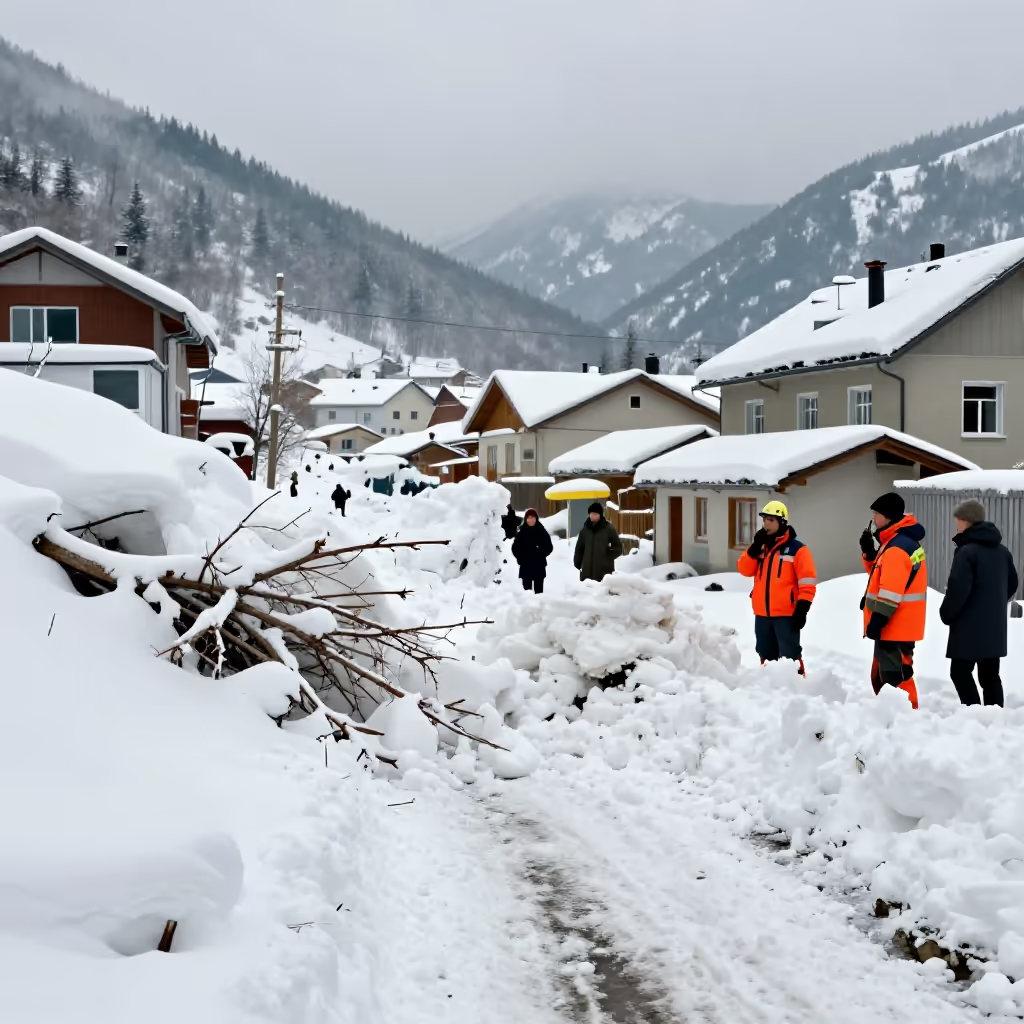
to cut off
To isolate someone or something from the surrounding area or from a supply.
Durch den Schneesturm war das Dorf von der Außenwelt abgeschnitten.
Because of the snowstorm, the village was cut off from the outside world.
'Abschneiden' (to cut off/to perform) is a separable verb. The prefix 'ab-' goes at the end in a main clause, stays connected to the verb in a subordinate clause, and in the infinitive with 'zu', 'zu' comes between the prefix and the verb.
Er schneidet sich ein großes Stück vom Kuchen ab.
He cuts himself a large piece off the cake.
The verb consists of the prefix 'ab-' (away/off) and the verb 'schneiden' (to cut). The literal meaning 'etwas wegschneiden' (to cut something away) also helps you understand the figurative meaning 'to isolate from something'.
Der Friseur hat mir die Haare zu kurz abgeschnitten.
The hairdresser cut my hair too short.
In the meaning of 'to achieve a result', 'abschneiden' is almost always combined with an adverb that evaluates performance. Typical phrases are 'gut', 'schlecht', 'hervorragend', or 'erfolgreich abschneiden' (to perform well, badly, excellently, or successfully).
Wie hast du im Test abgeschnitten?
How did you perform on the test?
When someone or something is isolated, this meaning is usually used in the passive with the auxiliary verb 'sein' (to be). The preposition 'von' names what the person or place is separated from.
Nach dem Erdrutsch waren mehrere Dörfer von der Außenwelt abgeschnitten.
After the landslide, several villages were cut off from the outside world.
When you cut something off for another person, that person is in the dative. The pattern is: jemandem (dative) etwas (accusative) abschneiden.
Schneidest du mir bitte auch ein Stück Wurst ab?
Could you please cut me a piece of sausage too?
to shorten / reduce
When talking about hair, both abschneiden and kürzen can be used. Abschneiden emphasizes that part of the hair is cut off with scissors and may suggest a more pronounced cut. Kürzen focuses only on the shorter length, regardless of how much is removed.

Die Friseurin schneidet den langen Zopf vollständig ab.
The hairdresser cuts off the long braid completely.
Die Friseurin kürzt die langen Haare nur um zwei Zentimeter.
The hairdresser shortens the long hair by only two centimeters.