

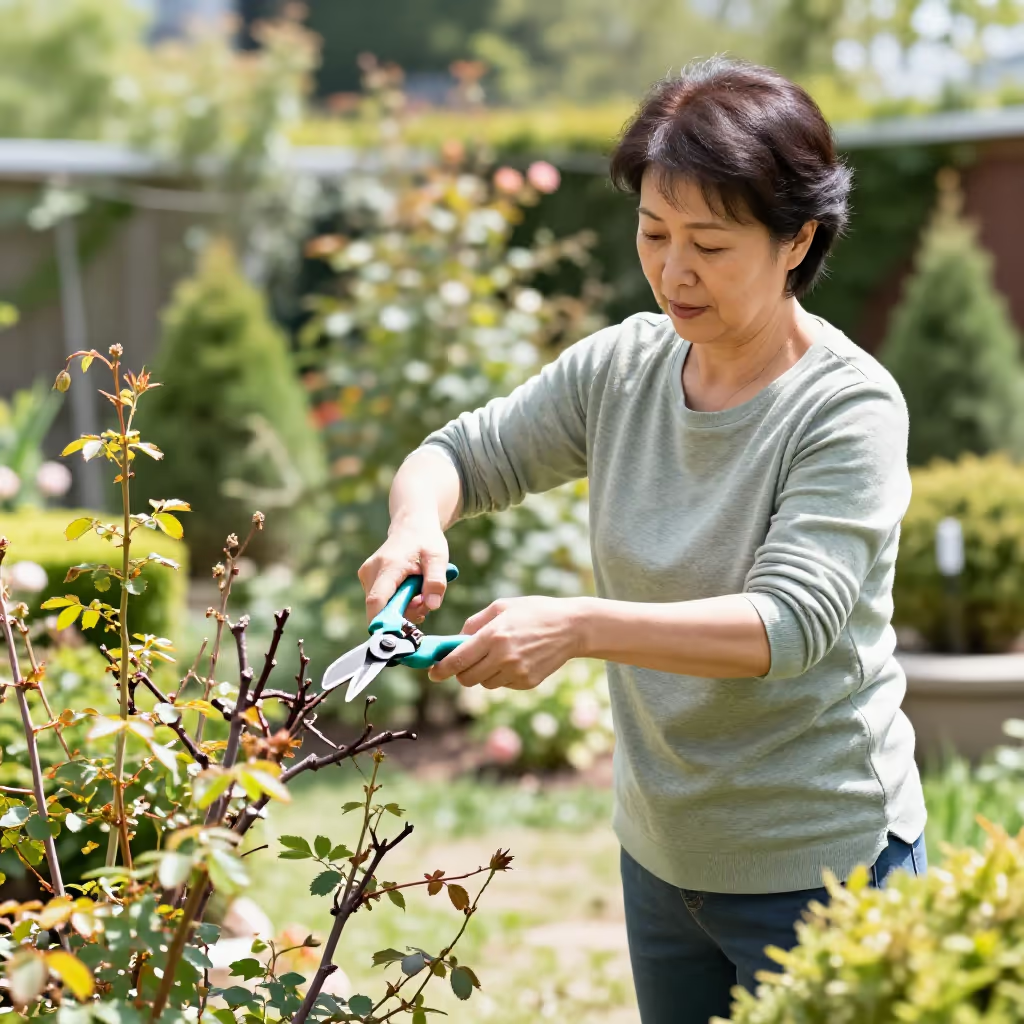
beschneiden
to prune
To cut back plants, trees, or shrubs in order to promote their growth, give them a shape, or remove dead parts.
EXAMPLE
Im Frühling müssen die Rosen stark beschnitten werden.
In spring, the roses have to be pruned heavily.
to prune / to restrict
Loading your saved state.
to prune
To cut back plants, trees, or shrubs in order to promote their growth, give them a shape, or remove dead parts.
Im Frühling müssen die Rosen stark beschnitten werden.
In spring, the roses have to be pruned heavily.

to restrict
To limit, cut, or reduce something, for example rights, freedoms, or resources.
Durch die neuen Gesetze wurden die Rechte der Bürger empfindlich beschnitten.
The new laws severely restricted citizens' rights.

to circumcise
To surgically remove the foreskin of the male organ for medical or religious reasons (circumcision).
In vielen Kulturen ist es üblich, Jungen kurz nach der Geburt zu beschneiden.
In many cultures, it is common to circumcise boys shortly after birth.

to trim
To cut off the edges of paper, photos, films, or printed materials in order to obtain a clean format.
Nach dem Druck werden die Plakate auf das richtige Format beschnitten.
After printing, the posters are trimmed to the correct format.
'Beschneiden' (to prune / to restrict) is an inseparable verb. The prefix 'be-' stays firmly attached to the stem verb 'schneiden' (to cut) in all tenses and sentence constructions.
Der Gärtner beschnitt die Bäume im Herbst.
The gardener pruned the trees in the fall.
You can recognize the meaning of 'beschneiden' (to prune / to restrict) from the object. If it involves plants ('Bäume' (trees), 'Hecken' (hedges)), it is about gardening. With abstract nouns ('Rechte' (rights), 'Budget' (budget)), it means 'reduzieren' (to reduce).
Wir müssen die Hecke im Garten beschneiden.
We have to prune the hedge in the garden.
In a gardening context, 'beschneiden' (to prune) is typically used with plants such as 'Bäume' (trees), 'Sträucher' (shrubs), 'Rosen' (roses), or 'Hecken' (hedges).
Wenn man Obstbäume regelmäßig beschneidet, tragen sie mehr Früchte.
If you prune fruit trees regularly, they bear more fruit.
In the figurative meaning 'einschränken' (to restrict), the verb is often combined with abstract nouns such as 'Rechte' (rights), 'Freiheiten' (freedoms), 'Mittel' (resources), or 'Budget' (budget).
Man warf der Regierung vor, die bürgerlichen Freiheiten zu beschneiden.
The government was accused of restricting civil liberties.
The figurative meaning, to reduce something, is used mainly in formal, official, or written contexts such as news reports or political debates.
In der Sitzung wurde beschlossen, die Ausgaben für das Projekt zu beschneiden.
At the meeting, it was decided to cut the spending for the project.
to cut
Schneiden generally refers to removing or working on something with a sharp tool. Beschneiden is more specific for plants: it means deliberately removing branches or other parts of a plant, for example to shape it or influence its growth. For this planned gardening task, beschneiden is the better choice.

Im Garten beschneidet Paul den Strauch, damit er seine Form behält.
In the garden, Paul prunes the shrub so that it keeps its shape.
Im Garten schneidet Paul einen beschädigten Zweig für die Vase ab.
In the garden, Paul cuts off a damaged branch to put in a vase.