
To have a vague idea or knowledge of something. It is very commonly used in negative sentences to express that one knew absolutely nothing about something.
example
Ich hatte keine Ahnung, dass die Prüfung schon morgen ist!
I had no idea that the exam is already tomorrow!
Usage tips
Word family
The verb 'ahnen' (to suspect / sense) is the basis for the noun 'die Ahnung' (idea, notion). If you 'ahnen' something, you have an Ahnung of it. The phrase 'keine Ahnung haben' (to have no idea) is extremely common in colloquial speech.
EXAMPLE
Ich habe keine Ahnung, wie spät es ist.
I have no idea what time it is.
Frequent negation
The verb 'ahnen' (to suspect) is very often used in negative sentences to express that you absolutely did not know or expect something. Typical formulations are 'nichts ahnen' (to suspect nothing) or 'nicht ahnen können' (to not be able to know / suspect).
EXAMPLE
Er ahnte nichts von der Überraschungsparty.
He suspected nothing about the surprise party.
Sentence structure
When 'ahnen' (to sense) describes a premonition, it is often followed either by a direct object in the accusative or by a subordinate clause with 'dass' (that).
EXAMPLE
Sie ahnte das Unglück schon, bevor es passierte.
She sensed the disaster even before it happened.
Negative connotation
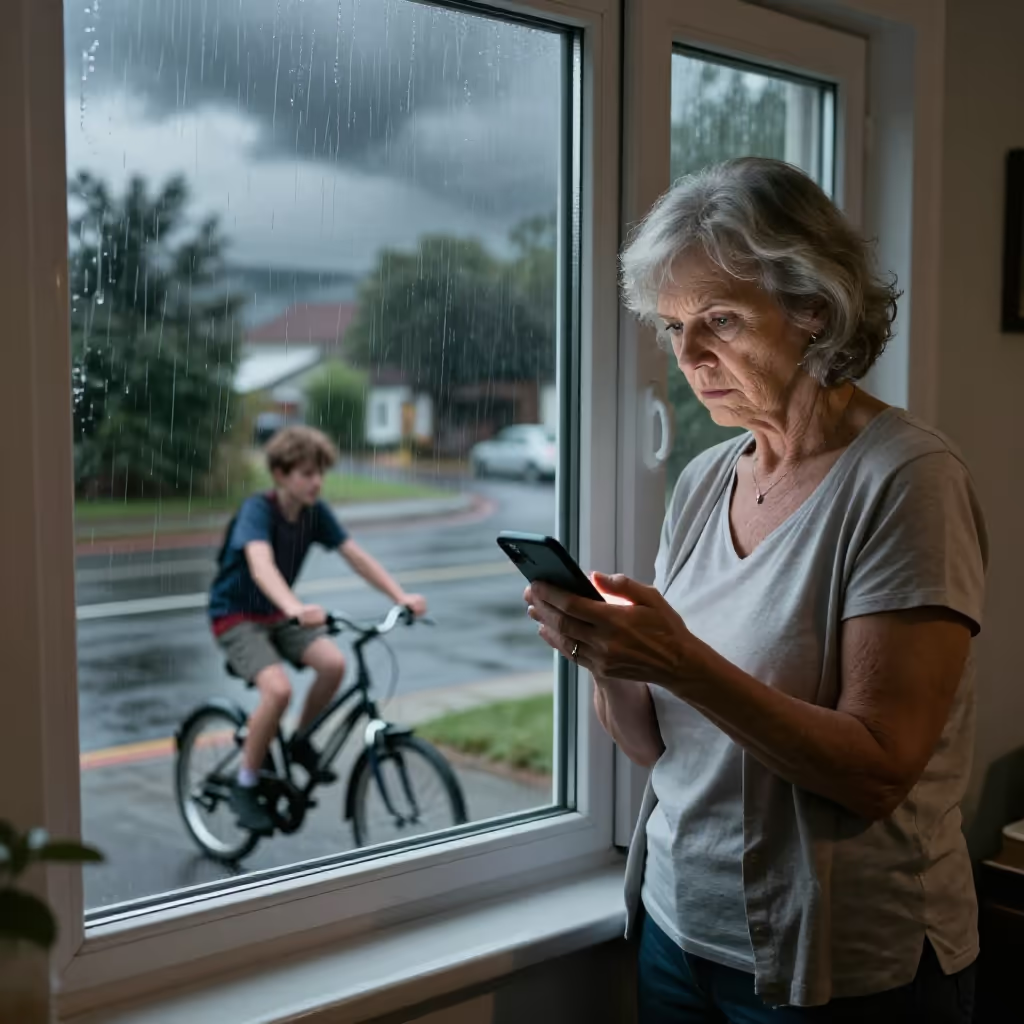
In the meaning of 'eine Vorahnung haben' (to have a premonition), 'ahnen' (to sense) is mostly used for negative or worrying events. You rarely sense something good; rather, you sense a problem or danger.
EXAMPLE
Er ahnte Böses, als er die Polizei vor seiner Tür sah.
He sensed something bad when he saw the police at his door.
Compare with
antonym · confusable
ahnen vs wissen
to know
'wissen' and 'ahnen' both have to do with information in your mind. The important difference is certainty. 'wissen' is used when you have information and are sure. 'ahnen' is used when you only have a feeling or a vague idea, but no certain information. Learners may confuse the words because both can express that you have something in your mind. In practice: if it is certain, 'wissen' fits. If it is only a feeling or a guess, 'ahnen' fits. In negative sentences, 'keine Ahnung haben' (to have no idea) or 'nichts ahnen' (to suspect nothing) often means that you were not informed at all.
ahnen
Ich ahne, dass das Gespräch heute schwierig wird.
I sense that the conversation today will be difficult.