
das Amt
office / agency
A public authority or office responsible for specific administrative tasks.
Für die Ummeldung deines Wohnsitzes musst du zum Bürgeramt gehen.
To re-register your place of residence, you have to go to the citizens' office.


office / agency
Loading your saved state.
office / agency
A public authority or office responsible for specific administrative tasks.
Für die Ummeldung deines Wohnsitzes musst du zum Bürgeramt gehen.
To re-register your place of residence, you have to go to the citizens' office.
In the meaning 'Behörde' (authority / agency), 'Amt' (office / agency) is a very common component of compound nouns. These often name the specific task of the authority, for example 'Finanzamt' (tax office), 'Gesundheitsamt' (public health office), or 'Bürgeramt' (citizens' office).
Für die Steuererklärung ist das Finanzamt zuständig.
The tax office is responsible for the tax return.
When talking about a government office, certain prepositions are used: you go 'zum Amt' (to the office; accusative, direction) and then you are 'auf dem Amt' (at the office; dative, location).
Ich muss morgen zum Amt, um meinen Pass zu beantragen.
I have to go to the office tomorrow to apply for my passport.
When 'Amt' (office / position) means a function or position, it is often combined with formal verbs. Typical phrases are 'ein Amt antreten' (to take office), 'ein Amt innehaben' (to hold office), or 'von einem Amt zurücktreten' (to resign from an office).
Der Politiker trat nach dem Skandal von seinem Amt zurück.
The politician resigned from his office after the scandal.
The meaning 'Amtszeit' (term of office) is often recognizable from time expressions. When people say 'während seines Amtes' (during his term of office) or 'nach ihrem Amt' (after her term of office), the time period is meant, not the position itself.
Nach seinem Amt als Kanzler schrieb er seine Memoiren.
After his term of office as chancellor, he wrote his memoirs.
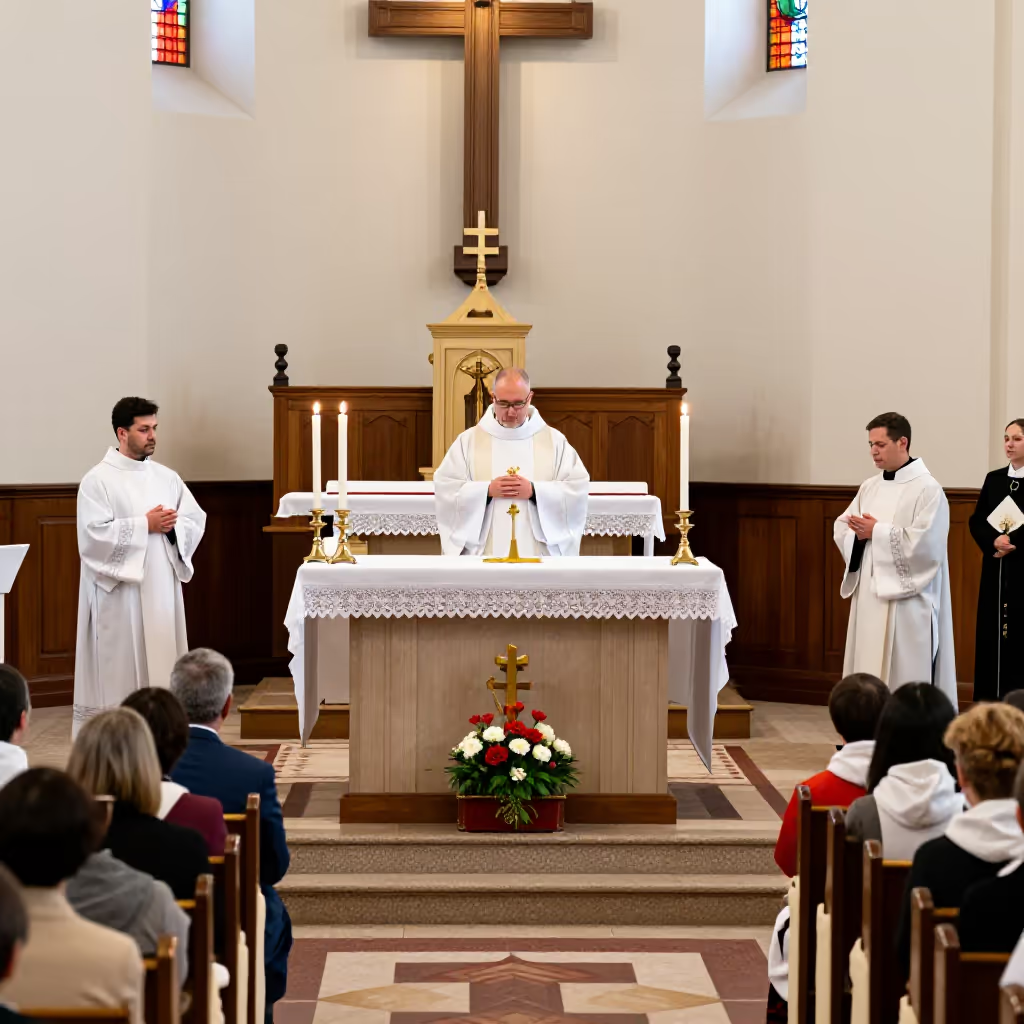
The religious meaning of 'Amt' (mass / service) is rare and is used almost only in a Catholic context. You can recognize it from words like 'Kirche' (church), 'Bischof' (bishop), 'Priester' (priest), or 'Gottesdienst' (church service).
Der Priester hielt ein feierliches Amt in der voll besetzten Kirche.
The priest held a solemn mass in the completely full church.
place / position
'die Stelle' and 'das Amt' can both have to do with official duties or positions. 'Stelle' is broader: it can be a job position in a company, or also a responsible office or authority. 'Amt' is used mainly in public or official contexts, for example for an office / agency or an important position with duties. Learners may confuse the words because both occur in contexts of work and administration. Not every 'Stelle' is an 'Amt'. An 'Amt' is usually more strongly official and connected with responsibility.

Nach der Wahl übernimmt Frau Becker ein wichtiges Amt in der Stadt.
After the election, Ms. Becker takes on an important office in the city.
Für diese Stelle im Rathaus braucht man gute Kenntnisse am Computer.
For this position at city hall, you need good computer skills.