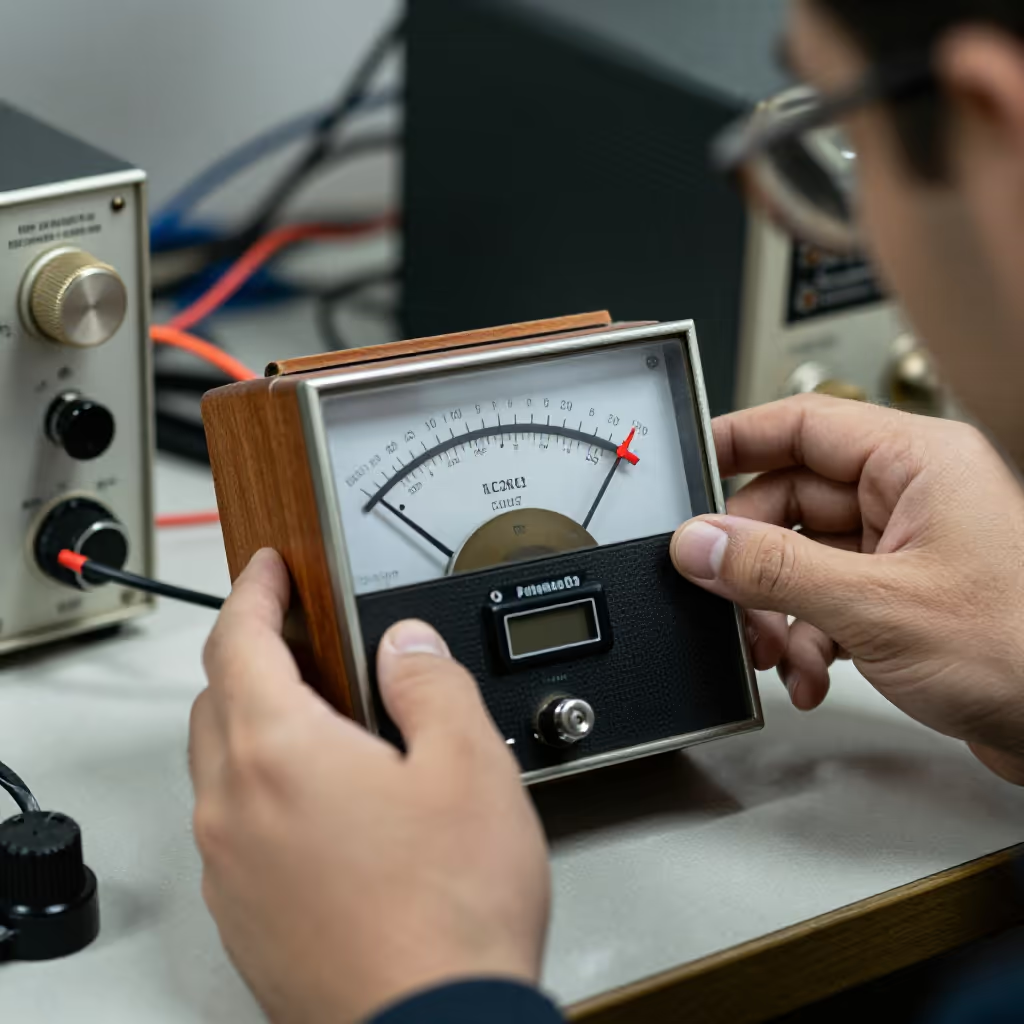
Refers to technology in which information is represented by continuously variable physical quantities (such as voltage or pointer positions). The opposite of digital.
example
Eine Uhr mit Ziffernblatt und Zeigern ist eine analoge Uhr.
A clock with a dial and hands is an analog clock.

Usage tips
Context clue
You can recognize the meaning of 'analog' from the context. Technical devices point to the meaning 'non-digital'. Formal verbs like 'gelten' (to apply) or 'anwenden' (to apply/use) indicate 'by analogy'. A contrast with the internet or computers points to the colloquial meaning 'in the real world'.
EXAMPLE
Ich habe noch eine alte, analoge Kamera zu Hause.
I still have an old analog camera at home.
Typical collocations
In its technical meaning, 'analog' usually describes older or non-digital technologies. Common combinations are 'analoge Uhr' (analog clock/watch), 'analoge Fotografie' (analog photography), 'analoges Fernsehen' (analog television), or 'ein analoges Signal' (an analog signal).
EXAMPLE
Viele Musikliebhaber bevorzugen den Klang von analogen Schallplatten.
Many music lovers prefer the sound of analog records.
Sentence structure and use
In the meaning 'by analogy', 'analog' is used as an adverb and is not declined. It often appears in formal or legal texts, frequently in the construction 'analog zu etwas' (analogous to something) or 'etwas gilt analog' (something applies analogously).
EXAMPLE
Diese Regelung gilt analog für alle Mitarbeiter.
This regulation applies analogously to all employees.
Colloquial use
The meaning 'in the real world' is modern and rather colloquial. It is used to create a contrast with digital activities such as chatting or online meetings.
EXAMPLE
Lass uns das nicht per E-Mail klären, wir sollten uns mal analog zusammensetzen.
Let's not sort this out by email; we should sit down together offline sometime.
Compare with
near_synonym
analog vs ähnlich
similar
'ähnlich' and 'analog' can both express that two cases are comparable in a certain way. 'ähnlich' is the normal word for shared features in people, things, or situations. 'analog' sounds a little more formal and often means that a rule, principle, or procedure is applied to a comparable case. In everyday language, people usually say 'ähnlich'. 'analog' is more suitable in school, at work, in technology, or when explaining rules.
analog
Für die zweite Aufgabe gilt analog dieselbe Regel wie im ersten Beispiel.
For the second exercise, the same rule applies analogously as in the first example.
ähnlich
Die Situation am Bahnhof war gestern ähnlich wie letzte Woche.
The situation at the train station yesterday was similar to last week.