


anstellen
to employ
To employ someone as a worker in a company or organization; to give someone a job.
EXAMPLE
Die Firma wird nächstes Jahr zehn neue Ingenieure anstellen.
The company will employ ten new engineers next year.
to employ / to turn on / to line up
Loading your saved state.
to employ
To employ someone as a worker in a company or organization; to give someone a job.
Die Firma wird nächstes Jahr zehn neue Ingenieure anstellen.
The company will employ ten new engineers next year.
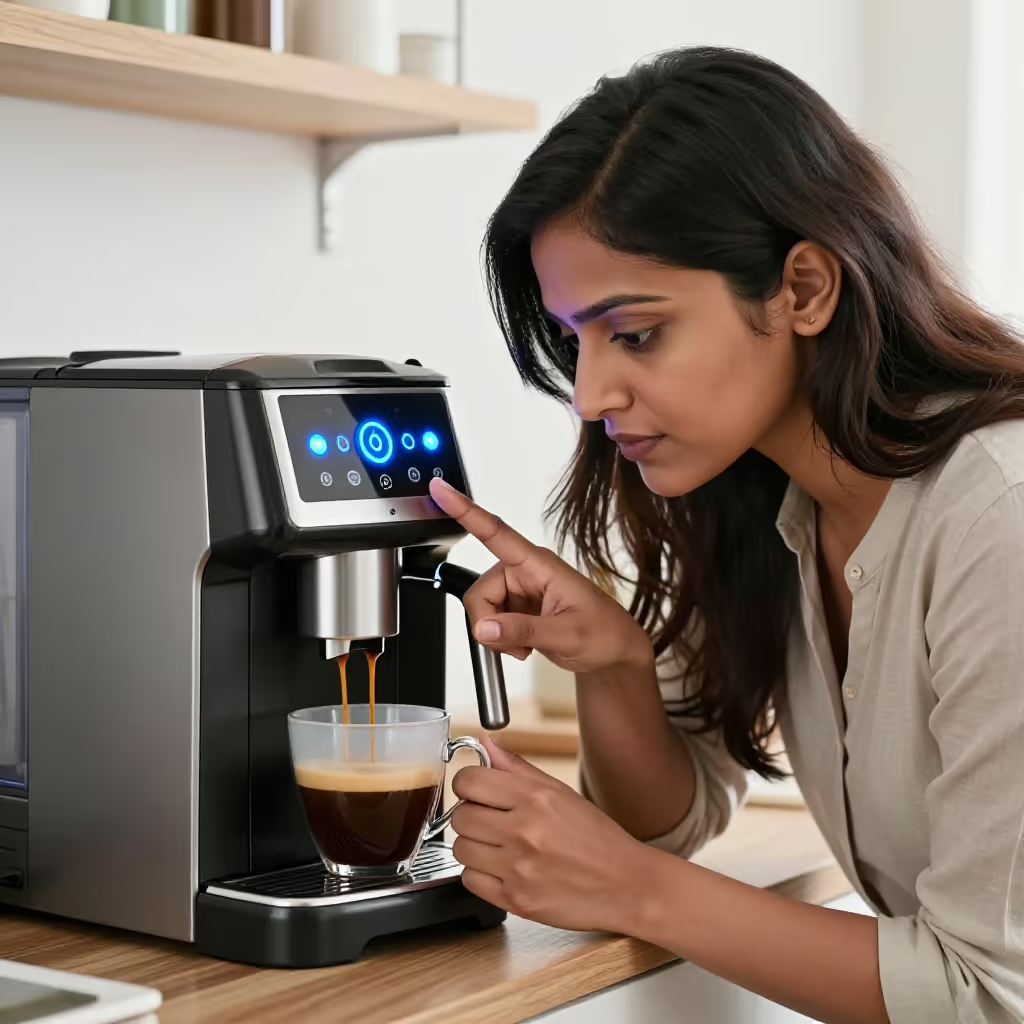
to turn on
To turn on a device, machine, or light so that it works or lights up.
Kannst du bitte die Heizung anstellen? Mir ist kalt.
Can you please turn on the heating? I'm cold.

to get up to something
To do something that is usually stupid, thoughtless, or forbidden and often has negative consequences.
Was habt ihr denn schon wieder angestellt? Die Vase ist kaputt!
What have you been getting up to again? The vase is broken!

to line up
To stand in a line with other people who are waiting, for example at a checkout or a counter.
Wir mussten uns eine halbe Stunde an der Kasse anstellen.
We had to line up at the checkout for half an hour.

to make a fuss
To behave in a certain way, often perceived as clumsy, exaggerated, or stupid.
Stell dich nicht so an, das ist doch nur ein kleiner Kratzer!
Don't make such a fuss, it's only a small scratch!
'Anstellen' (to employ/to turn on/to line up) is a separable verb. The prefix 'an-' goes at the end in a main clause; in subordinate clauses and in the infinitive, it is connected to the verb. In the 'zu' construction, 'zu' comes between the prefix and the verb.
Mein Bruder stellt immer die Musik zu laut an.
My brother always turns the music on too loud.
This verb changes its meaning completely depending on whether it is used reflexively (with 'sich') or non-reflexively. 'Jemanden anstellen' (to employ someone) means to give them work, while 'sich anstellen' (to line up/to make a fuss) means 'to wait in a line' or 'to behave in a complicated way'.
Die Supermarktkette stellt viele neue Kassierer an.
The supermarket chain is employing many new cashiers.
When 'sich anstellen' (to line up/to make a fuss) is used reflexively, the context helps distinguish the meanings. If a place expression follows, such as 'an der Kasse' (at the checkout) or 'hinten' (at the back), it means 'to stand in line'. If it is combined with an adverb like 'so' (like that) or 'dumm' (stupidly), it means 'to behave in a certain way'.
Für die neue Ausstellung muss man sich stundenlang anstellen.
For the new exhibition, you have to line up for hours.
The command 'Stell dich nicht so an!' (Don't make such a fuss!) is a very common idiom. You say it to someone who is behaving in an exaggerated or unnecessarily complicated way.
Komm, hilf mir, und stell dich nicht so an!
Come on, help me, and don't make such a fuss!
In the meaning of 'Unfug machen' (to cause mischief), the verb is often used with indefinite objects like 'etwas' (something), 'nichts' (nothing), or 'Dummheiten' (silly things). It often appears in the question: 'Was hast du angestellt?' (What have you done?/What have you been up to?)
Ich hoffe, der Hund stellt nichts an, während wir weg sind.
I hope the dog doesn't get up to anything while we're away.
When it is about turning on devices, 'anstellen' (to turn on) is often combined with 'Heizung' (heating), 'Radio' (radio), 'Fernseher' (television), or 'Licht' (light).
Stellst du bitte das Radio an? Ich möchte Nachrichten hören.
Could you please turn on the radio? I want to listen to the news.
to occupy / employ
Both verbs can refer to an employment relationship. anstellen usually emphasizes the decision to give someone a position, while beschäftigen more often describes an existing situation. anstellen is therefore especially suitable when someone joins an organization, while beschäftigen fits ongoing employment.

Die Klinik stellt nächsten Monat fünf weitere Pflegekräfte an.
The clinic is hiring five more nurses next month.
Die Klinik beschäftigt bereits dreißig Pflegekräfte.
The clinic already employs thirty nurses.