


der Arbeitsplatz
job
A job or position with an employer; an employment relationship.
EXAMPLE
Durch die Schließung der Fabrik sind hunderte Arbeitsplätze in Gefahr.
Because of the factory closure, hundreds of jobs are at risk.
job / workplace
Loading your saved state.
job
A job or position with an employer; an employment relationship.
Durch die Schließung der Fabrik sind hunderte Arbeitsplätze in Gefahr.
Because of the factory closure, hundreds of jobs are at risk.
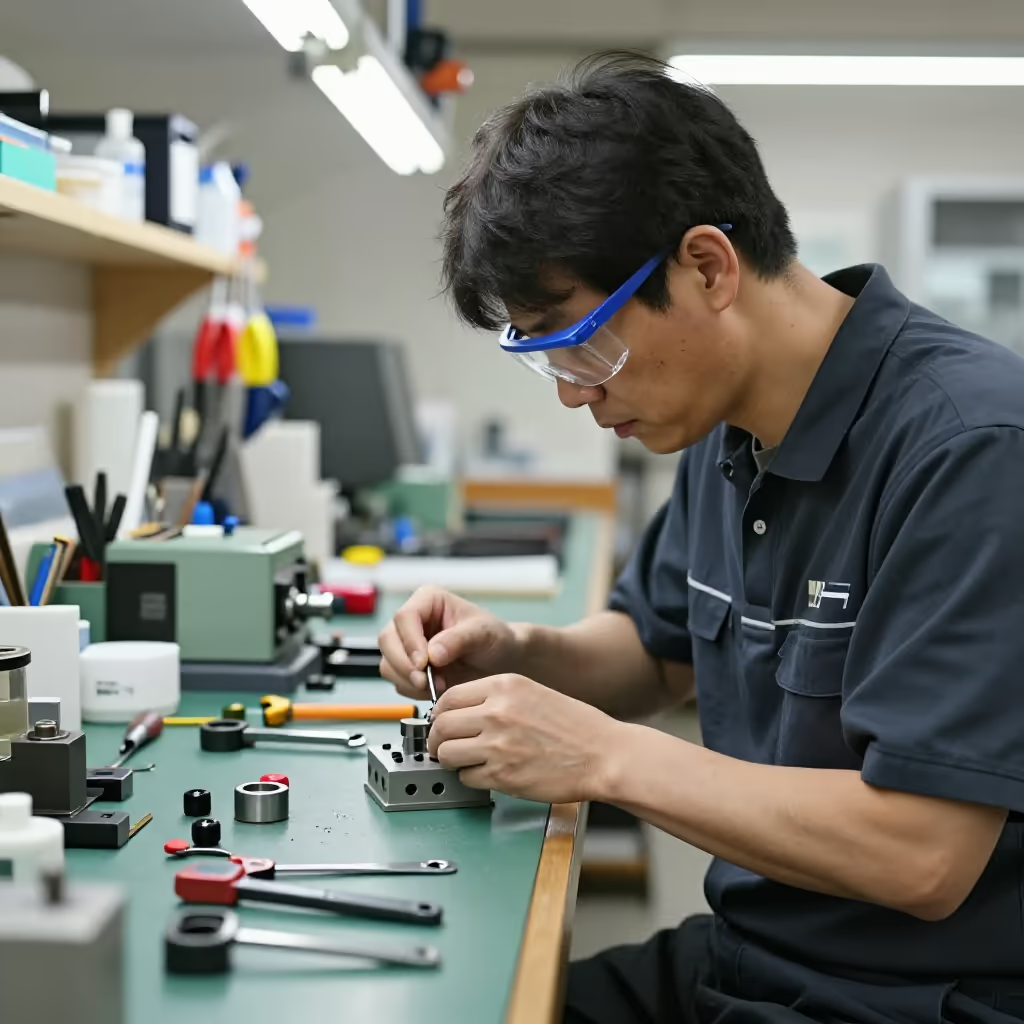
workplace
The physical place where a person does their work, for example the desk in an office or an area in a workshop.
Bitte räumen Sie nach Feierabend Ihren Arbeitsplatz auf.
Please tidy up your workplace after work.
The word is made up of 'Arbeit' (work) and 'Platz' (place). The 's' in between is a linking element that connects the two parts. The literal meaning 'Arbeits-Platz' (work-place) helps you understand both meanings: the job (the 'place' in a company) and the physical location.
Mein Arbeitsplatz ist nur zehn Minuten von meiner Wohnung entfernt.
My workplace is only ten minutes from my apartment.
You can recognize the meaning from context. If it is about business, politics, or the number of positions, it usually means the employment relationship. If it is about a specific physical place with a desk or workbench, it means the place where work is done.
Die Firma schafft 50 neue Arbeitsplätze.
The company is creating 50 new jobs.
In the sense of a job or position, 'Arbeitsplatz' (job) is often used with verbs like 'schaffen' (to create), 'sichern' (to secure), 'verlieren' (to lose), or 'wechseln' (to change/switch).
Er hat nach langer Suche endlich einen neuen Arbeitsplatz gefunden.
After a long search, he finally found a new job.
To describe the physical place, German uses 'am Arbeitsplatz' (at the workplace) for position and 'zum Arbeitsplatz' (to the workplace) for direction.
Ich bin gerade am Arbeitsplatz und kann nicht telefonieren.
I'm at work right now and can't talk on the phone.
place / position
Stelle and Arbeitsplatz can both refer to employment with an employer. Stelle tends to mean the employment itself, while Arbeitsplatz can additionally refer to the place where the work is done. Stelle is suitable for a job someone has found; Arbeitsplatz is more precise for the specific place of work.

Im neuen Büro bekam er einen Arbeitsplatz direkt am Fenster.
In the new office, he got a workstation right by the window.
Nach langer Suche hat er endlich eine neue Stelle gefunden.
After a long search, he finally found a new job.