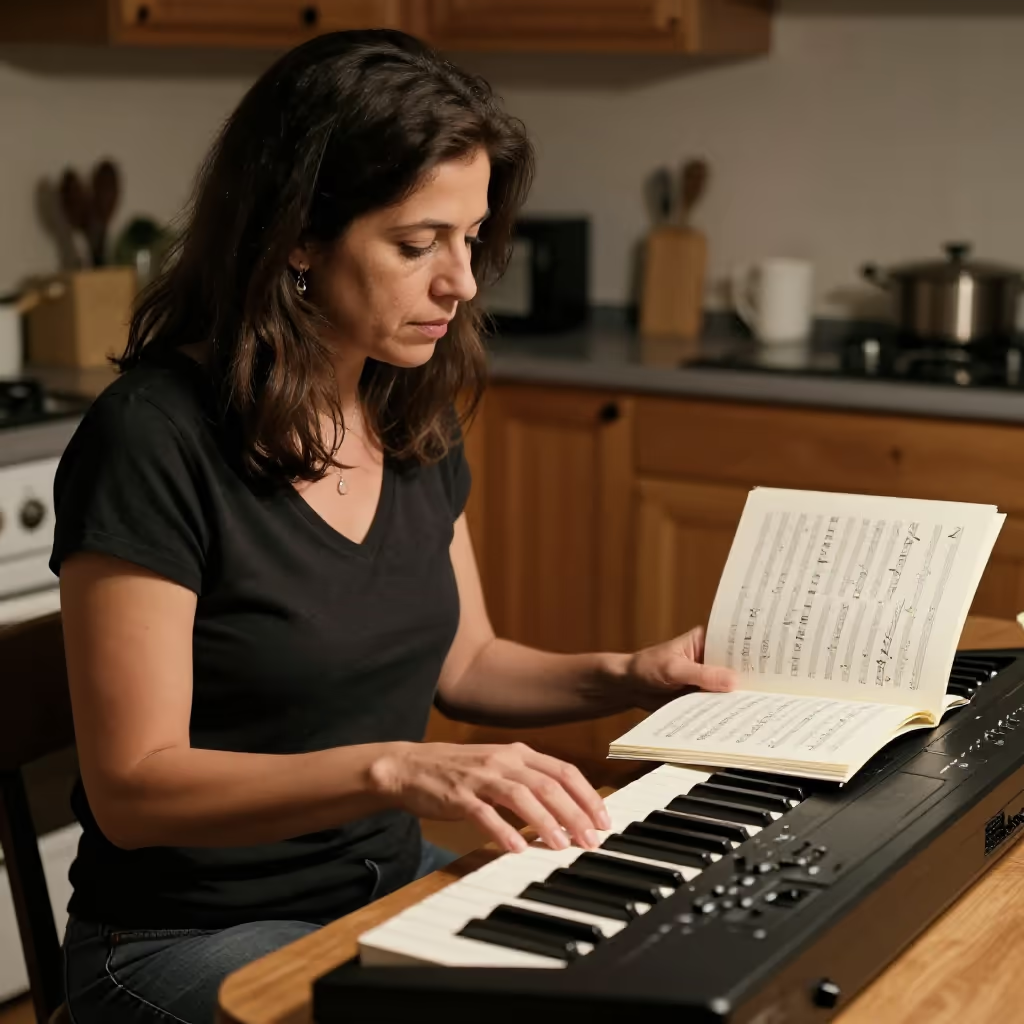
To reactivate and renew something that one used to know or be able to do. This often refers to knowledge, skills, or memories.
example
Ich muss vor der Reise mein Französisch wieder etwas auffrischen.
I need to brush up my French a little before the trip.

Usage tips
Separable verb
'Auffrischen' (to refresh/brush up) is a separable verb. The prefix 'auf-' comes at the end in a main clause. In subordinate clauses and in the infinitive with 'zu', the verb stays together.
EXAMPLE
Ich frische vor dem Urlaub meine Italienischkenntnisse auf.
I brush up my Italian skills before the vacation.
Typical collocations
This meaning is almost always used in relation to knowledge, skills, or social contacts. Typical objects are 'Kenntnisse' (knowledge/skills), 'eine Sprache' (a language), 'Erinnerungen' (memories), or 'eine Freundschaft' (a friendship).
EXAMPLE
Wir haben uns nach langer Zeit getroffen, um unsere Freundschaft aufzufrischen.
We met after a long time to refresh our friendship.
Reflexive use
The verb can be used reflexively: 'sich auffrischen' means to tidy up one's appearance again, e.g. to wash or comb one's hair briefly.
EXAMPLE
Nach der langen Zugfahrt wollte ich mich im Hotel erst einmal auffrischen.
After the long train ride, I first wanted to freshen up at the hotel.
Weather context
In connection with the weather, 'auffrischen' (to freshen) has a very specific meaning: the wind gets stronger. People often say: 'Der Wind frischt auf.' (The wind is freshening.)
EXAMPLE
Am Abend soll der Wind stark auffrischen.
In the evening, the wind is expected to freshen strongly.
Compare with
near_synonym · confusable
auffrischen vs wiederholen
to repeat / retrieve
'wiederholen' and 'auffrischen' can both fit when talking about learning or knowledge. 'wiederholen' means to review learning material again so that you remember it better. This can also be shortly after learning it. 'auffrischen' is used when you used to know or be able to do something, but it is no longer fully active. Then you bring it back into your memory. Learners may confuse the words because both have to do with learning again. Practically speaking: for current learning material, you are more likely to say 'wiederholen'; for old knowledge, 'auffrischen' is more likely.
auffrischen
Nach vielen Jahren möchte Sofia ihr Französisch auffrischen.
After many years, Sofia wants to brush up her French.
wiederholen
Vor der Prüfung wiederholt Max die wichtigsten Regeln noch einmal.
Before the exam, Max reviews the most important rules once more.