


aufwerfen
to raise
To put forward or bring up a question, problem, or topic for discussion.
EXAMPLE
Die Studie wirft wichtige Fragen zur Zukunft der Arbeit auf.
The study raises important questions about the future of work.
to raise / pile up
Loading your saved state.
to raise
To put forward or bring up a question, problem, or topic for discussion.
Die Studie wirft wichtige Fragen zur Zukunft der Arbeit auf.
The study raises important questions about the future of work.

to pile up
To heap up soil, sand, or other material into a pile or embankment.
Der Maulwurf hat im ganzen Garten Hügel aufgeworfen.
The mole has piled up mounds all over the garden.
to set oneself up as
To put oneself into a certain role or position, often in a presumptuous or arrogant way.
Er warf sich zum Richter über das Verhalten seiner Kollegen auf.
He set himself up as judge over his colleagues' behavior.

to throw up
To throw something upward or toss it up with a quick movement.
Der Bagger warf eine große Menge Erde auf.
The excavator threw up a large amount of soil.
'Aufwerfen' is a separable verb. The prefix 'auf-' goes at the end of the main clause. In subordinate clauses and in the infinitive with 'zu', the verb stays together.
Diese Diskussion wirft viele neue Probleme auf.
This discussion raises many new problems.
The meaning of 'aufwerfen' depends heavily on the object. Abstract nouns like 'Frage' (question), 'Problem' (problem), or 'Thema' (topic) point to the figurative meaning 'to bring up'. Concrete nouns like 'Erde' (soil) or 'Sand' (sand) point to the literal meaning 'to pile up'.
Der Artikel wirft die Frage nach der Verantwortung auf.
The article raises the question of responsibility.
In the figurative meaning, 'aufwerfen' is often combined with intellectual or social topics. Typical phrases are 'eine Frage aufwerfen' (to raise a question), 'ein Problem aufwerfen' (to raise a problem), or 'ein Thema aufwerfen' (to raise a topic).
In der Sitzung wurden einige heikle Punkte aufgeworfen.
Some sensitive points were raised in the meeting.
The phrase 'sich aufwerfen zu' is reflexive and uses the preposition 'zu' with the dative. It describes someone claiming a role for themselves, usually in a negative, presumptuous way. The structure is: subject + wirft sich (accusative) + zum/zur [role in the dative] + auf.
Er hat sich zum Sprecher der ganzen Gruppe aufgeworfen, obwohl ihn niemand gewählt hat.
He set himself up as the spokesperson for the whole group, even though no one elected him.
to put / to set
Eine Frage stellen means asking someone a question directly. Eine Frage aufwerfen means introducing it as an open issue in a discussion, without necessarily addressing it to a specific person. Use stellen when an answer is expected and aufwerfen when introducing a new topic for discussion.

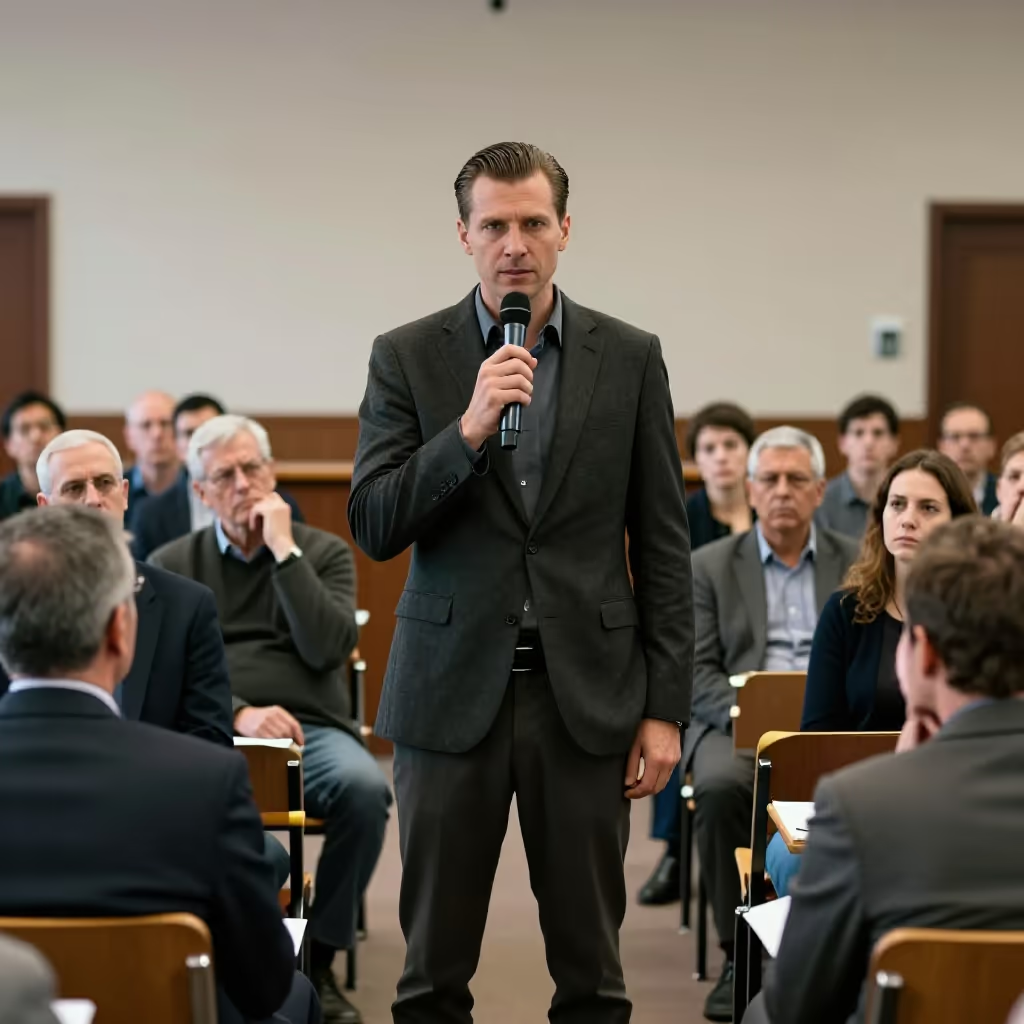
Im Meeting wirft Leas Bericht die Frage auf, wann das Projekt beginnen kann.
At the meeting, Lea’s report raises the question of when the project can begin.
Im Meeting stellt Lea dem Chef die Frage, wann das Projekt beginnt.
At the meeting, Lea asks the boss when the project will start.