


stellen
to put
To bring something to a specific place in an upright position.
EXAMPLE
Kannst du bitte die Gläser in den Schrank stellen?
Can you please put the glasses in the cupboard?
to put / to set
Loading your saved state.
to put
To bring something to a specific place in an upright position.
Kannst du bitte die Gläser in den Schrank stellen?
Can you please put the glasses in the cupboard?

to ask a question
To ask someone something.
Der Journalist durfte dem Politiker nur eine einzige Frage stellen.
The journalist was allowed to ask the politician only a single question.

to turn oneself in
To voluntarily hand oneself over to the police or another authority.
Nach tagelanger Flucht stellte sich der Verdächtige der Polizei.
After days on the run, the suspect turned himself in to the police.

to face
To consciously and actively face a challenge, problem, or unpleasant situation.
Sie musste sich ihren Ängsten stellen, um die Prüfung zu bestehen.
She had to face her fears in order to pass the exam.
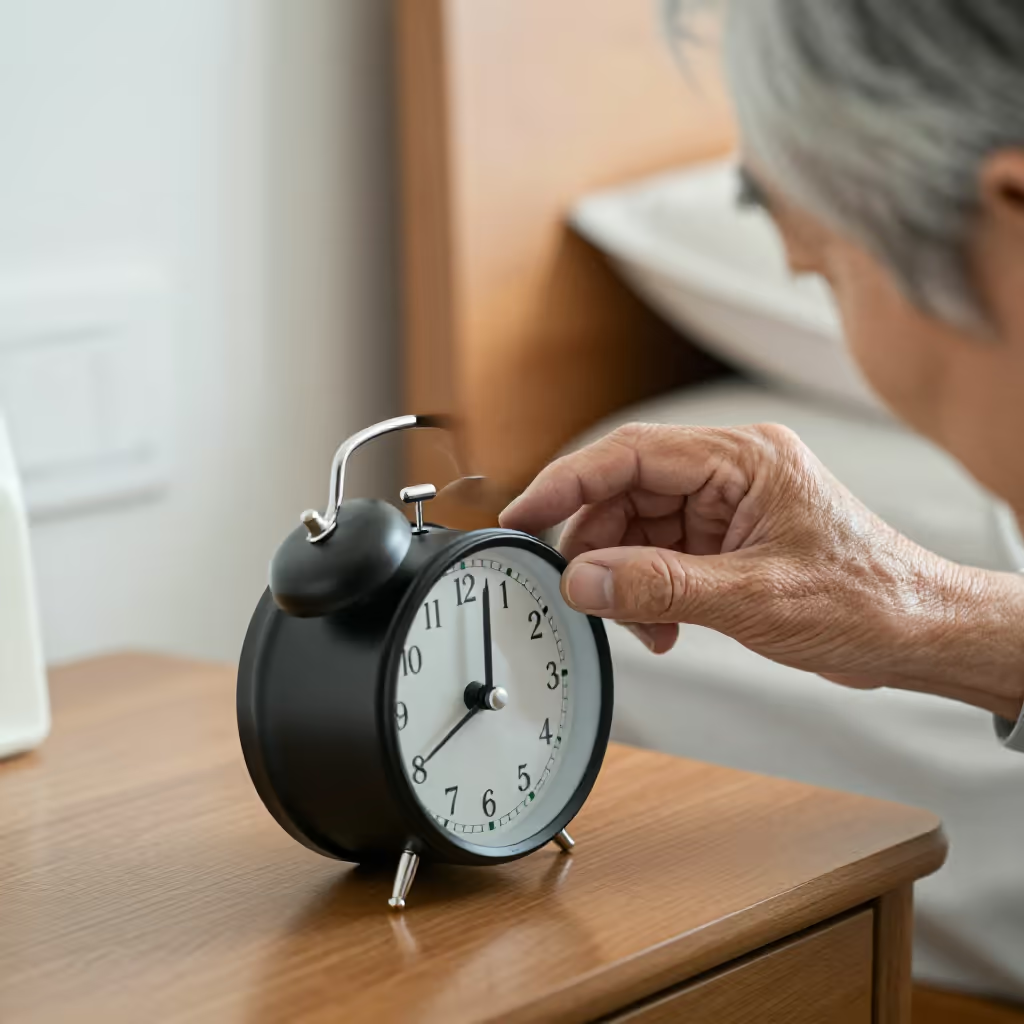
to set
To set a device, especially a clock or alarm clock, to a specific time or function.
Ich muss meinen Wecker auf 6 Uhr morgens stellen.
I have to set my alarm for 6 a.m.

to provide
To make something available to someone for use.
Die Bibliothek wird den Studierenden zusätzliche Lernräume zur Verfügung stellen.
The library will provide the students with additional study rooms.

to submit an application
To formally apply for something at an authority or institution.
Um finanzielle Unterstützung zu erhalten, müssen Sie einen Antrag stellen.
To receive financial support, you have to submit an application.

to catch
To stop a person in order to catch them or confront them.
Der Detektiv konnte den Dieb stellen, als dieser das Gebäude verlassen wollte.
The detective was able to catch the thief as he was trying to leave the building.

to make a diagnosis
As a doctor, to identify and name an illness or medical problem.
Nach mehreren Untersuchungen konnte der Arzt endlich eine klare Diagnose stellen.
After several examinations, the doctor was finally able to make a clear diagnosis.

to call into question
To doubt something or challenge the validity of something.
Die neuen Forschungsergebnisse stellen die bisherige Theorie in Frage.
The new research findings call the previous theory into question.

to pretend
To act differently from how one really is; to feign a certain behavior.
Das Kind stellte sich schlafend, als seine Mutter ins Zimmer kam.
The child pretended to be asleep when his mother came into the room.
In its basic meaning, 'stellen' (to put) has a fixed sentence pattern: someone puts something (accusative) in/at a place (accusative). The place information is in the accusative because it describes movement toward a destination.
Ich stelle die Milch in den Kühlschrank.
I put the milk in the fridge.
The verb 'stellen' (to put/set) can be used reflexively ('sich stellen'). In this case, the meaning changes significantly. It can mean to surrender to an authority or to face a challenge.
Der Dieb hat sich am nächsten Tag der Polizei gestellt.
The thief turned himself in to the police the next day.
'Stellen' (to put/set) is the base verb for many important verbs with prefixes, such as bestellen, vorstellen, herstellen, or einstellen. If you recognize 'stellen', you can often work out the meaning of these more complex verbs more easily.
Können wir Pizza bestellen?
Can we order pizza?
The combination 'eine Frage stellen' (to ask a question) is a very common fixed expression. The person being asked is in the dative.
Darf ich Ihnen eine persönliche Frage stellen?
May I ask you a personal question?
When someone faces something (e.g., a fear, a problem), that thing is in the dative. The pattern is: sich + dative object + stellen.
Er muss sich endlich seiner Verantwortung stellen.
He finally has to face his responsibility.
In this meaning, 'stellen' (to set) is almost always used with devices that show or measure time. Typical combinations are 'den Wecker stellen' (to set the alarm), 'die Uhr stellen' (to set the clock/watch), or 'den Timer stellen' (to set the timer).
Hast du den Wecker auf 7:00 Uhr gestellt?
Did you set the alarm for 7:00?
The expression 'zur Verfügung stellen' (to provide / make available) has a fixed structure: someone (subject) provides someone (dative) with something (accusative).
Die Firma stellt ihren Mitarbeitern Laptops zur Verfügung.
The company provides its employees with laptops.
'Einen Antrag stellen' (to submit an application) is a fixed combination often used in bureaucratic contexts. You submit an application 'auf' something (accusative) or 'bei' an institution (dative).
Sie hat bei der Behörde einen Antrag auf Wohngeld gestellt.
She submitted an application for housing benefit to the authority.
This meaning of 'stellen' (to catch/confront) is found almost exclusively in contexts where someone is pursued and confronted, e.g., in crime novels or news reports about crimes.
Die Polizei konnte den flüchtigen Bankräuber nach kurzer Verfolgung stellen.
The police were able to catch the fleeing bank robber after a short chase.
The expression 'eine Diagnose stellen' (to make a diagnosis) belongs firmly to medical language. Only doctors or specialists can make a diagnosis.
Es war für die Ärztin nicht einfach, die richtige Diagnose zu stellen.
It was not easy for the doctor to make the correct diagnosis.
The expression 'etwas in Frage stellen' (to call something into question) means to doubt something. What is being doubted appears as an accusative object.
Einige Wissenschaftler stellen diese ganze Theorie in Frage.
Some scientists call this entire theory into question.
The verb 'sich verstellen' (to pretend / disguise oneself) is related to 'stellen' (to put/set). The inseparable prefix 'ver-' changes the meaning here to 'to act as if' or 'to feign'.
Er verstellte seine Stimme am Telefon, damit man ihn nicht erkennt.
He disguised his voice on the phone so that people would not recognize him.
to do / make
Machen can generally refer to carrying out an action, and stellen is also used in connection with a diagnosis. However, for a medically identified illness, eine Diagnose stellen is the established expression. Machen remains understandable here, but it sounds less appropriate than stellen.

Die Ärztin stellt nach der Untersuchung eine Diagnose.
After the examination, the doctor makes a diagnosis.
Die Ärztin macht nach der Untersuchung eine erste Diagnose.
After the examination, the doctor makes an initial diagnosis.