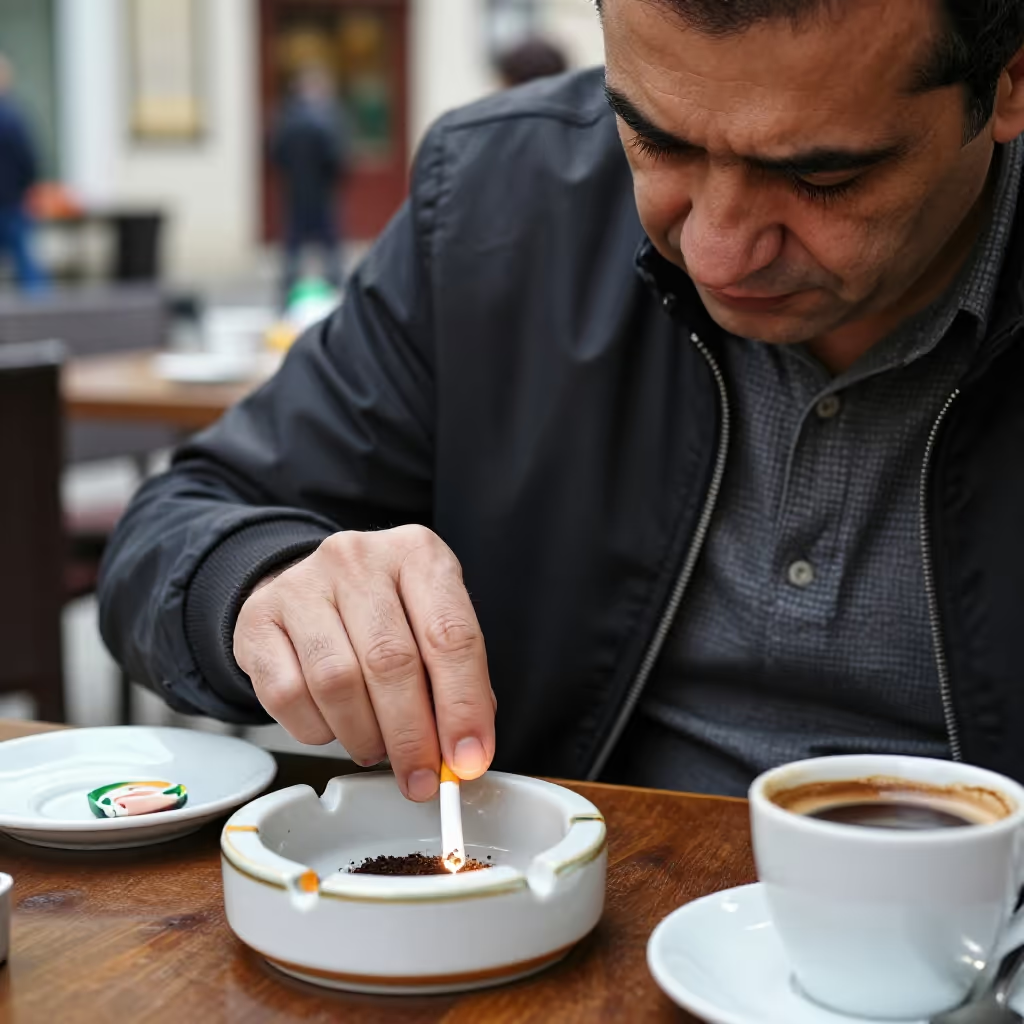
To communicate thoughts, feelings, or information with words or in another way, for example through gestures or art.
example
Manchmal fällt es mir schwer, meine Gefühle richtig auszudrücken.
Sometimes I find it hard to express my feelings properly.

Usage tips
Separable verb
'Ausdrücken' (to express / squeeze out) is a separable verb. The prefix 'aus-' comes at the end in a main clause. In subordinate clauses and in the infinitive with 'zu', the verb stays together.
EXAMPLE
Er drückt seine Freude durch ein Lächeln aus.
He expresses his joy with a smile.
Context clue
You can recognize the meaning from the object: if it is about feelings or thoughts, it means communicating. If it is about a wet object, such as a sponge or cloth, it means pressing or squeezing. If it is about a cigarette, it means extinguishing.
EXAMPLE
Sie konnte ihre Dankbarkeit kaum in Worte ausdrücken.
She could hardly express her gratitude in words.
Reflexive use
The verb is very often used reflexively: 'sich ausdrücken' (to express oneself). This means describing one's own ability to make thoughts and feelings understandable.
EXAMPLE
Er kann sich sehr präzise ausdrücken.
He can express himself very precisely.
Typical collocations
In the physical meaning, 'ausdrücken' (to squeeze out) is often combined with objects that contain liquid. Typical examples are: 'eine Zitrone ausdrücken' (to squeeze a lemon), 'einen Schwamm ausdrücken' (to squeeze out a sponge), or 'eine Tube ausdrücken' (to squeeze out a tube).
EXAMPLE
Für das Dressing müssen Sie zwei Zitronen ausdrücken.
For the dressing, you need to squeeze two lemons.
Compare with
near_synonym · confusable
ausdrücken vs zeigen
to show
'zeigen' and 'ausdrücken' can both have to do with feelings, thoughts, or attitudes. 'zeigen' means that something becomes outwardly visible, for example through behavior, a facial expression, or a reaction. 'ausdrücken' puts more emphasis on someone communicating a thought or feeling, often with words, gestures, or art. Learners may confuse the words because a smile can show joy and also express joy. 'zeigen' fits better for the visible sign; 'ausdrücken' fits better for communicating an inner attitude.
ausdrücken
In der E-Mail hat er seinen Dank sehr freundlich ausgedrückt.
In the email, he expressed his thanks very kindly.
zeigen
Nach dem Gespräch zeigte Maria deutlich ihre Enttäuschung.
After the conversation, Maria clearly showed her disappointment.