

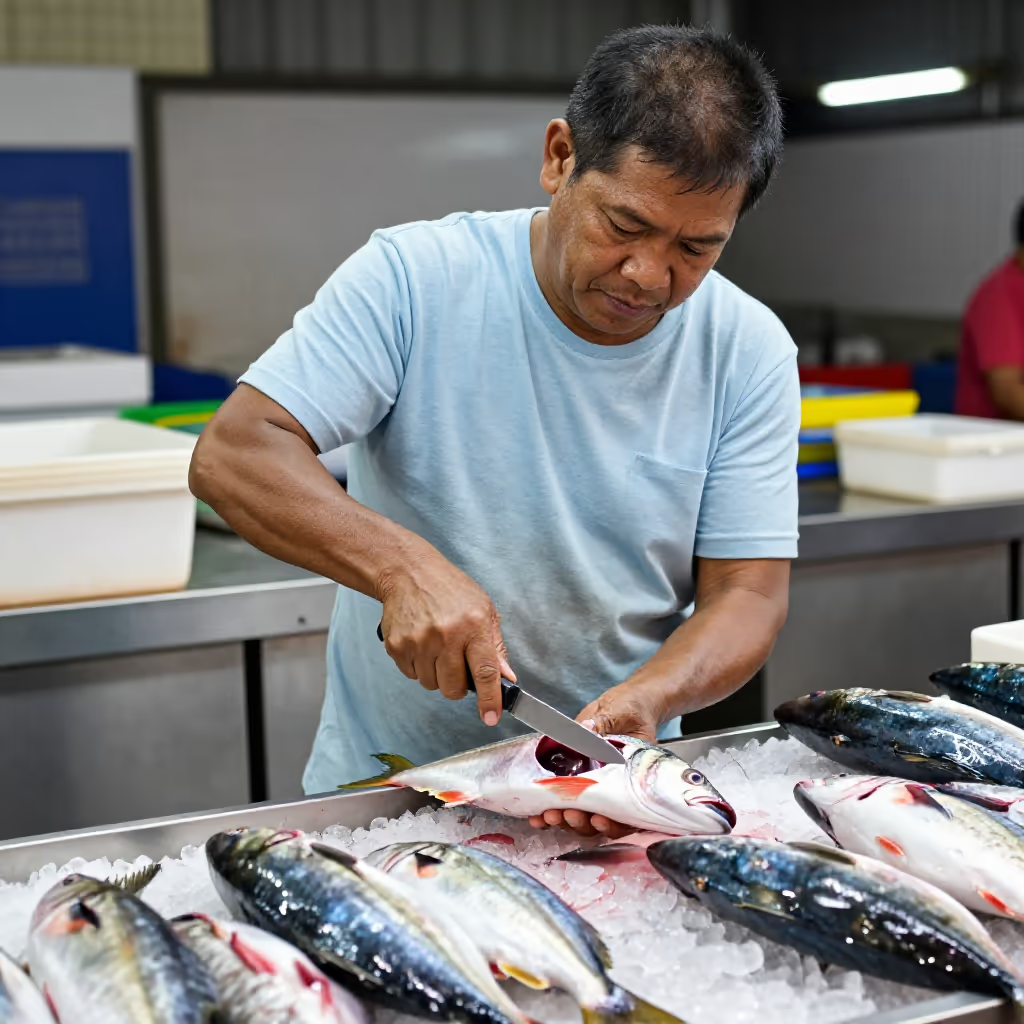
ausnehmen
to gut
To remove the internal organs of an animal, especially a fish or poultry, before preparing it.
EXAMPLE
Der Koch zeigte uns, wie man eine Forelle fachgerecht ausnimmt.
The cook showed us how to gut a trout properly.
to gut / exclude / rip off
Loading your saved state.
to gut
To remove the internal organs of an animal, especially a fish or poultry, before preparing it.
Der Koch zeigte uns, wie man eine Forelle fachgerecht ausnimmt.
The cook showed us how to gut a trout properly.

to exclude
To make an exception for someone or something; to exclude someone or something from a rule, a group, or a general statement.
Alle müssen mithelfen, niemand wird ausgenommen!
Everyone has to help; no one is excluded!

to rip off
Colloquial: to take someone's money in an unfair way, often through fraud or inflated prices.
Pass auf bei diesem Verkäufer, der ist dafür bekannt, Touristen auszunehmen.
Be careful with that seller; he's known for ripping off tourists.

to appear
To make a certain impression; to seem or look a certain way. This use is rather formal or old-fashioned.
Seine plötzliche Freundlichkeit nahm sich nach dem Streit etwas seltsam aus.
His sudden friendliness appeared somewhat strange after the argument.
'Ausnehmen' (to gut / exclude / rip off) is a separable verb. In a main clause, the prefix 'aus-' comes at the end. In subordinate clauses or in the infinitive with 'zu', the verb stays together.
Der Fischer nimmt den Fisch sofort aus.
The fisherman guts the fish immediately.
The verb consists of 'aus' and 'nehmen'. The logic of 'taking something out' helps with understanding all meanings: taking the organs out of an animal, taking a person out of a group, or taking the money out of someone's pocket.
Wer nimmt das Huhn für das Abendessen aus?
Who is gutting the chicken for dinner?
The meaning becomes clear from the context. If it is about cooking, such as fish or poultry, it means removing organs. If it is about rules or groups, it means making an exception. If it is about money and fraud, the colloquial meaning is intended.
Zuerst muss man den Karpfen ausnehmen und waschen.
First you have to gut and wash the carp.
When an exception is made, the thing or person that is excluded from the rule is in the accusative. A prepositional phrase with 'von' often follows to name the group or rule.
Kinder unter sechs Jahren sind von der Maskenpflicht ausgenommen.
Children under six are exempt from the mask requirement.
In the meaning 'to take someone's money through fraud', 'ausnehmen' (to rip off) is very colloquial. It is used in informal conversation, but not in formal texts.
Lass dich von den Verkäufern am Strand nicht ausnehmen!
Don't let the sellers on the beach rip you off!
to seem / take effect
Wirken and sich ausnehmen both describe the impression something makes. Sich ausnehmen, however, is more formal or old-fashioned and often emphasizes the effect something has in a particular setting. Wirken is more suitable in everyday situations; sich ausnehmen can be appropriate in a formal assessment.

In der formellen Beschreibung heißt es, dass sich das rote Sofa in dem hellen Raum sehr elegant ausnimmt.
The formal description says that the red sofa looks very elegant in the bright room.
Das rote Sofa wirkt in dem hellen Raum sehr elegant.
The red sofa looks very elegant in the bright room.