

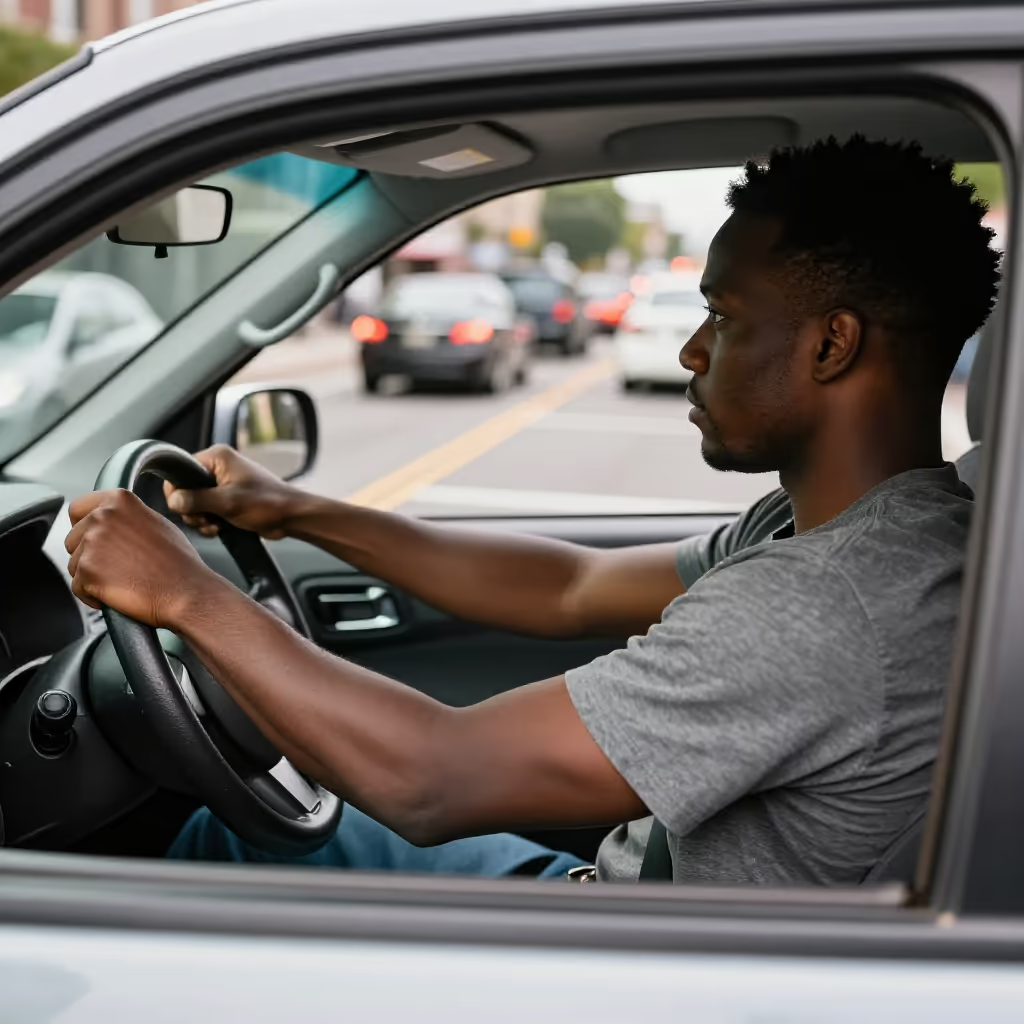
To steer and operate a car as the driver. In German, this activity is often expressed as the verb 'Auto fahren' or written as one word, 'autofahren'.
example
Am Wochenende fahre ich gerne ohne bestimmtes Ziel Auto.
On weekends, I like driving around without a specific destination.
Usage tips
Word structure and separation
This activity is formed from 'Auto' (car) and 'fahren' (to drive / to travel). In a sentence, 'Auto' is often treated like a separable prefix and stands at the end of the clause.
EXAMPLE
Ich fahre am liebsten nachts Auto, wenn die Straßen leer sind.
I prefer driving at night, when the roads are empty.
Perfect tense with 'sein'
Since 'fahren' (to drive / to travel) describes movement from one place to another, the perfect tense is always formed with the auxiliary verb 'sein' (to be), not with 'haben' (to have).
EXAMPLE
Wir sind letztes Jahr mit dem Auto nach Italien gefahren.
We drove to Italy by car last year.
Spelling
The recommended spelling for the activity is separated: 'Auto fahren' (to drive a car). However, the one-word form 'autofahren' is also very common and often used.
EXAMPLE
Darf man nach der Operation sofort wieder Auto fahren?
Are you allowed to drive again immediately after the operation?
Compare with
near_synonym · confusable
autofahren vs fahren
to drive / ride
'fahren' and 'autofahren' can both have to do with a car. But 'fahren' is more general: you can travel by car, train, bus, or bicycle. You can also 'fahren' as a passenger or drive a vehicle yourself. 'autofahren' more specifically means the activity of driving a car yourself. That is why 'Ich fahre nach Berlin' (I am going to Berlin) leaves the means of transport open, while 'Ich fahre Auto' or 'ich autofahre' emphasizes driving as the car driver.
autofahren
Mein Nachbar fährt nicht gern Auto, wenn es stark regnet.
My neighbor does not like driving when it is raining heavily.