


steuern
to steer
To steer a vehicle, ship, or aircraft in a particular direction.
EXAMPLE
Der Kapitän steuerte das Schiff sicher in den Hafen.
The captain steered the ship safely into the harbor.
to steer / control
Loading your saved state.
to steer
To steer a vehicle, ship, or aircraft in a particular direction.
Der Kapitän steuerte das Schiff sicher in den Hafen.
The captain steered the ship safely into the harbor.

to control
To deliberately direct, regulate, or control a process, system, or development.
Die Software steuert die automatische Produktion in der Fabrik.
The software controls the automated production in the factory.

to be heading for
To move toward a specific goal or point, both spatially and figuratively.
Wir steuern auf eine schwere Wirtschaftskrise zu.
We are heading for a serious economic crisis.
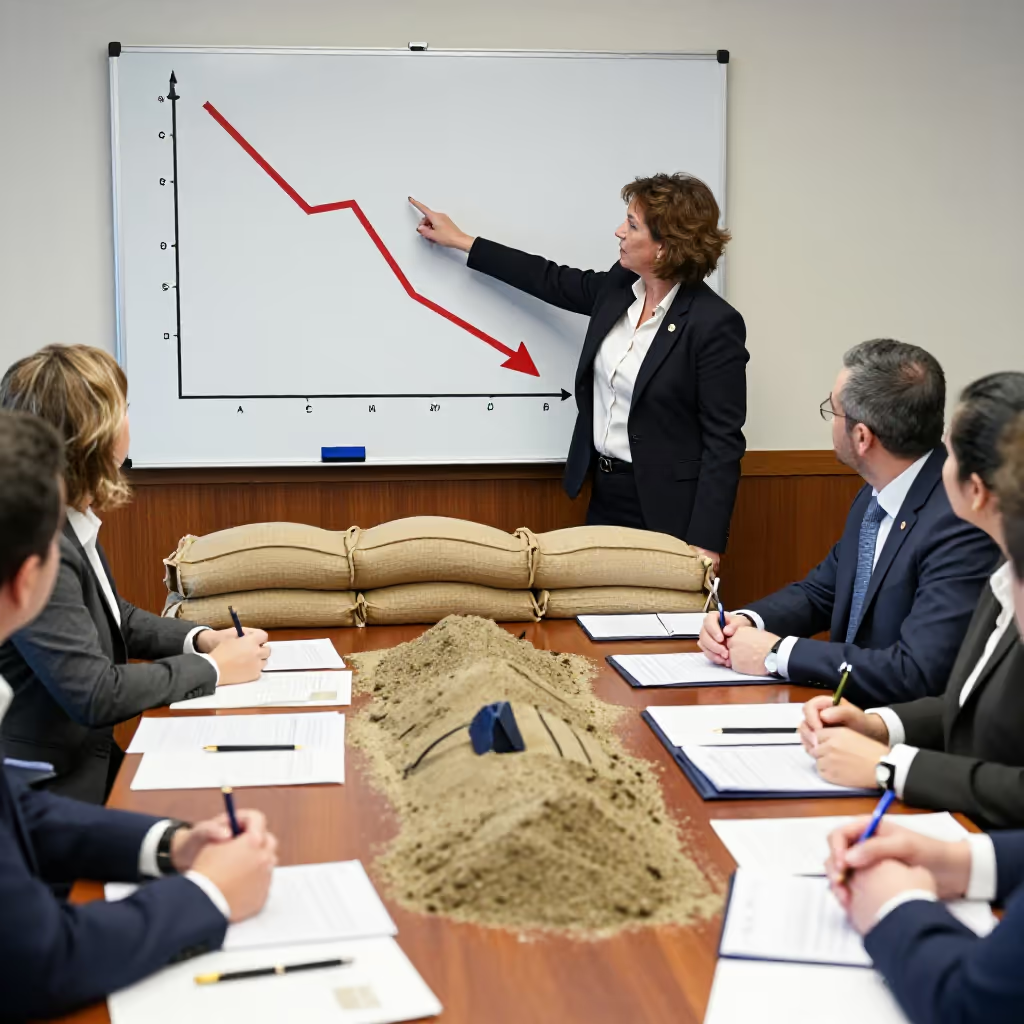
to counteract
To take measures to counteract a negative development.
Die Regierung versucht, mit neuen Gesetzen gegen die Inflation zu steuern.
The government is trying to counteract inflation with new laws.

to contribute
To make a contribution to something; to contribute something. This meaning is rarer today and is often replaced by 'beisteuern' (to contribute).
Jeder Gast steuerte etwas zum Buffet bei.
Each guest contributed something to the buffet.
The verb 'steuern' (to steer/control) is related to two nouns: 'das Steuer' (steering wheel, rudder) and 'die Steuer' (tax). The main meaning 'to steer' comes from 'das Steuer', while the rare meaning 'to contribute' is related to 'die Steuer'.
Der Kapitän hält das Steuer fest in der Hand.
The captain holds the rudder firmly in his hand.
You can often recognize the meaning of 'steuern' (to steer/control) from the object. If it appears with a vehicle (car, ship), it means 'to steer'. If it appears with a process or project, it means 'to control' or 'to regulate'.
Der Pilot steuert das Flugzeug durch den Sturm.
The pilot steers the airplane through the storm.
In the meaning 'to control', 'steuern' is often combined with abstract nouns from business, technology, and management. Typical examples are: 'Abläufe steuern' (to control processes), 'die Nachfrage steuern' (to manage demand), or 'eine Kampagne steuern' (to direct a campaign).
Ein Thermostat steuert die Temperatur im Raum.
A thermostat controls the temperature in the room.
In combination with the preposition 'auf' (+ accusative), 'steuern' means that one is moving toward a goal or event. This can be meant spatially or, more often, figuratively.
Das Schiff steuert direkt auf die Küste zu.
The ship is heading directly toward the coast.
Together with the preposition 'gegen' (+ accusative), 'steuern' expresses that one is taking measures against a negative development. It means 'to counteract'.
Die Zentralbank versucht, gegen die hohe Inflation zu steuern.
The central bank is trying to counteract high inflation.
The meaning 'to contribute something' is rare today and is mostly used in elevated or older language. Often the verb 'beisteuern' (to contribute) is used instead.
Jeder Autor steuerte ein Kapitel zu dem Sammelband.
Each author contributed a chapter to the anthology.
to drive / ride
Fahren refers to the entire process of moving and operating a vehicle. Steuern, by contrast, emphasizes deliberately controlling the direction. Fahren is suitable for the general activity; when guiding the vehicle along a particular course is important, steuern is the better choice.

Klara steuert das Boot gezielt in den kleinen Hafen.
Klara steers the boat deliberately into the small harbor.
Klara fährt das Boot langsam über den See.
Klara takes the boat slowly across the lake.